
 Worksheets
Semester 1 Mini Review
Total questions: 75
Worksheet time: 41mins
Who was the Chinese military leader who reunified China in the 580s?
Yang Jian (Emperor Wendi)
Siddhartha Gautama
Lao Tzun
Han Dynasty
Which of the following did Wendi establish to help link together the North and the South?
Strong central government
Standardized money
Grand Canal
All of the above
What did Buddhism promise to the poor people of China?
Wealth and power
Relief from suffering
Eternal life
Political freedom
What did Wendi and his wife encourage the people of China to do?
Practice Confucianism
Practice Taoism
Practice Buddhism
Practice Shintoism
What philosophy is said to be the foundation of modern Chinese culture?
Buddhism
Confucianism
Daoism
Legalism
What did passing the civil service exams ensure?
Military leaders would serve in government
Scholar-officials would serve in government
Merchants would serve in government
Farmers would serve in government
What did scholars of Confucianism integrate into the philosophy during the Song Dynasty?
Elements of Buddhism and Daoism
Elements of Legalism and Mohism
Elements of Hinduism and Jainism
Elements of Shintoism and Zoroastrianism
How much of Asia did Genghis Khan control when he died?
One-third
Half
Two-thirds
All
Which regions did Genghis Khan conquer?
South America and Africa
Northern China and Eastern Europe
Australia and New Zealand
Central America and Caribbean
Which dynasty did Kublai Khan conquer to become the ruler of all of China?
Ming Dynasty
Qing Dynasty
Song Dynasty
Tang Dynasty
Who advised Kublai Khan on governing the people?
Confucian scholars
Mongol warriors
Foreign diplomats
Religious leaders
What was the significance of Kublai Khan's conquest of the Song Dynasty?
It marked the end of Mongol rule in China
It established the Yuan Dynasty
It led to a period of cultural decline
It resulted in a power struggle within the Mongol Empire
What did the Mongol Empire do to improve and expand the Silk Road?
Increased tolls and taxes on the roads
Ignored the condition of the roads
Lowered tolls and taxes on the roads
Encouraged bandit attacks on travelers
What did the spread of technologies and ideas along the Silk Road lead to?
Decrease in trade and cultural exchange
Isolation of the Yuan Dynasty
Spread of Chinese technologies and practices
Collapse of the Mongol Empire
What did Marco Polo's book, The Travels of Marco Polo, do?
Encouraged people to travel westward along the Silk Road
Discouraged people from traveling along the Silk Road
Promoted European inventions and technologies
Highlighted the decline of the Mongol Empire
What did civil servants have to pass in order to work in the government during the Ming Dynasty?
Physical fitness test
Artistic talent assessment
Competitive civil service exams
Personality evaluation
What was the main reason for the Ming Dynasty's decision to rebuild and improve the Great Wall?
To showcase their architectural skills
To protect against Mongol attacks
To attract more tourists
To establish trade routes
What was the purposeful design of the Forbidden City meant to convey?
Imperial power
Peace and harmony
Religious devotion
Scientific progress
What is the importance of shrines in Shintoism?
To worship gods
To perform ceremonies
To show respect to ancestors
All of the above
What is the purpose of the rituals in Shintoism?
To cleanse and purify the world
To achieve spiritual enlightenment
To gain material wealth
To connect with supernatural beings
What did Confucianism teach in Japan?
A way of living and behaving
Everyone has national and family obligations
Loyalty to the government
All of the above
Buddhism influenced the Constitution of Prince Shōtoku by emphasizing...
The importance of the individual
The importance of harmony
The power of the clans
The influence of Buddhism
What did the Constitution of Prince Shōtoku state about the government?
It is more important than the individual
It should be ruled by clans
It should copy the Chinese emperors
It should prioritize personal interests
What was the capital city of Japan during the Heian period?
Heiankyo
Kyoto
Tokyo
Osaka
Who wrote the Tale of Genji?
Murasaki Shikibu
Sei Shonagon
Lady Murasaki
Izumi Shikibu
What was the Tale of Genji?
The world's first novel
A collection of love poems
A historical chronicle
An epic poem
What was the warrior class created by the shogun called?
Samurai
Daimyo
Peasants
Government workers
Who were the wealthy landowners in the Japanese military society?
Samurai
Peasants
Daimyo
Government workers
What did Bushido stress in the samurai code of ethics?
Loyalty to one's master
Respect for one's superior
Ethical behavior
All of the above
What were the main differences between the Eastern and Western Roman Empires?
Size and wealth
Language and culture
Border security
Religious beliefs
What made Constantinople an ideal city for trading?
Its natural harbor
Its location along the Silk Road
Its geographical position
All of the above
What were the advantages of life in the Eastern Roman Empire compared to the Western Roman Empire?
Larger and wealthier cities
More open to different ideas
Better border security
All of the above
Which of the following was NOT an achievement of Justinian?
He reconquered parts of the Western Roman Empire
He created the Code of Justinian
He improved rights for women
He defeated the Ottoman Empire
What was the Code of Justinian?
A collection of all Roman laws
A legal textbook for education
A set of modern Byzantine laws
All of the above
What new right did women gain in the age of Justinian?
The right to vote
The right to divorce
The right to own property
The right to hold public office
What role did the Hagia Sophia serve in Byzantine culture and politics?
Central church and coronation place
Library and university
Government office
Military headquarters
Who ordered the construction of the third Hagia Sophia?
Justinian
Constantine
Theodora
Basil
Label
Label the bodies of water.
What is the holiest book in Islam?
Quran
Sunnah
Mecca
Arabic
During which month do Muslims fast?
Ramadan
Mecca
Mohammad
Allah
What are the Five Pillars of Muslim life?
Faith, Prayer, Giving, Fasting, Pilgrimage
Quran, Sunnah, Mecca, Arabic
Mohammad, Gabriel, Allah, Mecca
Islam, Muslims, Allah, Quran
Where did Mohammad and his followers migrate to?
Mecca
Medina
Yathrib
Quraysh
What was one of the reasons for conversion to Islam?
Appeal of new religious beliefs
Desire to be part of Islamic society
Wish to avoid taxes and restrictions
All of the above
How did Muslim people treat conquered Jewish and Christian people?
With intolerance
With tolerance
With discrimination
With exclusion
Who wrote the book Canon of Medicine?
Ibn al-Nafis
Al-Khwārizmī
Ibn Sina
Al-Kindi
What did Muslim doctors do to advance the practice of medicine?
Translated Greek and Roman books about medicine
Established hospitals throughout the empire
Discovered the existence of one God
Developed the scientific method
Which book is a collection of Persian, Indian, and Arabian folktales?
Arabian Nights
The Pleasure Excursion of One Who Is Eager to Traverse the Regions of the World
Canon of Medicine
On First Philosophy
Who led a group of Turkish warriors in battles against the Byzantines?
Osman I
Mehmed II
Bayezid II
Selim I
Who captured Constantinople in 1453?
Murad II
Osman I
Mehmed II
Suleyman I
What was Mehmed II's impact on the Ottoman Empire?
Encouraged advancements in science
Compiled criminal laws
Ruled harshly
Ruled softly
What artistic achievements were made during the Ottoman golden age?
Painting
Ceramics
Music
Dance
Which trade was particularly significant in the Islamic empire?
Gold trade
Spice trade
Textile trade
Salt trade
What were some of the luxury goods highly desired by the upper class?
Salt and grains
Silk and spices
Fur and incense
Paper and medicine
What were large transactions made using in the Islamic empire?
Gold coins
Silver coins
Letters of credit
Bank checks
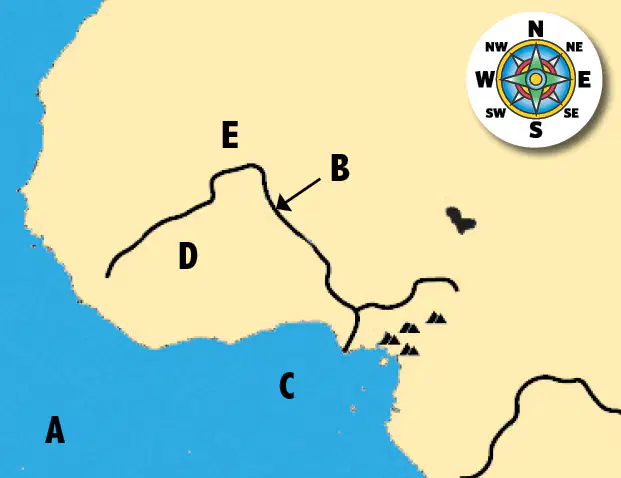
Which letter represents the Gulf of Guinea?
C
A
B
D
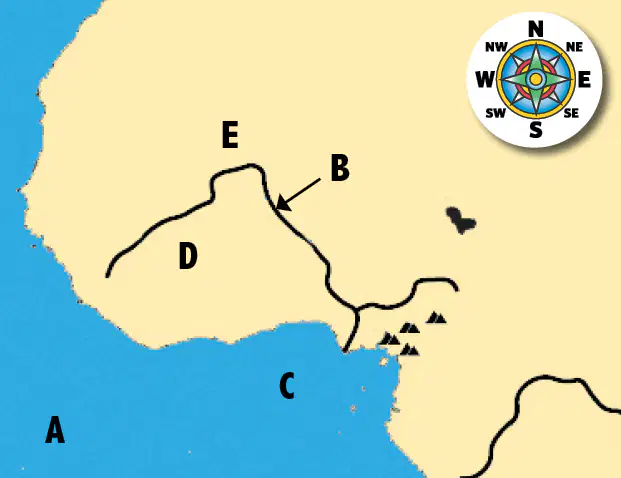
Which letter represents Timbuktu?
E
D
B
C
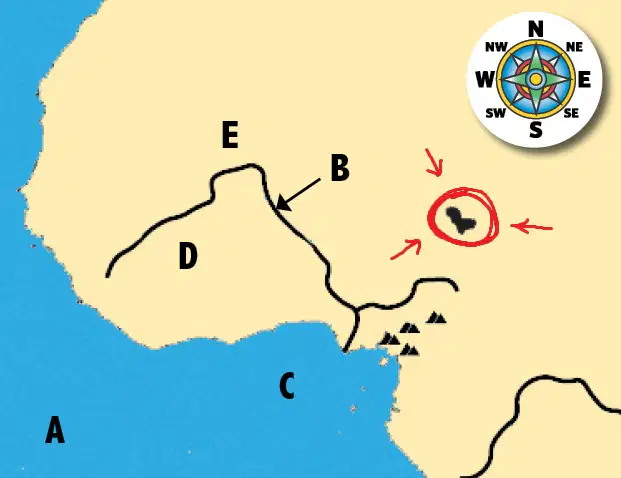
The arrows are pointing to what lake in West Africa?
Lake Chad
Caspian Sea
Lake Mali
Niger Lake
What did indigenous African spiritual traditions believe about lesser gods and divinities?
They represented various forces of nature
They were all-powerful
They were human ancestors
They did not exist
Who influenced people's lives in indigenous African spiritual traditions?
Living family members
Ancestors
Shamans and priests
Lesser spirits
How did deities interact with humans in indigenous African spiritual traditions?
Directly
Through lesser gods and spirits
Through religious ceremonies
They did not interact
What were the two important minerals that Ghana controlled?
Gold and copper
Salt and gold
Salt and spices
Copper and spices
What goods did the kingdom of Mali trade, in addition to gold and salt?
Copper and Spices
Ivory and Ostrich Feathers
Slaves
Rice and Paper
Which country did Songhai trade with, exchanging gold for metals, cloth, manufactured goods, and enslaved people?
Portugal
Spain
France
Britain
What new faith did Arab traders introduce to West African kingdoms?
Christianity
Hinduism
Buddhism
Islam
How did the spread of Islam influence West African culture?
It led to the decline of West African kingdoms
It had no impact on West African culture
It influenced schools, architecture, and language
It caused conflicts between West African kingdoms
What was the main reason for the flourishing of the West African kingdoms?
The discovery of gold mines
The establishment of strong military forces
The development of advanced agricultural techniques
The Trans-Saharan caravan trade
What method did West African people use to convey history?
Writing and printing
Oral tradition
Art and music
Symbols and patterns
What role did griots play in West African communities?
Maintaining oral histories
Creating written records
Leading political movements
Teaching foreign languages
In addition to storytelling, what other roles did griots play in their communities?
Medicine and healing
Diplomacy and ambassadorship
Construction and building
Farming and agriculture
Under Mansa Musa's reign, the Mali Empire expanded its borders to roughly how many times its original size?
1.5 times
2 times
2.5 times
3 times
Which religious group did Mansa Musa allow to practice their faith in his kingdom?
Muslims only
Christians only
Muslims and Christians
No religious groups
What did Mansa Musa do to make Islam a stronger presence in his kingdom?
Built mosques and libraries
Invited architects, artisans, and scholars
Sent local scholars to study in North Africa
All of the above
What did Mansa Musa do in each place of rest during his hajj?
Paid for the construction of a mosque
Gave gifts and gold to the people
Paid for the construction of monuments to himself
Gave slaves and salt to the people
What did Mansa Musa do to promote education in his kingdom?
Established schools
Sent scholars to study in North Africa
Invited scholars to come to Mali
Raised the educational requirements of teachers

