
NEW
Font size
 Worksheets
Fall 2023 Astro 150 Final Review Part 1
Total questions: 17
Worksheet time: 15mins
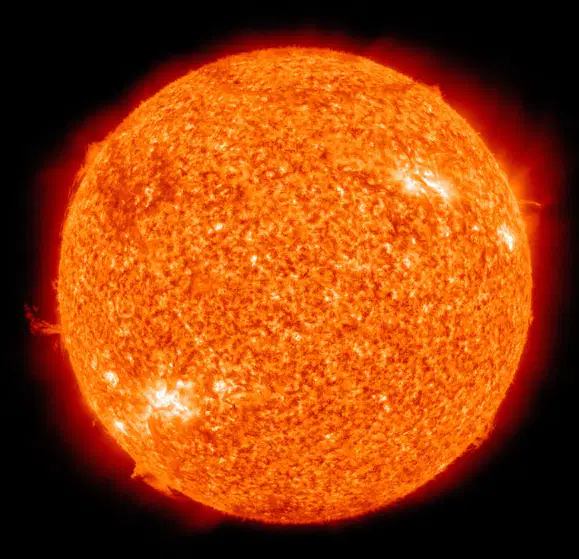
If the Sun were the size of a basketball and placed on this desk, how far away would Alpha Centauri be?
Howe Hall
Ankeny
Not even in this state
Sioux City

Which of these is NOT one of Kepler's laws of planetary motion?
Planets orbit the sun in elliptical orbits
An object at rest stays at rest unless perturbed by an outside force
Planets move faster when closer to the sun
P2 = a3
What supports a star from collapsing under its own gravity?
Outward radiation pressure.
Pauli exclusion principle.
Centrifugal force due to rotation.
Support from magnetic field lines.
Star 1 has a brightness of 4*1010 erg/s/cm2 . Star 2 is twice as far away with the same luminosity. What is its brightness, also in erg/s/cm2?
1*1010
4*105
2*1010
2*105
You observe two stars. Star #1 has a temperature 10x that of Star #2, but Star #1 is 1/10th the size of Star #2. How does the luminosity of Star #1 compare to Star #2?
L1/L2 = 102
L1/L2 = 10-2
L1/L2 = 104
L1/L2 = 10-4
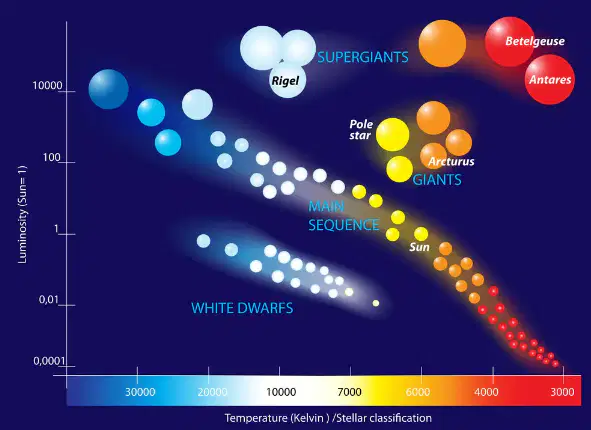
What is the total amount of time our Sun will spend on the Main Sequence?
~1 billion years
~5 billion years
~10 billion years
~13.8 billion years
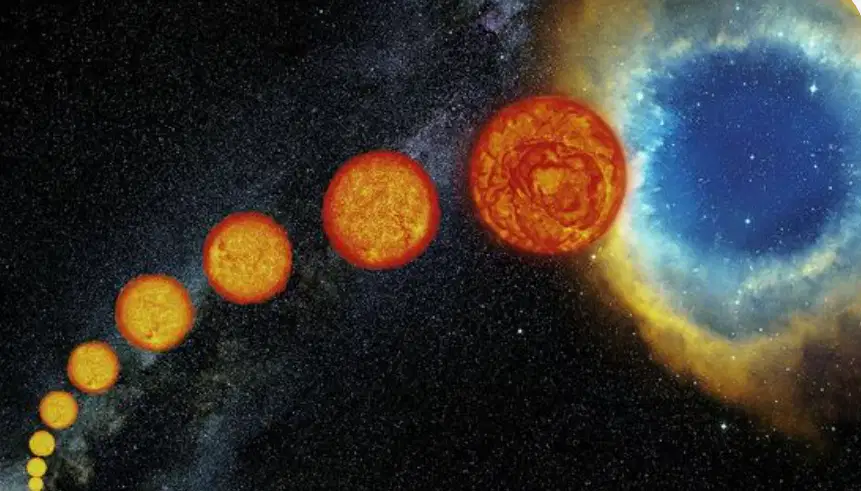
What kind of object will our Sun eventually turn into?
A brown dwarf
A white dwarf
A neutron star
A black hole
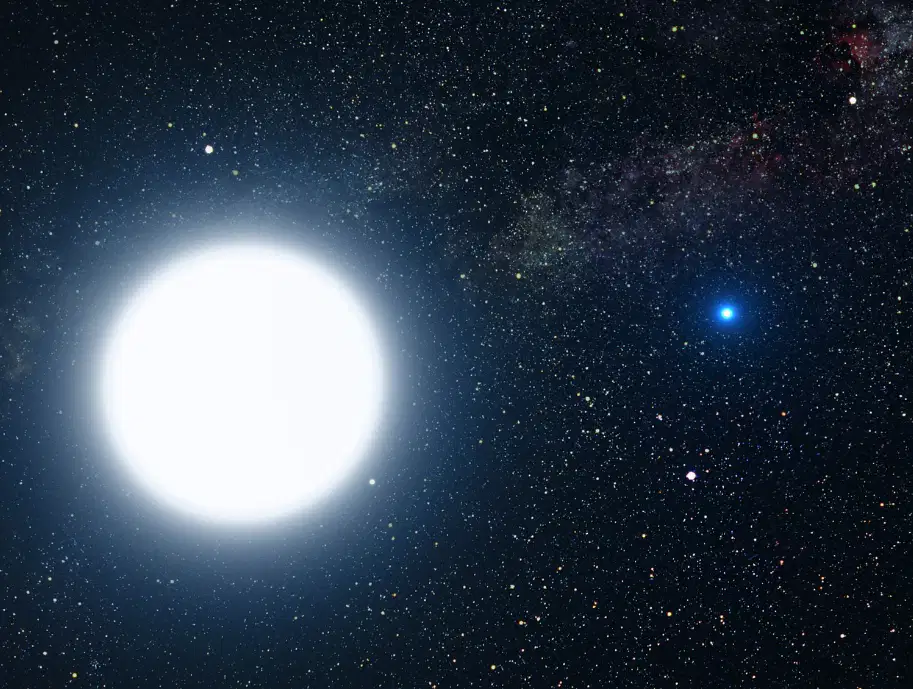
A white dwarf star has a surface temperature of ~12,000 K. A red giant star has a temperature of ~4,000 K. Which star (according to Wein's Law) has a shorter peak wavelength? ( λmaxT = const. )
White Dwarf
Red Giant
Neither
Not enough information

What is a radio interferometer?
An irritating radio signal that distorts astronomical radio data
Such a device does not exist
A device radio astronomers use to filter out earth-based radio broadcasts
Several radio telescopes working together to improve resolution

What is NOT an advantage of a GROUND BASED telescope?
You can see any wavelength
They're cheaper to construct
There's much fewer limitations on the size of the telescope
If something goes wrong, it's easier to fix
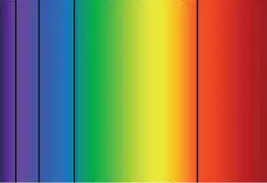
Why are spectral lines different for each material?
The electron orbital energy levels are different for every material
The nucleus absorbs different amounts of energy from incoming photons, depending on the material
The gravity of the different kinds of atoms slow down photons differently
They aren't--spectral lines are a fun demonstration but they don't have any real scientific use
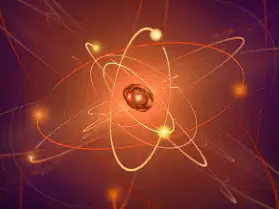
What happens to an electron within an atom when it absorbs a photon?
It drops to the lowest energy level
It rotates around the atom faster
It drops to a lower energy level
It rises to a higher energy level
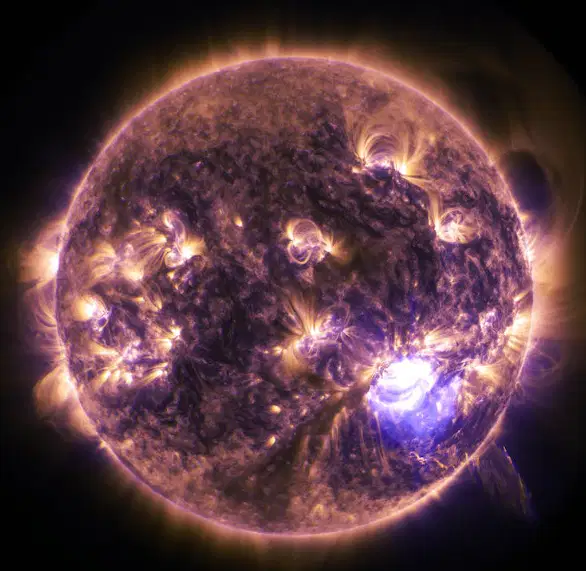
You measure the spectrum of a star and take note of its absorption lines. These lines appear at shorter wavelengths than their laboratory counterparts. What can you say about this star?
It is red-shifted, moving towards us
It is blue-shifted, moving towards us
It is red-shifted, moving away from us
It is blue-shifted, moving away from us
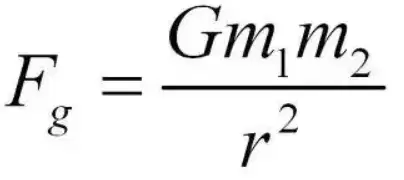
If Earth was moved to 0.5 AU, by how much would the gravitational force increase or decrease?
It would increase by a factor of 2
It would increase by a factor of 4
It would decrease by a factor of 2
It would decrease by a factor of 4
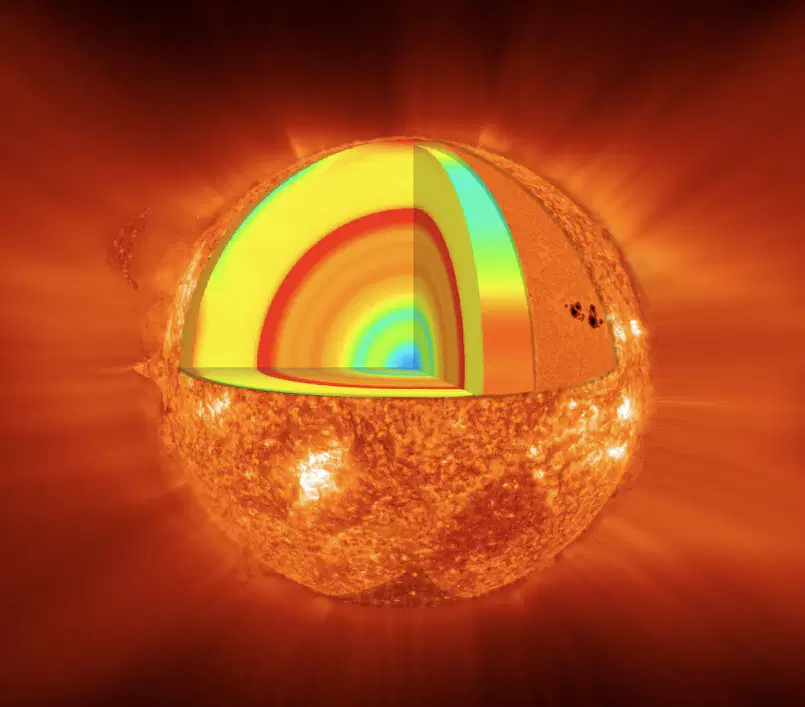
What is the correct order for the layers of the sun? (from the outside in?)
Corona, Convective Zone, Photosphere, Core
Core, Convective Zone, Photosphere, Corona
Convective Zone, Photosphere, Corona, Core
Corona, Photosphere, Convective Zone, Core
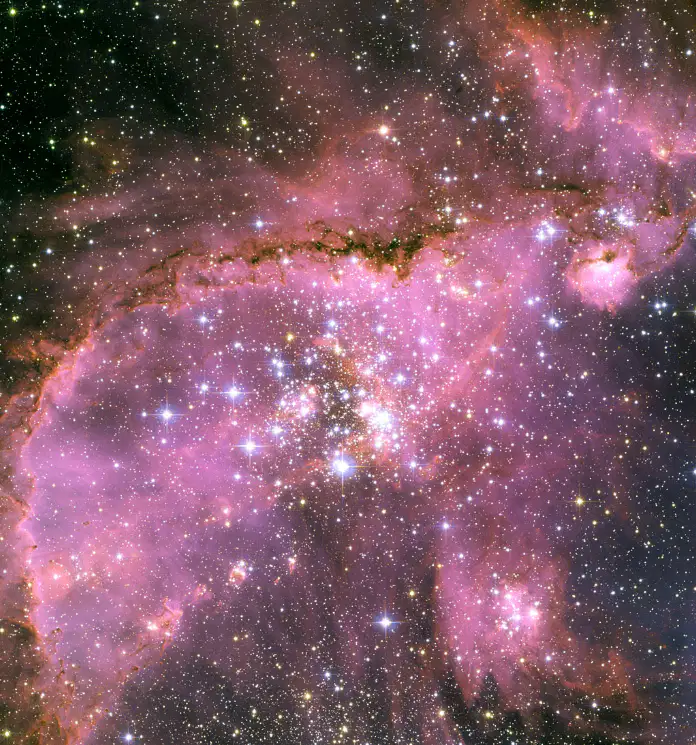
How can we determine the age of a star cluster?
Looking at where the stars lie on an HR diagram.
By measuring the total luminosity of the star cluster.
By using stellar parallax.
By measuring its velocity dispersion.
A closer star is more likely to have...
A high proper motion and small parallax angle
A high proper motion and a large parallax angle
A small proper motion and a small parallax angle
A small proper motion and a large parallax angle

