
 Worksheets
Unit 5 Quiz
Total questions: 10
Worksheet time: 5mins
Name
Class
Date
1.

#1 -Plants have many varied adaptations to insure survival. One such adaptation is to have strong internal structures to allow the plant to be stronger and to grow taller to receive more sunlight. These internal structures are composed of a carbon based molecule called cellulose. Where do plants obtain the carbon building blocks from?
a)
Water
b)
Air
c)
Sunlight
d)
Soil
2.
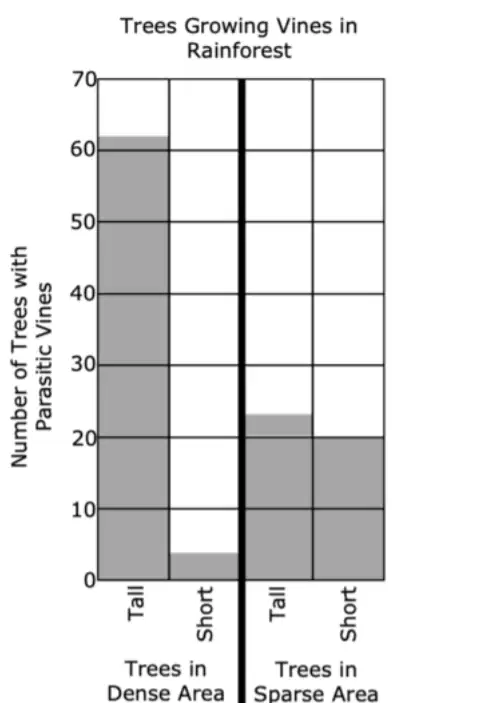
#2- A group of scientist studied the growth of parasitic vines growing on trees in two different areas of the same rainforest.The scientists observed that the tallest trees located in the densely packed area of the rainforest were more likely to have vines than the trees located in the sparse areas on the edge oft he rainforest where trees are more spaced out. This graph shows the scientists’ data. Which inference is best supported by this information?
a)
Vines are unable to grown in sparse areas of the forest.
b)
Short trees are the preferred host of parasitic vines growing in the rainforest.
c)
Trees in sparse areas of the forest release chemicals that prevent the vine growth
d)
Vines are more likely to climb trees in areas where plants have to compete for sunlight.
3.
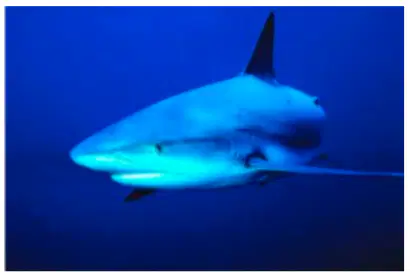
#3- Many sharks, including great white sharks, mako sharks, and whale sharks, are obligate ram breathers. This means that they are unable to pump water over their gills. Instead, these sharks must continually swim to ram water into their gills. If these sharks stop swimming for too long, they can drown. For great white sharks, mako sharks, and whale sharks swimming is necessary for –
a)
accessing food
b)
hiding from large predators
c)
obtaining oxygen
d)
maintaining body temperature
4.
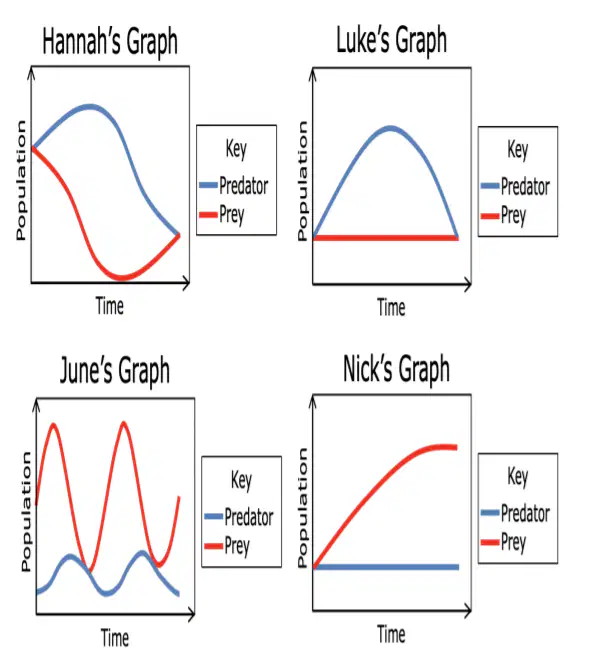
#4- Four students were asked to make a graph showing the typical relationship shared between predator and prey. The four graphs are below. Which student's graph accurately represents this relationship?
a)
Luke's Graph
b)
Hannah's Graph
c)
June's Graph
d)
Nick's Graph
5.
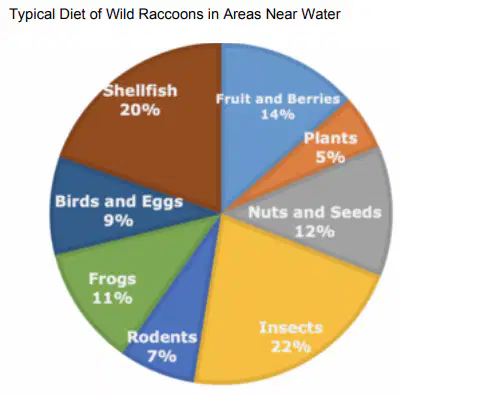
#5-The graph below shows information about the eating habits of raccoons living in areas near water. A rancher is concerned about competition between the ranch animals and the raccoons. Based on the graph, which animals compete for the most food with raccoons?
a)
Turkeys that seeds and fruit
b)
Cattle that eat grass and feed
c)
Hogs that eat fruit, seeds, and feed
d)
Chickens that eat seeds and insects
6.
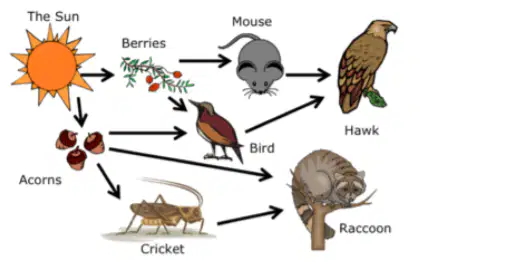
#6- Which organisms in the food web shown below compete for the same food source in this environment?
a)
Hawks and racoons
b)
Birds and mice
c)
Acorns and hawks
d)
Crickets and mice
7.
#7-A student observes several species of plants growing in a large field. Some species have shallow roots, while others have long roots. During periods of drought, the field dries out and many plants die. During the drought, many more plants with shallow roots die than plants with deep roots.Which of the following short-term effects will most likely result from a very dry year?
a)
Most plants in the field will have shallow roots.
b)
There will be an equal number of plants with deep roots and shallow roots
c)
Most plants in the field will have deep roots.
d)
There will be no resulting change in the number of plants with deep or shallow roots
8.
#8- Scientists are studying native grasses in the Midwest prairie region. In 2004, the scientists identified 48 species of native grasses in one area. In 2007, there was a fire in the area. The scientists returned to the area after the fire and found only 22 species of native grass. Which inference is best supported from the scientists’ observations?
a)
Certain native grass species are better adapted to survive fires than others
b)
Grass fires permanently removes species of native grass from the ecosystem
c)
Most native grasses are unsusceptible to grass fires.
d)
The biodiversity of an area increases after a fire.
9.
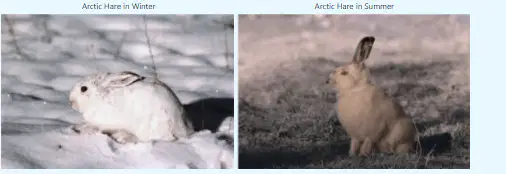
#9-The arctic hare lives in extremely cold environments in northern areas of Canada that receive a lot of seasonal snow. During the summer, the arctic hares’ fur is brownish-gray. The hares molt their darker fur and grow a new white haircoat during the winter. Scientists are concerned that rising global temperatures will affect the Arctic hare. If global climate change leads to the elimination of snow in the habitat of arctic hares, which adaption is most likely to occur over many generations?
a)
Hares with brownish gray fur will be easier to see on the ground in the winter. Over time this could lead to artic hares that have brownish gray fur year-round.
b)
Hares with brownish gray frul will be in areas without winter show will be easier for predators to find. Over time this could lead to arctic hares that have white fur year-round
c)
Hares with white fur will be easier to see on the ground in the summer. Over time this could lead to arctic hares that have white fur year-round
d)
Hares with white fur in areas without winter snow will be easier to find. Over time this could lead to arctic hares that have brownish gray fur year-round.
10.
#10 When humans dump chemical fertilizer pollutants into the ocean, the excessive nutrients deplete the oxygen required to support most marine life near the bottom of the ocean. This creates dead zones, or pockets of low-oxygen areas in the ocean where few organisms can survive. Which human activities would be affected by the increasing number of dead zones in the ocean?
a)
Commercial shipping because fewer people will purchase products after hearbout about dead zones.
b)
Offshore drilling, because dead zones prevent large oil tanks from passing through the ocean
c)
Beach vacationing, because dead zones are toxic to swim in
d)
Commercial Fishing, because fish cannot survive without oxygen
100 %

