
 Worksheets
Ch 27 - Bacteria
Total questions: 17
Worksheet time: 17mins
Peptidoglycan is
found in the chromosomes of most bacteria.
composed of long polysaccharides crosslinked with short polypeptides.
composed of long polypeptides held together by disulfide bridges.
a unique combination of protein lipid and fat.
Bacteria can obtain their nutrition by
photosynthesis.
chemosynthesis.
heterotrophy.
all of the above
The methane-producing bacteria belong to
archaebacteria
prokaryotes
eukaryotes
urkaryotes
Listed below are descriptions of bacterial shape. Select the exception.
coccus
bacillus
pili
spiral
Which of the following allow the bacteria to join together to transfer genes?
flagella
pores
connecting channels
pili
Which of the following statements about prokaryotes is correct?
Bacterial cells conjugate to mutually exchange genetic material
Their genetic material is confined within a nuclear envelope
They divide by binary fission, without mitosis or meiosis
The persistence of bacteria throughout evolutionary time is due to genetic similarity
How are bacterial cells different from the cells of eukaryotes?
The bacteria are prokaryotes, and the genetic material is not contained in the nuclei.
The bacteria are eukaryotes, and the genetic material is not contained in the nuclei.
The bacteria are prokaryotes, and the genetic material is contained in the nuclei.
The bacteria are eukaryotes, and the genetic material is contained in the nuclei.
Thick peptidoglycan in cell wall
Gram positive bacteria
Gram negative bacteria
Thin peptidoglycan in cell wall
Gram positive bacteria
Gram negative bacteria
Has an outer membrane (capsule)
Gram positive bacteria
Gram negative bacteria
Stained pink
Gram positive bacteria
Gram negative bacteria
Stains purple
Gram positive bacteria
Gram negative bacteria

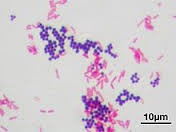
What type of bacteria is this?
Gram Postive
Gram Negative
Process of gene transfer where a virus moves genetic material from one bacteria to another
conjugation
transdution
transformation
Process of gene transfer where a virus die/bursts & another bacteria takes in the free-floating plasmids
conjugation
transduction
transformation
The process gene transfer where bacteria connect pili to exchange plasmids
conjugation
transformation
transduction

