
 Worksheets
Fall Vocab
Total questions: 65
Worksheet time: 3hrs 15mins




This is a......
an obtuse triangle
an equilateral triangle
a scalene triangle
a right triangle
These two lines will never intersect
Parallel Lines
Perpendicular lines
Bisector
Not possible
This geometric object has no dimension and is represented as a single dot in space
point
line
plane
ray
Two angles that add to be 180 degrees
Supplementary
Complementary
Angles
Straight Line

Name the angle in the image
∠OAB
∠OBA
∠AOB
∠BOA
means having the same shape and size
congruent
small
large
equal
What is the opposite of squaring a number?
divide
square root
fractions
multiply
Points on the same line are __________ points
Coplanar
Coordinate
Conjecture
Collinear
___________ are lines that lie in the same plane
Coplanar Lines
Line Segment
Collinear Points
Intersection

State if the two triangles are congruent. If they are, state how you know.
A
B
C
D


What is the purpose of using the SAS Congruence theorem in proving triangle congruence?
To identify the congruent sides and included angle
To compare corresponding parts of the triangles
To state that the triangles are congruent
To prove that the corresponding parts of the triangles are congruent
What does triangle congruence allow us to solve for?
Unknown angles and sides
Corresponding parts of congruent triangles
Congruence postulates
Triangle congruence


What type of special segment is shown?
Median
Perpendicular Bisector
Angle Bisector
Altitude

What type of special segment is shown?
Angle Bisector
Altitude
Median
Perpendicular Bisector

What type of special segment is shown?
Median
Angle Bisector
Perpendicular Bisector
Altitude

What type of special segment is shown?
Altitude
Perpendicular Bisector
Median
Angle Bisector

What type of special segment is shown?
Angle Bisector
Altitude
Median
Perpendicular Bisector

The figures above are examples of...
altitudes
perpendicular bisectors
medians
angle bisectors
Which point of concurrency is the intersection of the perpendicular bisectors of the triangle?
Centroid
Incenter
Orthocenter
Circumcenter
What does an angle bisector do?
Makes two 90 degree angles
splits a 90 degree angle in half
splits an angle in half
splits 2 sides in half

8
10
3
12

9
4.5
18
2.25

60
16
21
52

A
B
C
D
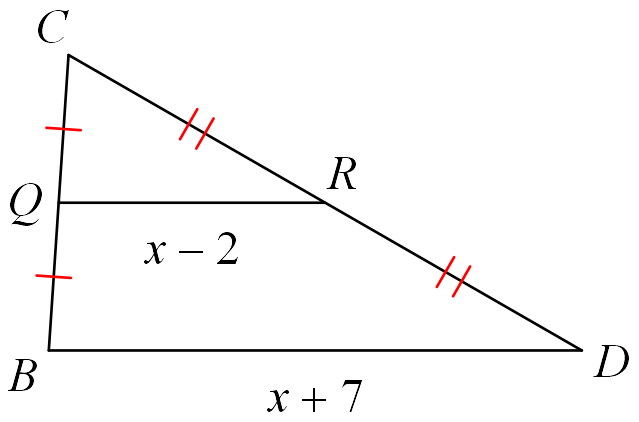
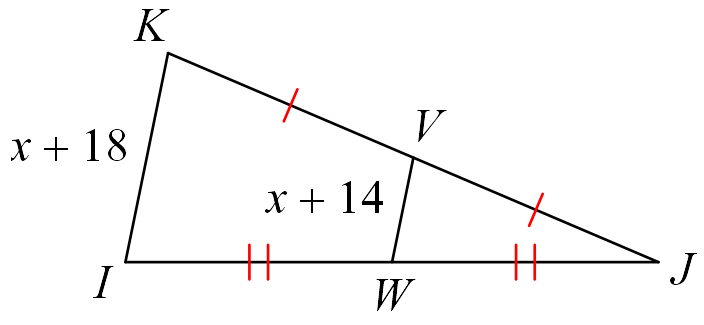

Write a rule for the translation.
(x -1, y + 2)
(x -2, y + 1)
(x +2, y - 1)
(x +1, y - 2)

Choose the correct scale factor:
2.5
1.5
3.5
4
The non-rigid transformation that changes the size of the pre-image is called:
Dilation
Rotation
Translation
Reflection
Underline the hypothesis and italicize the conclusion in each statement.
If your dog eats Purina, then he’ll stay happy and healthy.
If your dog eats Purina, then he’ll stay happy and healthy.
If your dog eats Purina, then he’ll stay happy and healthy.
If your dog eats Purina, then he’ll stay happy and healthy.
Refer to the following statement: "If a polygon is a quadrilateral, then it is a trapezoid."
What is the converse of this statement?
If a polygon is not a quadrilateral, then it is not a trapezoid.
If a polygon is not a trapezoid, then it is not a quadrilateral.
If a polygon is a trapezoid, then it is a quadrilateral.
A rectangle is also a quadrilateral.
Refer to the following statement: "If a polygon is a quadrilateral, then it is a trapezoid."
What is the inverse of this statement?
If the polygon is not a quadrilateral, then it is not a trapezoid.
If the polygon is not a trapezoid, then it is not a quadrilateral.
If the polygon is a trapezoid, then it is a quadrilateral.
A rectangle is also a quadrilateral.
Refer to the following statement: "If a polygon is a quadrilateral, then it is a trapezoid."
What is the contrapositive of this statement?
If a polygon is a trapezoid, then it is a quadrilateral.
If a polygon is not a quadrilateral, then it is not a trapezoid.
If a polygon is not a trapezoid, then it is not a quadrilateral.
A rectangle is also a quadrilateral.
Refer to the following statement: "If a polygon is a quadrilateral, then it is a trapezoid."
What is a counterexample of this statement?
If a polygon is a trapezoid, then it is a quadrilateral.
If a polygon is not a quadrilateral, then it is not a trapezoid.
If a polygon is not a trapezoid, then it is not a quadrilateral.
A rectangle is also a quadrilateral.
Given the conditional statement;
"If it is Wednesday, then Jane doesn't have baseball practice."
What is the hypothesis of this statement.
It is Wednesday
Jane doesn't have baseball practice
If it is Wednesday
Then Jane doesn't have baseball practice

Which of the following is true about the conditional statement below?
If a man is 7 feet tall, then he plays basketball.
Hypothesis: a man is 7 feet tall
Conclusion: he plays basketball
Hypothesis: IF a man is 7 feet tall
Conclusion: THEN he plays basketball
Hypothesis: THEN he plays basketball
Conclusion: IF a man is 7 feet tall
Hypothesis: he plays basketball
Conclusion: a man is 7 feet tall


reverse

Which of the following is the BICONDITIONAL of the statement below?
If it is water, then it is wet.
If it is not wet, then it is not water.
If it is wet, then it is water.
It is water if and only if it is wet.
There is no biconditional statement.

