

wayground logo

Free Printable Worksheets

Font size

S
M
L
XL
Worksheets

The Origins of Hinduism and Buddhism

Total questions: 18

Worksheet time: 9mins

Name
Class
Date
1.

What two things characterized cities in the Indus Valley?

a)
Poorly-planned layouts and advanced irrigation systems
b)
Unplanned layouts and primitive drainage systems
c)
Well-planned layouts and no drainage systems
d)
Well-planned layouts and advanced drainage systems
2.

Why do historians know so little about the people of the Indus Valley Civilization?

a)
The people of the Indus Valley Civilization did not leave any artifacts behind.
b)
The people of the Indus Valley Civilization were nomadic and did not settle in one place.
c)
The writing system of the Indus Valley Civilization has not yet been deciphered.
d)
The people of the Indus Valley Civilization did not have a written language.
3.

What were the Vedas (or Vedic Hymns?)

a)
Ancient Greek poems
b)
Buddhist texts
c)
Modern-day Hindu scriptures
d)
Ancient Hindu scriptures containing hymns, mantras, and rituals.
4.

What was the relationship between Brahmins and kings in what came to be called Brahmanism?

a)
Brahmins were the priestly class and provided guidance to the kings.
b)
Brahmins were the merchants and traded with the kings.
c)
Brahmins were the ruling class and had authority over the kings.
d)
Brahmins were the warriors and protected the kings.
5.

What aspects of people's lives did the caste system determine?

a)
Religion, education, and political affiliation
b)
Physical appearance, age, and gender
c)
Geographic location, language, and diet
d)

Jobs, Who people could hang out with, and Who people could marry

6.

What are atman and brahman?

a)
Characters in a Bollywood movie
b)
Famous landmarks in Mumbai
c)

Atman is the Hindu concept of the Soul, Brahmin is the universal collection of energy/souls

d)
Types of food in Indian cuisine
7.

What is moksha in the Hindu faith?

a)
Achieving enlightenment through meditation
b)
Attaining material wealth and success
c)
Becoming a deity in the afterlife
d)
Liberation from the cycle of birth, death, and rebirth
8.

What role does reincarnation play in the Hindu faith?

a)
Reincarnation is the belief in the power of meditation in Hinduism.
b)
Reincarnation is the belief in the existence of multiple gods in Hinduism.
c)
Reincarnation is the belief in the afterlife in Hinduism.
d)
Reincarnation is the belief in the cycle of birth, death, and rebirth in Hinduism.
9.

What idea is karma based on?

a)
Karma is based on the alignment of the stars and planets
b)
Karma is based on the number of good deeds one does in a day
c)
Karma is based on the color of one's aura
d)
Actions in this life determine future lives
10.

Who was Siddhartha Gautama?

a)
Genghis Khan
b)
Buddha
c)
Julius Caesar
d)
Napoleon Bonaparte
11.

What were three things about Hinduism that led to the practicing of a new set of ideas in India.

a)
Worship of nature, belief in divine intervention, emphasis on asceticism
b)
Strict hierarchy, belief in fate, emphasis on sacrifice
c)
Polytheism, belief in multiple gods, emphasis on meditation
d)

Buddha rejected the Hindu Gods, The Caste system, and The Wealth of the Priests classes

12.

What did Siddhartha see on his journey outside the palace?

a)

A suffering man, an old age man, a sick man, and a dead man.

b)
Power, authority, and control
c)
Wealth, luxury, and comfort
d)
Happiness, joy, and peace
13.

According to Siddhartha, what are the Four Noble Truths? Why do people suffer?

a)

That people suffer because of their desires and that learning to let go will bring peace.

b)

The truth that College football playoff should include FSU, Texas, Michigan, and Washington. People suffer when Alabama wins
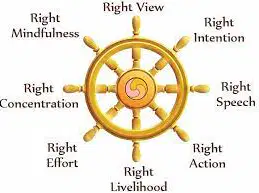
14.

What was the Eightfold Path?

a)
A type of martial arts
b)
A set of guidelines in Buddhism
c)
A mathematical equation
d)
A form of meditation
15.

Why was the Eightfold Path sometimes called the Middle Way?

a)

Moderation and balance between extreme indulgence and extreme self denial

b)
Embracing extreme indulgence and asceticism
c)
Following a path of extreme self-denial
d)
Complete rejection of indulgence and asceticism
16.

What role does reincarnation play in the Buddhist faith?

a)
Reincarnation is not a belief in Buddhism.
b)

Reincarnation allows people many lifetimes to find "The Middle Path/Enlightenment"

c)
Reincarnation is only believed by a small sect of Buddhists.
d)
Reincarnation is a recent addition to Buddhist teachings.
17.

What is nirvana?

a)
A state of perfect peace and happiness achieved through enlightenment in Buddhism.
b)
A type of fruit found in Southeast Asia.
c)
A type of dance originating from South America.
d)
A popular rock band from the 90s.
18.

Why did the Buddha's teachings never take hold in the country of India where it originated?

a)
The Buddha's teachings were too complex for the people of India to understand
b)

The Buddha's teachings were absorbed into the Hindu faith.
