
NEW
Font size
 Worksheets
Review: Constitutional Conventin, Ratification, and Constitution
Total questions: 17
Worksheet time: 9mins
Which group opposed (was against) ratification of the Constitution?
Federalists
Republicans
Anti-Federalists
Democrats
Which of the following individuals was the Big Cheese (an important contributor) at the Constitutional Convention
James Madison
Teddy Roosevelt
Thomas Jefferson
Abraham Lincoln
Which of the following is NOT one of the three branches of government?
Legislative
Bill of Rights
Judicial
Executive
Which of the following jobs would be found in the Executive Branch of government?
Senator
Representative
President
Supreme Court Justice
What is the main duty of Congress?
to make or create laws
to interpret and judge the law
to execute, carry out, or enforce the law
What is the main duty of the Supreme Court?
to make the laws
to interpret and judge the law
to execute, carry out, or enforce the laws
What is the main duty of the President and the Executive Branch?
to make the laws
to interpret and judge the law
to execute, carry out, and enforce the laws
Congress is divided into what two parts?
Supreme Court and President
Senate and Supreme Court
Senate and House of Representatives
State and Defense Departments
How many Senators does each state have in Congress?
two
one
seven
ten
How is the number of representatives per state determined for the House of Representatives?
there are nine per state
by the state's population
by territorial size
by money
What is federalism?
a word to describe your rights under the Second Amendment
The Supreme Court
The power of the states
The relationship and power sharing between the states and the national government
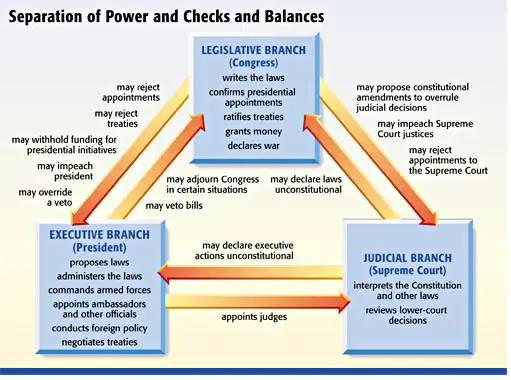
Why did the U.S. Constitution establish a system of checks and balances?
to make sure that government debts are paid
to keep the state governments from becoming too powerful
to keep any one branch of government from becoming too powerful
to make sure that the government does not spend more money than it takes in
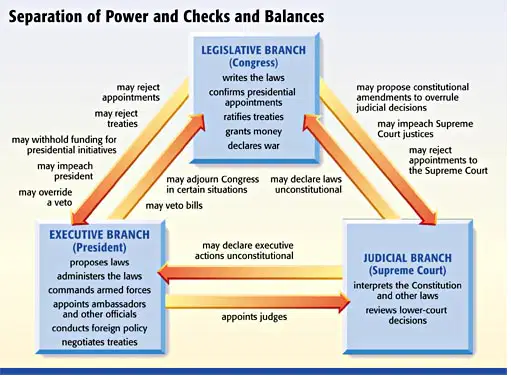
What action can the President take to block a legislative bill from becoming law?
impeachment
veto
judicial review
the Bill of Rights
Why did the Articles of Confederation fail?
it was a weak government structure
it had too much taxing power
it gave too much power to the president
it gave too much power to the national government
Why was the Constitution created?
to create a stronger national government
the Articles of Confederation was not adequate for the new nation
to create a power-sharing system between the national government and the states
All answers listed
"All bills shall be read three times in each house and shall be signed by the presiding officer of each house before being presented to the Governor. If the Governor approves, the Governor shall sign it and it shall become a law; but if not, the Governor shall return it with objections, together with a veto message stating the reasons for such objections," ---North Carolina Constitution, Article 2, Section 22
WHICH DEMOCRATIC OR CIVIC IDEAL IS PRESENTED IN THIS EXCERPT FROM THE NORTH CAROLINA STATE CONSTITUTION?
limited government
separation of powers/checks and balances
popular sovereignty
trial by jury of peers
“The proposed Constitution, (in regards to) the State governments, makes them ... parts of the national sovereignty, by allowing them a direct representation in the Senate, and leaves in their possession certain exclusive and very important portions of ... power. This fully corresponds, in every rational ...terms, with the idea of a federal government.” (Federalist Paper No. 9)
WHICH CONSTITUTIONAL IDEA IS EXPLAINED IN THIS QUOTE FROM THE FEDERALIST PAPERS?
federalism
veto
impeachment
freedom of speech

