
 Worksheets
Review for Rhythm/Expression Test 8th Grade
Total questions: 51
Worksheet time: 26mins
Name
Class
Date
1.

What do you do when you see this musical symbol in the music?
a)
play the note shorter
b)
accent the note
c)
hold out the note until the conductor cuts you off
d)
play the note for as long as you wish
2.

What is the name of this musical symbol?
a)
fermata
b)
staccato
c)
accent
d)
legato
3.
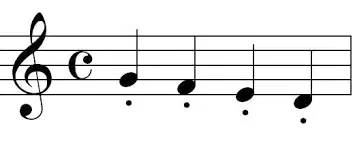
Which phrase best describes staccato?
a)
short and not connected
b)
gradually louder
c)
gradually softer
d)
smooth and flowing
4.

Which phrase best describes legato?
a)
short and not connected
b)
gradually louder
c)
gradually softer
d)
smooth and flowing
5.
To take a large thing and break it down into smaller parts.
a)
Count
b)
Tie
c)
Slur
d)
Subdivide
6.
When deciding what rhythm to use to subdivide a rhythm pattern, you should use the...
a)
shortest rhythm in the pattern
b)
longest rhythm in the pattern
c)
rhythm you wish
d)
quarter notes
7.
How many beats does it take to play or sing ti-tibi or tibi-ti?
a)
One
b)
Two
c)
Three
d)
Four
8.
How many beats does it take to play or sing tim-ti?
a)
One
b)
Two
c)
Three
d)
Four
9.
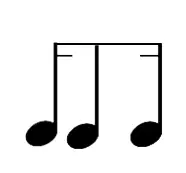
What is the name of this rhythm?
a)
ti-tibi (eighth-two sixteenths)
b)
tibi-ti (two sixteenths- eighth)
c)
short/long/short (sixteenth-eigthth-sixteenth)
d)
tim-ti (dotted eighth-sixteenth)
10.

What is the name of this rhythm?
a)
ti-tibi (eighth-two sixteenths)
b)
tibi-ti (two sixteenths-eighth)
c)
short/long/short (sixteenth-eigthth-sixteenth)
d)
tim-ti (dotted eighth-sixteenth)
11.

What is the name of this rhythm?
a)
ti-tibi (eighth-two sixteenths)
b)
tibi-ti (two sixteenths-eighth)
c)
short/long/short (sixteenth-eigthth-sixteenth)
d)
tim-ti (dotted eighth-sixteenth)
12.
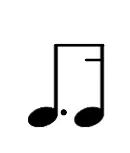
What is the name of this rhythm?
a)
ti-tibi (eighth-two sixteenths)
b)
tibi-ti (two sixteenths-eighth)
c)
short/long/short (sixteenth-eigthth-sixteenth)
d)
tim-ti (dotted eighth-sixteenth)
13.
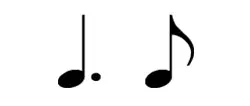
How many beats does it take to play or sing a "tam-ti" (dotted quarter eighth) rhythmic building block?
a)
One
b)
Two
c)
Three
d)
Four
14.
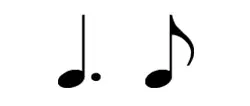
What rhythm do you think about when subdividing a "tam-ti" (dotted quarter eighth) rhythmic building block?
a)
dotted quarter notes
b)
quarter notes
c)
eighth notes
d)
sixteenth notes
15.

Which pattern below shows the correct ties for syncopa?
a)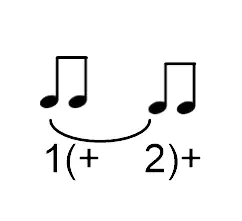
Option 1
b)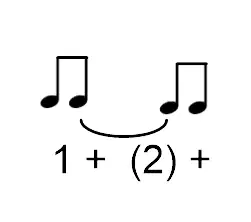
Option 2
16.

Which pattern below shows the correct ties for ti-tibi (eighth note-two sixteenths)?
a)
Option 1
b)
Option 2
c)
Option 3
d)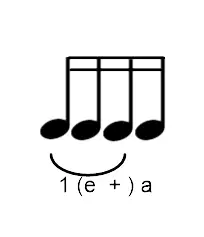
Option 4
17.
Which pattern below shows the correct ties for tim-ti (dotted eighth-sixteenth)?
a)
Option 1
b)
Option 2
c)
Option 3
d)
Option 4
18.
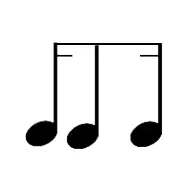
Which pattern below shows the correct ties for short-long-short (sixteenth-eighth-sixteenth)?
a)
Option 1
b)
Option 2
c)
Option 3
d)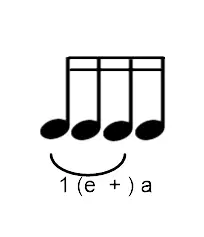
Option 4
19.
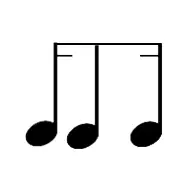
What rhythm do you subdivide for short-long-short (sixteenth-eighth-sixteenth)?
a)
quarter notes
b)
eighth notes
c)
sixteenth notes
20.
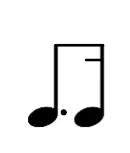
What rhythm do you subdivide for tim-ti (dotted-eighth sixteenth)?
a)
quarter notes
b)
eighth notes
c)
sixteenth notes
21.

What rhythm do you subdivide for ti-tibi?
a)
quarter notes
b)
eighth notes
c)
sixteenth notes
22.

What rhythm do you subdivide for tibi-ti?
a)
quarter notes
b)
eighth notes
c)
sixteenth notes
23.

Which pattern below shows the correct ties for tibi-ti (two sixteenths-eighth note)?
a)
Option 1
b)
Option 2
c)
Option 3
d)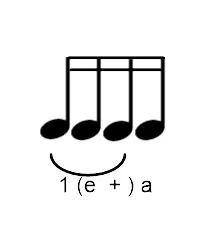
Option 4
24.
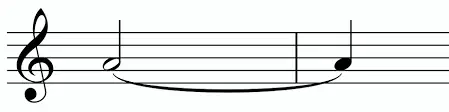
What do we call the curved line that connects two or more notes of the same pitch?
a)
a rhythm
b)
a tie
c)
a slur
d)
a beat
25.
Which pattern below shows the correct ties for tam-ti?
a)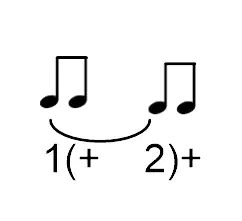
Option 1
b)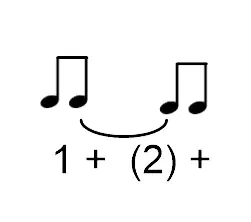
Option 2
26.

How many beats does it take to play or sing a "syncopa" rhythmic building block?
a)
One
b)
Two
c)
Three
d)
Four
27.

What rhythm do you think about when subdividing syncopa?
a)
Whole notes
b)
Half notes
c)
Quarter Notes
d)
Eighth Notes
28.
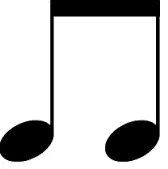
What is this rhythmic value?
a)
Pair of Eighth Notes
b)
Sixteenth Notes
c)
Whole Note
d)
Syncopa
29.
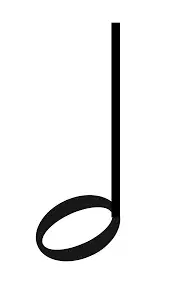
What is this rhythmic value?
a)
Pair of Eighth Notes
b)
Sixteenth Notes
c)
Whole Note
d)
Half Note
30.

What is this rhythmic value?
a)
Pair of Eighth Notes
b)
Quarter Note
c)
Half Note
d)
Eighth Notes
31.
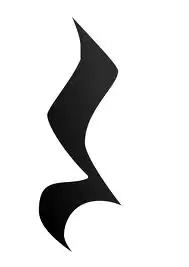
What is this rhythmic value?
a)
Eighth Rest
b)
Quarter Note
c)
Half Note
d)
Quarter Rest
32.

What is this rhythmic value?
a)
Whole Note
b)
Quarter Note
c)
Half Note
d)
Whole Rest
33.

What is this rhythmic value?
a)
Whole Note
b)
Quarter Note
c)
Half Note
d)
Whole Rest
34.

What is this rhythmic value?
a)
Whole Note
b)
Half Rest
c)
Half Note
d)
Whole Rest
35.
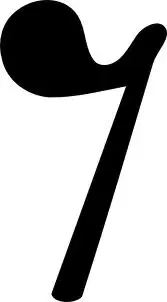
What is this rhythmic value?
a)
Eighth Note
b)
Half Rest
c)
Eighth Rest
d)
Sixteenth Rest
36.
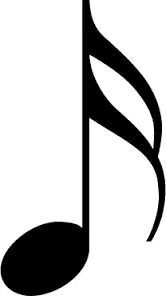
What is this rhythmic value?
a)
Eighth Note
b)
Quarter Note
c)
Eighth Rest
d)
Sixteenth Note
37.

What is this rhythmic value?
a)
Pair of Eighth Notes
b)
Four Sixteenth Notes
c)
Sixteenth Note
d)
Sixteenth Rest
38.

What is this rhythmic value?
a)
Pair of Eighth Notes
b)
Four Sixteenth Notes
c)
Sixteenth Note
d)
Sixteenth Rest
39.
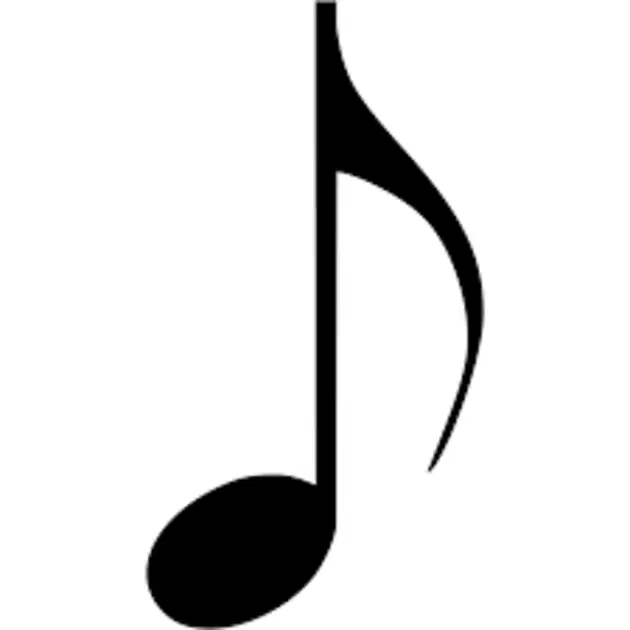
What is this rhythmic value?
a)
Pair of Eighth Notes
b)
Eighth Note
c)
Sixteenth Note
d)
Sixteenth Rest
40.

The space between two bar lines on a staff is called a ______________.
a)
Bar Line
b)
Measure
c)
Meter
d)
Time Signature
41.
Tells how many sounds are on each beat, goes with the words, and tells the duration of a note.
a)
Beat
b)
Tempo
c)
Rhythm
d)
Pitch
42.
How many beats does it take to play or sing four sixteenth notes in 4/4 time?
a)
One
b)
Two
c)
1/4 of a beat
d)
1/2 of a beat
43.
How many beats or what portion of a beat does it take to play or sing one sixteenth note in 4/4 time?
a)
One
b)
Two
c)
1/4 of a beat
d)
1/2 of a beat
44.
How many beats does it take to play or sing a pair of eighth notes in 4/4 time?
a)
One
b)
Two
c)
1/4 of a beat
d)
1/2 of a beat
45.
How many beats or what portion of a beat does it take to play or sing one eighth note in 4/4 time?
a)
One
b)
Two
c)
1/4 of a beat
d)
1/2 of a beat
46.
How many beats does it take to play or sing a quarter note in 4/4 time?
a)
One
b)
Two
c)
1/4 of a beat
d)
1/2 of a beat
47.
How many beats does it take to play or sing a half note in 4/4 time?
a)
One
b)
Two
c)
1/4 of a beat
d)
1/2 of a beat
48.
How many beats does it take to play or sing a whole note in 4/4 time?
a)
One
b)
Two
c)
Three
d)
Four
49.
An organization of beats and accents into recurring patterns (how the beats are grouped), tells how many beats are in each measure.
a)
Beat
b)
Rhythm
c)
Meter
d)
Pitch
50.
Tells the meter of the song, including how many beats are in each measure and what type of note "gets" the beat.
a)
Time Signature
b)
Rhythm
c)
Pitch
d)
Beat
51.
The steady pulse of the music.
a)
Beat
b)
Tempo
c)
Rhythm
d)
Pitch
100 %

