Worksheets
Practice Quiz - Basic Electrical
Total questions: 57
Worksheet time: 57mins
What is a circuit?
A type of clothing
A type of bird
A type of fruit
A closed loop through which an electric current can flow.
What is voltage?
The flow of electric current in a circuit.
The resistance in an electric circuit.
The amount of electric charge in a circuit.
The electric potential difference between two points in an electric circuit.
What is current?
The speed of a moving object.
The flow of electric charge in a circuit or conductor.
The flow of water in a river.
The movement of air in a room.
What is resistance?
The measure of opposition to the flow of electric current in a material
The measure of temperature of electric current in a material
The measure of support to the flow of electric current in a material
The measure of speed of electric current in a material
What is Ohm's Law?
Ohm's Law is the relationship between current, frequency, and resistance in an electrical circuit.
Ohm's Law is the relationship between power, voltage, and resistance in an electrical circuit.
Ohm's Law is the relationship between current, voltage, and capacitance in an electrical circuit.
Ohm's Law is the relationship between current, voltage, and resistance in an electrical circuit.
Which of the following is a unit of electrical resistance?
Volt
Ohm
Ampere
Watt
Which of the following is a unit of voltage?
ohm
ampere
volt
watt
Which of the following is a unit of current?
Watt
Volt
Ampere
Ohm
Which of the following is a unit of electrical power?
ohm
volt
watt
ampere
What happens to the current in a circuit if the voltage increases?
The voltage in the circuit will decrease.
The current in the circuit will increase.
The current in the circuit will remain the same.
The current in the circuit will decrease.
A complete electrical path is called a
path
current
circuit
light


This symbol represents a conductive path in a circuit
V=IxR
R=IxV
I=RxV


The type of electricity derived from a battery is
Alternating Wattage
Alternating Current
Direct Wattage
Direct Current

identify the following symbol
fusible link
interlock
fuse
solenoid

identify the following symbol
push button
ground
caution symbol
Battery

This symbol represents a ..............
valve
voltmeter
Variable
Vacuum
Match circuit with description
(+) Cont. Simple
(-) Cont. Series-Parallel
(+) Cont. Series
(+) Cont. Series-Parallel
(-) Cont. Simple
(-) Cont. Parallel
Place measurement in proper place
12
6V
2A
3
Match the following
Source Voltage
Current Flow
Avalable Voltage
Voltage Drop
Match the following

Open Circuit

Ground Control

Series

Short Circuit

Power Control
A material that does NOT let electricity pass through it is called ...
An electrical conductor
An electrical insulator
An electrical source
An electric appliance

To complete the circuit, a wire should be placed from —

In a closed circuit, how does battery voltage affect current?
As voltage increases, current increases.
As voltage increases, current decreases.
Voltage has no affect on current.
If voltage exceeds current, a short circuit circuit will develop.
In a standard series circuit, the voltage is the same everywhere in the circuit.
True
False
Which of the symbols represents current in an electrical circuit?
i
c
e
r

The diagram below at the right shows a light bulb connected by wires to the + and - terminals of a car battery. Compared to point D, point A is _______________ electric potential.
12 V higher in
12 V lower in
exactly the same
impossible to tell

Battery
Fuse
Switch (closed)
Switch (open)

A device for opening or closing the flow in a circuit is _______.
an insulator
a battery charger
a switch
a resistor
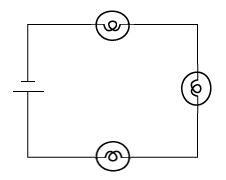
How many paths does a series circuit have?
4
3
2
1
What happens to the voltage in a series circuit?
The voltage stays the same
The voltage is added
The voltage is reduced
The voltage is split between the light bulbs
Conventionally, current is described as flowing from the ................ terminal of a battery to the ................ terminal.
Negative.....negative
Negative....positive
Positive......negative
Positive....positive
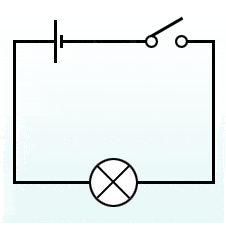
In the circuit, the bulb lights up because there is ............... flowing in the closed circuit.
battery
current
resistance
voltage
SI unit of current is
ampere
metre
ohm
volt
Current can be measured using ............
ammeter
light bulb
resistor
voltmeter
An ammeter is connected in ...........
Parallel
Series
Voltage divided by Resistance
(V / R)
Current
Power
Ohms
Watts