
 Worksheets
Unit 9 Test Review - Judicial Branch
Total questions: 31
Worksheet time: 31mins
What is the term of office for a federal judge?
6 years
8 years
the duration of the President's term
for the rest of his/he life or good behavior
How many Justices serve on the U.S. Supreme Court?
5
6
9
11
The President nominates a candidate for the Supreme Court Justice, but which part of Congress must approve his/her nomination?
The Senate
The Vice President
The House of Representatives
The Secretary of Judicial Affairs
When a person becomes a Supreme Court Justice, he or she hold that job
for life
until age 65
for four years
unitil a new President takes office
Which of these is a difference between the term of office for a Federal judge and a member of Congress?
Judges cannot get voted out of office.
Members of Congress cannot be impeached.
Judges have to run for office every six years.
The Senate cannot prevent a person from becoming a Federal judge
State and federal courts often share the authority to hear a case. This is called
original jurisdiction
appellate jurisdiction
exclusive jurisdiction
concurrent jurisdiction
Most federal cases are first heard in what type of courts?
remanded courts
U.S. District Courts
the U.S. Supreme Court
U.S. Court of Appeals
In the United States, most state courts have
original jurisdiction
appellate jurisdiction
exclusive jurisdiction
concurrent jurisdiction
A person committed a federal crime and is awaiting trial. In which court will the trial be held?
a state trial court
a U.S. district court
a state supreme court
a U.S. appellate court
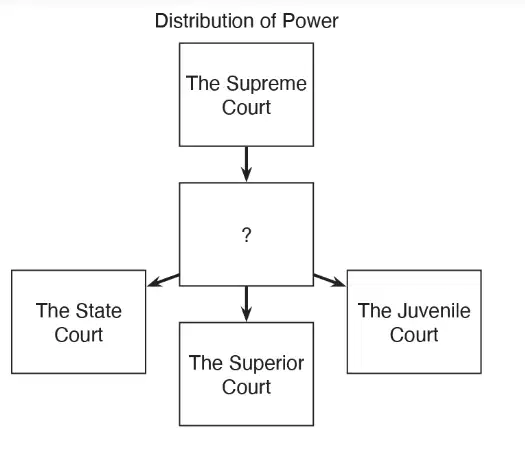
Which of these BEST completes the diagram?
Local Courts
Probate Courts
Court of Appeals
Magistrate Courts
When is concurring opinion written?
when a supreme court justice agrees with the majority decision
when a supreme court justices disagrees with the majority decision
when a supreme court justice cannot decide on a case due to personal reasons
when a supreme court justice votes with the majority but for different reasons
The Supreme Court of the United States is mainly an appellate court, meaning
it cannot hear a case the first time
it is the court used by the military services
it is always allowed to rule on any case it sees fit.
it hears a case after another court has ruled on that case
In legal proceedings, lower courts tend to have original jurisdiction, meaning
they are only allowed to hear cases classified as felonies
they are only allowed to hear cases classified as misdemeanors
they have the right to hear a case for the first time it has been presented in the legal system
they can only hear a case after it has already been argued in a different level of the legal system
Which branch of the federal government is responsible for interpreting the laws of the united States?
Executive
Judicial
Legislative
Treasury
In the Supreme Court decision Marbury v. Madison,
the taxing power of states was limited
the power of "judicial review" was established
the rights of corporations were clearly outlined
the Supreme Court expanded the meaning of eminent domain
The Constitution has been amended 27 times. However, other changes have taken place through interpretation of the Constitution.
Who has the final authority on interpreting the constitution?
the President
the Supreme Court
the executive cabinet
the House of Representatives
The authority to review decisions of lower courts is called
original jurisdiction
appellate jurisdiction
exclusive jurisdiction
concurrent jurisdiction
The Supreme Court rules by a 6 to 3 margin that Andy was wrongfully discriminated against at his place of employment. The six Justices who ruled in favor of Andy may compile their reasoning for the decision in
the majority opinion
the dissenting opinion
a writ of certiorari
an amicus curiae brief
Approximately how many cases is the Supreme Court asked to hear each year?
about 100
about 1000
less than 50
more than 5000
The Second Amendment to the United States Constitution deals with which issue?
Freedom of Religion
the Right to Bear Arms
the Rights of the Accused
Unreasonable Search and Seizure
This is the name given to a written decision by Supreme Court Justices that, while they agree with the final outcome of the case, they do not agree with the reasoning behind the final outcome.
(The answer is either Concurring Opinion, Dissenting Opinion, Original Jurisdiction, ot Appellate Jurisdiction)
(a)
This is the name given to the written decision of a case authored by Justices of the Supreme Court that did not agree with the final decision.
(The answer is either Concurring Opinion, Dissenting Opinion, Original Jurisdiction, ot Appellate Jurisdiction)
(a)
This is the authority of a court to hear a case for the first time.
(The answer is either Concurring Opinion, Dissenting Opinion, Original Jurisdiction, ot Appellate Jurisdiction)
(a)
This is the authority of a court to hear or review a case after it has been decided at a lower level court.
(The answer is either Concurring Opinion, Dissenting Opinion, Original Jurisdiction, ot Appellate Jurisdiction)
(a)
This is the judicial philosophy of using the interpretive power of the courts to current legal injustices. (Is the answer Judicial Activism or Judicial Restraint)?
(a)
This is the judicial philosophy of upholding all previously established laws unless there is a clear violation of the Constitution. (Is the answer Judicial Activism or Judicial Restraint)?
(a)
This was the first decision of the Supreme Court of the United States to declare an act of Congress unconstitutional, thus establishing the doctrine of judicial review.
Marbury v. Madison
Miranda v. Arizona
Gideon v. Wainwright
McCulloch v. Maryland
This is the court case that upheld that the Fifth Amendment privilege against self-incrimination requires law officials to advise a suspect of his rights to remain silent and to obtain a lawyer.
Marbury v. Madison
Miranda v. Arizona
Gideon v. Wainwright
McCulloch v. Maryland
This 1963 Supreme Court case ruled that states are required by the 6th Amendment to provide legal counsel for defendants if they can not afford their own lawyer.
Marbury v. Madison
Miranda v. Arizona
Gideon v. Wainwright
McCulloch v. Maryland
This Supreme Court case upheld the Federal government's use of "implied powers," those that are necessary to keep the government running and are not expressly listed in the Constitution.
Marbury v. Madison
Miranda v. Arizona
Gideon v. Wainwright
McCulloch v. Maryland
In this 1824 case, the Supreme Court upheld the power of the federal government to regulate commerce between states.
Miranda v. Arizona
Gideon v. Wainwright
McCulloch v. Maryland
Gibbons v. Ogden

