
 Worksheets
Benchmark 2 Practice
Total questions: 46
Worksheet time: 1hrs 5mins
What is necessary for photosynthesis?
water
sunlight
chlorophyl
carbon dioxide
al of the above
What are water and carbon dioxide converted into by the end of photosynthesis?
air and sunlight
water and air
sugar and water
sugar and oxygen
Where do people and animals get the oxygen they breathe?
from plants
from other animals
from water
from the sun
What is the science word for turning sunlight into food?
Photosynthesis
Cellular Respiration
Decomposition
Can you remember the three states of matter? Select all three:
Solid
Air
Gas
Water
Liquid
Is a change in a substance's states of matter a physical change or chemical change?
Chemical
Physical
______ is anything that takes up space and has weight.
Mass
Matter
Machine
Music
Which form of matter keeps its shape?
Solid
Liquid
Gas
Which form of matter takes the shape of its container?
Solid
Liquid
Gas
A student completes an investigation, where sand and water are mixed together. The student needs to separate the sand from the water. Which of the following procedures should the student follow?
Pour the mixture through a funnel to separate the sand from the water.
Pour the mixture through a paper filter to separate the sand, and allow the water to flow through to another container.
Pour the mixture into a glass, and use your hand to separate the sand from the water.
Pour the mixture into a bowl, and dip all the water out with a spoon.
A student mixes together iron filings, sand, salt, gravel, and water. Which ingredients will keep all their physical properties after being mixed?
Iron filings, sand, and gravel
Iron filings, sand, and salt
Sand, gravel, and salt
Sand, salt, and water
What do we call a mixture in which one of the substances have dissolved?
Mixture
Solution
Solvent
Solute

What is a natural resource?
A man-made resource made from something in the environment
A substance created in nature
Something that is NOT natural to the environment
Which of the following is NOT a natural resource?
Sun
Rocks
Plants
Clothing
What is a renewable resource?
A resource that can regenerate or be replenished by natural cycles
A resource that exists in a finite amount
A resource that cannot be regenerated or replenished
Which of the following is a renewable resource?
Fossil fuels
Water
Metals
Minerals
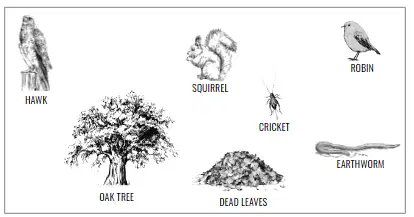
What organisms does the Robin eat?
Cricket and Earthworm
Squirrel and Cricket
Oak Tree and Earthworm
Hawk and Oak Tree

What are food webs?
They are made up of many food chains joined together and interconnected.
They are only plants
They are only animals
the basic unit of an element
Atom
Proton
Neutron
Electron
-that which occupies space and has mass
Molecule
Matter
Mass
Volume
a group of atoms bonded together to make a new substance.
Molecule
Element
Proton
Mass
Which of the following is an example of a chemical change?
Rust forming on your bike.
A popsicle melting in the sun.
Rolling a ball of dough into a flat pizza.
Boiling a pot of water.
Which of the following is an example of a physical change?
Rust forming on your bike.
Sugar turning into caramel.
Rolling a ball of dough into a flat pizza.
Plants changing sunlight, water, and carbon dioxide into
glucose and oxygen.

This model shows which state of matter?
Solid
Liquid
Gas
Plasma
Baking a cake
Chemical Change
Physical Change
Ripping paper
Chemical Change
Physical Change
A _________ is a special kind of mixture where one substance is dissolved in another.
solution
mixture
balance
beaker
When salt dissolves in water _____________.
the salt is still there (the salt is still present)
the salt goes away (the salt is absent)
the salt becomes a solid
the salt evaporates

Sand + water
Solution
Mixture

Trail mix
Solution
Mixture
The more solute a solution has, the more concentrated it is said to be.
True
False
Hot water will dissolve a solute faster than cold water.
True
False
to spread out evenly in a liquid
Evaporation
Dissolve
Magnetic
Solute
Stirring the solute into the solvent has no effect on the rate of dissolving.
True
False
Crushing the sugar cube allows the solute to dissolve faster.
True
False
Concentration is
the amount of solute in the solvent
the amount of solvent in the solute
density
particle size
Which solution is more concentrated?
Solution 1:
500 mL of water
100 g of salt
Solution 2:
500 mL of water
90 g of salt
Solution 1
Solution 2
They have the same concentration
I have no idea
If a person tries to dissolve more sugar into his glass of iced tea, why might the sugar NOT dissolve quickly?
sugar doesn't dissolve in water
there was too much water
the water was too cold
there wasn't enough sugar
Which is the most concentrated solution?
20 g of salt in 200 ml of water
50 g of salt in 100 ml of water
10 g of salt in 200 ml of water
20 g of salt in 100 ml of water

