
NEW
Font size
S
M
L
XL
 Worksheets
Unit 2 - Cycles Influencing Weather and Climate
Total questions: 27
Worksheet time: 37mins
Name
Class
Date
1.
A continuous chain of cause and effect is present everywhere in nature. One such string is the formation of ice. As ice covers a region of land, it reflects sunlight back out through the atmosphere instead of absorbing it as heat. The surrounding air cools, causing more ice to form. What is this particular string an example of?
a)
positive feedback
b)
global cooling
c)
Earth system
d)
water cycle
2.
Kordell and his grandmother love to look for shapes in the clouds. Which sphere interaction results in the formation of clouds?
a)
The atmosphere absorbs water from the biosphere.
b)
The cryosphere melts and becomes part of the atmosphere.
c)
The hydrosphere evaporates and becomes part of the atmosphere.
d)
The geosphere releases water from the aquifer into the atmosphere.
3.
Mount Etna erupted in March 2017. Researchers are studying the effects of the eruption in the vicinity. Which statement best explains what will happen in the area surrounding the volcano?
a)
The atmosphere will absorb the smoke from the eruption, leaving all the other spheres relatively unaffected.
b)
Because all spheres are interconnected, all will experience both positive and negative effects from the eruption.
c)
Even though all spheres are interconnected, the eruption occurred in the geosphere and will only harm the biosphere.
d)
The atmosphere and biosphere will only be affected by the smoke in the atmosphere and the displacing of living creatures in the biosphere.
4.
Lana lives on the coast in Florida and sees a storm warning announcement on the local TV news. The weather map shows that a hurricane is coming toward her city. Which of these is the best way to stay safe during the storm?
a)
Stay indoors.
b)
Evacuate the area.
c)
Stay in a car.
d)
Find lower ground.
5.
In 2016, Hurricane Matthew traveled over the Atlantic Ocean and reached the state of Florida. What happens to hurricanes soon after they reach land away from the ocean?
a)
Hurricanes stop.
b)
Hurricanes speed up.
c)
Hurricanes lose energy.
d)
Hurricanes gain energy.
6.
Energy and matter move throughout Earth’s spheres as interactions occur. Which part of the water cycle would be affected by a change in the biosphere, such as a forest fire?
a)
condensation
b)
evaporation
c)
precipitation
d)
transpiration
7.
When air masses collide in the atmosphere, different types of fronts can form. Which type of front forms when a warm air mass gets caught between two cold air masses?
a)
warm front
b)
cold front
c)
stationary front
d)
occluded front
8.
Darci is hiking on a summer day. As the day heats up, many clouds begin to form in the sky that were not there before. Which explains why the amount of clouds increased?
a)
Precipitation increased.
b)
Condensation increased.
c)
Evaporation increased.
d)
Transpiration increased.
9.
Trace gasses in the atmosphere are not as abundant as nitrogen or oxygen are. However, they play a part in making Earth’s atmosphere one in which life can live. What do trace gasses do in Earth’s atmosphere?
a)
create the greenhouse effect by adding additional carbon dioxide
b)
allow water vapor to remain in the atmosphere
c)
trap solar energy before it escapes to help insulate Earth
d)
suspend smoke and small particles in the atmosphere
10.
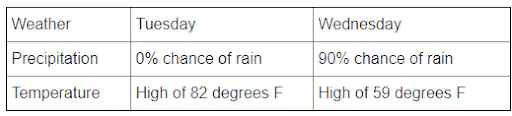
A meteorologist forecasts the weather for the next two days for the city of Middletown.
Which of these might explain the change in the weather overnight?
a)
a warm front
b)
a cold front
c)
continental tropical air mass
d)
continental polar air mass
11.

Warm air is able to hold more moisture than cold air. Marisol checks her weather app and sees the following temperature data.
What will happen to the weather once the temperature reaches the dew point where Marisol lives?
a)
condensation
b)
precipitation
c)
evaporation
d)
transpiration
12.
Local and global winds on Earth are caused by the unequal heating of the atmosphere, land, and oceans. Which of the following is a local wind pattern?
a)
trade winds
b)
sea breeze
c)
polar easterlies
d)
prevailing easterlies
13.
The lifeguards at a local pool want to protect swimmers from sunburn. They conduct a survey to find out the number of people who have received a severe sunburn in the past month. Which is responsible for causing sunburns?
a)
conduction
b)
convection
c)
microwaves
d)
radiation
14.
Wind is great for flying kites and drying clothes outdoors, and it is also an important source of renewable energy. What causes wind to form?
a)
Earth’s rotation
b)
air pressure
c)
Coriolis effect
d)
prevailing westerlies
15.
Global wind belts are formed from the unequal heating of Earth’s surface and the rotation of Earth. What is the result of Earth’s rotation on global wind patterns?
a)
sea breezes
b)
El Niño and La Niña
c)
land breezes
d)
Coriolis effect
16.
Ocean currents can move across the surface of the ocean or move thousands of feet below the surface. What causes the movement of currents deep below the surface of the ocean?
a)
wind
b)
climate
c)
density
d)
Earth’s rotation
17.
The atmosphere reflects some of the sun’s energy, absorbs some, and traps some near Earth’s surface. Most scientists think that human activity has been enhancing the greenhouse effect. There is evidence that increasing temperatures are causing the sea level to rise and polar ice caps to melt. Which of these explains the greenhouse effect on Earth?
a)
Energy is absorbed into space.
b)
Energy is released from land.
c)
Energy is reflected in oceans.
d)
Energy is trapped in the atmosphere.
18.
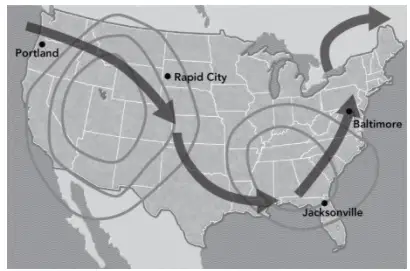
A local meteorologist displays a map of a jet stream traveling across the United States. The jet stream is a fast-moving current of air found high in the troposphere. The meteorologist predicts that the jet stream will move south of Baltimore in the next few days.
What kind of weather will the jet stream most likely bring to Baltimore?
a)
dry, clear weather
b)
no change in weather
c)
cold, snowy weather
d)
warm, rainy weather
19.
A student makes a model by taking ice water, placing it in a large container and covering it up. He waits about five minutes and then slips his hand under the cover to feel the air above the ice water. His hand feels cold and damp. Which type of heat transfer does his model represent?
a)
radiation
b)
convection
c)
thermal
d)
conduction
20.
Mr. Hank’s goal is to climb to the top of Mt. Everest. He trains for months and does extensive research on the local climate to prepare for the climb. Which of the following occurs as Mr. Hank gets closer to the top of the mountain and the altitude increases?
a)
temperature decreases
b)
pressure increases
c)
humidity increases
d)
temperature increases
21.
Earth’s atmosphere allows life to thrive by keeping temperatures suitable for organisms to live here. Which of the following keeps thermal energy from radiating into space?
a)
tropical air masses
b)
carbon dioxide
c)
greenhouse effect
d)
global warming
22.
Jun lives in a state that has a humid subtropical climate. Which factor affects the climate of a given area?
a)
population of the state
b)
the current temperature
c)
the distance from the ocean
d)
precipitation from the last storm
23.
The Gulf Stream moves along the eastern coast of the United States. What effect does it have on weather conditions along the eastern coast?
a)
It brings warmer water to the Atlantic Ocean, which creates convection currents along the coast.
b)
It brings warmer water to the Atlantic Ocean along the coast and influences the air masses over the water.
c)
It brings cooler water to the Atlantic Ocean and influences the air masses over the water.
d)
It brings cooler water to the Atlantic Ocean, which creates convection currents along the coast.
24.
Deon understood that global warming would cause polar ice caps and glaciers to melt. This in turn would cause sea levels to rise. What additional effects would a warming climate have on Earth?
a)
changing weather patterns and different environmental conditions
b)
increasing carbon dioxide in the atmosphere and the reduction of other gasses
c)
different forms of plant life and new animals
d)
changes in the behavior of animals and decreased atmospheric changes
25.
Luisa had an opportunity to travel to Brazil, and she was able to observe some of the lush rainforests and wildlife there. Why does Brazil have so many acres of rainforest compared to other regions?
a)
It receives indirect sunlight.
b)
It has high mountains.
c)
It lies on the equator.
d)
It has days and nights that are equal in length.
26.
The burning of fossil fuels puts additional carbon dioxide into the atmosphere. Under ordinary circumstances, the amount of carbon dioxide in the atmosphere is balanced. Carbon cycles through the land and oceans and is absorbed during photosynthesis. What effect would upsetting the balance of this cycle have on Earth?
a)
an unchanged atmosphere
b)
increase in greenhouse effect
c)
greenhouse effect reduction
d)
loss of amounts of oxygen in the atmosphere
27.
A warming climate melts ice, including the ice tied up as permafrost on the tundra. Which effect is a result of the melting permafrost?
a)
decreased sea levels
b)
an even warmer climate
c)
loss of food for tundra animals
d)
reduced activity in the water cycle
Reset

