
 Worksheets
Sedimentary Processes and Fossils
Total questions: 28
Worksheet time: 28mins
Which of the following is MOST likely to become a fossil that is preserved on Earth?
A jellyfish preserved in lava (Ha! Gotta laugh at this one)
A shark tooth preserved in mud that becomes shale
A land mammal that dies on land in mud that eventually becomes mud
A polar bear who dies and is frozen in glacial ice
Fossil remains are most likely to be found in which type of rock?


The organisms never die, they live forever

The organism died and was buried at the same time the sediment was accumulating only later to become rock.
If the same species of terrestrial (land) reptile was found in Africa and South America, what could this evidence support?
the used to be a land bridge between Africa and South America
That reptiles swam accross the ocean
Africa and South America used to be joined together
humans moved the reptiles from one continent to the other and placed them into the rock.
To become fossilized an organism needs to be (2 answers)
have a large body size
buried very slowly
contain hard parts
buried quickly
True or False: All dinosaurs in museums are made of original remains?
False
True
What is the study of fossils called?
Archaeology
Geology
Paleontology

What type of fossil preservation MOST LIKELY took place in order for us to have this:
Trace Fossils
Mineral Replacement
Casts/Molds
Original Remains
The Geologic Time Scale has recorded 'life' in the form of fossils that strongly support which major concept?
The concept of Extinction
The theory of Evolution
The force of gravity
String theory (physics)

Scientist study the ____________________ to learn about the history of life, past environments on Earth, and how different groups of organisms have changed over time.
fossil record
animal record
historical record
Earth record
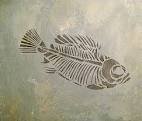
that the rock that formed this fossil was covered by water
Which of the following terms is the science of dating fossils based on what rock layer they are found in?
Radiometric dating
Stratigraphy
Geology
Fossilography

In which layer did fossil C come into existence? How do you know this?
Layer 1-Because that is the layer it is first seen
Layer 1- Because that is the last layer it is seen in
Layer 2- Because that is the layer it is first seen
Layer 2- Because that is the last layer it is seen in

Fossil A is an ancient mollusk, an organism that needs water to survive. Why do you think that the mollusk went extinct in this particular sample of the fossil record?
When the ocean levels rose in layer 4, the mollusk went extinct because they cannot live in water
For some reason, the ocean disappeared causing the mollusk to thrive
For some reason, the ocean disappeared causing the mollusk to go extinct
When the ocean level rose in layer 4, the mollusk thrived because they need water

What are the oldest fossils and why?
B, C- because they are closest to the top
A, B- because they are closest to the bottom
They are all the same age- because they are all found on layer 2
A, B- because they are found closest to the top

Why are similar fossils found all over the world?
The animals swam to new parts of the world before going extinct
The land masses were once connected
The organisms were transported to different areas of the world
They are not similar fossils.

Which organism went extinct before gastropods evolved?
Trilobite
Crinoid
Fern
Ammonite

Use relative age dating to put the rock layers in correct order from oldest to youngest.
B, D, A, E, C
C, E, D, A, B
A, C, E, D, B
C, E, D, B, A

Which is the youngest rock layer?
Siltstone
Conglomerate
Mudstone
Limestone

