wayground logo

Free Printable Worksheets

Font size

S
M
L
XL
Worksheets

Bio Test 3 Review

Total questions: 32

Worksheet time: 59mins

Name
Class
Date
1.
In a tall tree, water is carried high above the roots using the sticky nature of water molecules. The water molecules stick to the xylem, which is the tube that carries water up to the parts of the tree. The tree  would not get much water to its leaves if the water molecules could stick to the xylem but could not stick to each other as well. This important property of water, also due to polarity, allows all water molecules to form bonds with each other and is responsible for surface tension and capillary action. What is the property of water that allows its molecules to stick to each other?
a)
adhesion
b)
cohesion
c)
high specific heat capacity
d)
hydrogen bonding
2.

In Jacksonville Beach, the average daytime and nighttime temperatures usually only differ from 7-8oC, while temperatures in Ocala can differ as much as 12-15oC. What role does water play in keeping temperatures from fluctuating dramatically?

a)
Water is an Acid
b)
Water acts as a buffer
c)
Water is a versatile solvent
d)
Water has a high heat capacity
3.
All living things need to transport molecules from one place to another in order to carry out necessary life functions.Living things often transport these molecules by dissolving or dissociating them in water and then moving the resulting solution from place to place.What characteristic must a molecule have for it to form a solution in water?
a)
It must be at least as small as the polar water molecules
b)
It must contain hydrogen or oxygen to bond to part of the water molecule.
c)
It must be polar to be able to react with the polar water molecules.
d)
It must be covalently bonded in order to form new bonds with the polar water molecules
4.
This macromolecule comes in a variety of shapes and sizes, each with its own unique job in your body. They are not only the most abundant macromolecules in your body, but they are also the most diverse. Some give your cell shape or help them move. Some act as channels to move materials in and out of your cells while others are used for signaling and communication between cells. Some can be broken down by the body and used to build muscles and others are responsible for building and breaking down other molecules. This macromolecule is also responsible for carrying out all chemical reactions that take place in your body. What type of macromolecule is this?
a)
Carbohydrates
b)
Lipids
c)
Proteins
d)
Nucleic acids
5.
An organic chemist is studying a sample of a macromolecule. The compound has carbon, hydrogen, and oxygen in its structure. The physical properties of the compound show it is nonpolar and doesn’t dissolve in water. When placed in a calorimeter, it appears to have a long energy storage capacity. Which of the four types of biological macromolecules was the scientist most likely studying? 
a)
Carbohydrates
b)
Lipids
c)
Proteins
d)
Nucleic acids
6.

Match the structure to the appropriate macromolecule

a)

1.

Carbohydrate

b)

2.

Lipid

c)

3.

Protein

d)

4.

Nucleic Acid

7.
Enzymes are found in many different environments and can take on many different shapes and sizes.  Many enzymes have certain optimum conditions.  Some prefer certain temperatures, while others prefer certain pH levels. What could happen to an enzyme if a large change in temperature of pH level occurs?
a)

The enzyme will work normally

b)
The enzyme will adapt to its environment and continue to function at 90% efficiency
c)
The enzyme will alter its chemistry and become saturated
d)
The enzyme may become denatured and could stop functioning
8.
The human body maintains a temperature of around 98.6 degrees at all times. Enzymes are involved in almost every chemical reaction in the body. Which of the following describes the connection between these two statements?
a)
Enzymes function best at a specific temperature.
b)
The body needs to be warm to prevent hypothermia.
c)
The body is kept relatively warm to prevent too much enzyme action.
d)
There is no connection between the two statements.
9.
A template strand of DNA has the following sequence: TAC  GGA  TAA  CTA  CCG  GGT  ATT  CAA What would be the sequence of the expected complementary strand of mRNA?
a)
AUG  CCU  ATT  GAU  GGC  CCA  UAA  GTT
b)
AUG  CCU  AUT  GAU  GGC  CCA  UAA GUT
c)
AUG  CCU  AUU  GAU  GGC  CCA  UAA  GUU
d)
AUG  CCT  ATT  GAU  GGC  CCU  UAA  GUU
10.
DNA originally contains two parent strands, each forming one side of the double helix. After replication, each of these parent strands is copied into a daughter strand, so the overall result is 2 identical daughter cells. The process of DNA replication. In a semi-conservative model of DNA replication, which of the following is true?
a)
The daughter DNA molecule consists of 1 parent strand and 1 new strand
b)
The daughter DNA molecule consists of 2 newly formed strands
c)
The daughter DNA molecule consists of 2 parent strands
d)
The daughter DNA molecule consists of 2 parent strands
11.
Why is it necessary for DNA to replicate?
a)
To transmit the enzyme polymerase to replicate the strands of DNA.
b)
To transmit the nitrogenous bases for base pair sequences.
c)
To transmit and conserve genetic information.
d)
To make complementary strands of DNA in all living organisms.
12.
If the ribosomes of a cell were destroyed, what effect would this most likely have on the cell?
a)
It would simulate mitotic cell division.The cell would be unable to synthesize proteins.
b)
The cell would be unable to synthesize proteins.
c)
Development of abnormal hereditary features would not occur in the cell.
d)
Increased protein absorption would occur through the cell membrane.
13.
During the process of photosynthesis, chlorophyll within the leaves of plants captures light energy from the Sun to produce simple sugars. What gas is released into the air as a byproduct of photosynthesis?
a)
nitrogen
b)
argon
c)
carbon dioxide
d)
oxygen
14.
Two different species of bacteria are examined. Scientists find that species X always produces CO2 and H2O during cellular respiration. Species Y always produces ethyl alcohol and CO2. Which conclusion can be made from these observations?
a)
Only species Y is aerobic.
b)
Only species Y is anaerobic.
c)
Both species X and Y are aerobic
d)
Both species X and Y are anaerobic.
15.
ATP synthase is an enzyme that helps convert ADP into ATP in muscle cells. Which of the following would be increased by increasing ATP synthase?
a)
the amount of energy available
b)
the amount of energy released
c)
the number of mitochondria
d)
the number of cell divisions
16.
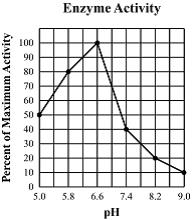
Which of the following conclusions can be drawn from this graph?
a)
The optimum pH of the enzyme is 6.6.
b)
The optimum pH of the enzyme is 5.8
c)
The enzyme’s activity increases as pH increases 5.0 to 9.0
d)
The enzyme’s activity is greater around pH of 8.0 .
17.

 Which of the following would most likely to be found in the stomach?

a)

chymotrypsin

b)

pepsin

c)

cholinesterase

d)

papain

18.

The picture below shows the steps of DNA replication beginning with step one and ending with step three.


​Because you are reusing the old, or parent, DNA strand DNA replication is said to be

a)

Semi- Conservative

b)

Semi-discontinuous

c)

Continuous

d)

Fully-Conserveative

19.
Which sequence of DNA bases would pair with this partial strand
CAT TCA CTG
a)
ATG TGA CAG
b)
TAC ACT GTC
c)
GTA AGT GAC
d)
CAT TCA CTG
20.
Genetic info flows in one direction. Which best represents this flow?
a)
DNA-protein-RNA
b)
Protein-RNA-DNA
c)
RNA-protein-DNA
d)
DNA-RNA-protein
21.

Use your codon chart to match the mRNA CUU to the correct amino acid

a)

VAL

b)

TYR

c)

LEU

d)

PHE

22.

Use your codon chart to match the mRNA ACU to the correct amino acid.

a)

Thr

b)

Ala

c)

Val

d)

Gly

23.

Use your codon chart to find the amino acid that codes for the mRNA codon GCA

a)

Thr

b)

Ala

c)

Pro

d)

Ser

24.

What products are released at "D" in the diagram?

a)

Carbon Dioxide & Glucose

b)

Glucose & Water

c)

Water & Oxygen

d)

Carbon Dioxide & Water

25.
What is the formula for photosynthesis?
a)
Carbon dioxide + Water → Glucose + Oxygen
b)
Glucose + Oxygen
→ Carbon dioxide + Water
c)
Carbon dioxide + Glucose
→ Oxygen + Water
d)
Carbon dioxide + Oxygen
→ Glucose + Water
26.
Which cells are responsible for opening and closing stomates to regulate water loss & gas exchange?
a)
Guard Cells
b)
Gate Cells
c)
Vascular Cells
d)
Root Cells
27.
How would you describe cellular respiration?
a)
Sunlight and CO2 make ATP
b)
ATP and O2 are used to make sugars
c)
Carbon-based molecules from food and oxygen are used to make ATP
d)
ATP and CO2 are used to make ADP and Water
28.

Which organelle is responsible making food (Glucose) using sunlight?

a)

Cell Membrane

b)

Nucleus

c)

Chloroplast

d)

Mitochondria

29.

This part of the plant is where photosynthesis occurs.

a)

b)

c)

30.
What is a small opening in leaves that allows gases to pass in and out of a plant?
a)
cell plate
b)
petiole
c)
stomata
d)
trichome
31.

For flowering plants to reproduce sexually, male gametes must be transferred to female ovules during pollination. What is one structure of the plant that makes this possible?

a)

The long filaments transport the pollen to the ovary.

b)

The anthers protect the ovule until pollination

c)

The stigma is often sticky and traps pollen.

d)

The sepals disperse pollen into the air.

32.

Label the parts of the flower.