
 Worksheets
2023 Env. Science Midterm Review
Total questions: 180
Worksheet time: 2hrs 27mins
What is the purpose of developing alternative energy sources?
To increase energy costs
To deplete natural resources
To reduce pollution
To increase dependence on fossil fuels
Which factors should be considered when defining problems associated with energy and mineral resources?
Economic costs only
Economic, social, and environmental costs
Social costs only
Environmental costs only
What are renewable resources?
Resources that are harmful to the environment
Resources that cannot be replenished
Resources that are naturally replenished
Resources that can be used only once
What are nonrenewable resources?
Resources that cannot be replenished
Resources that are unlimited in quantity
Resources that can be used only once
Resources that are harmful to the environment
Which type of resource is important for humans?
Neither renewable nor nonrenewable resources
Both renewable and nonrenewable resources
Nonrenewable resources
Renewable resources
What is the main benefit of using alternative energy sources?
Reduced greenhouse gas emissions
Depletion of natural resources
Decreased deforestation
Higher energy costs
Which of the following is a renewable energy source?
Solar power
Natural gas
Nuclear power
Coal
Which of the following is a nonrenewable energy source?
Oil
Wind power
Hydroelectric power
Geothermal power
What is a disadvantage to the economy associated with using alternative energy sources?
Lower energy costs
Decreased energy efficiency
Higher initial investment
Increased job opportunities
What is a disadvantage to the environment associated with using alternative energy sources?
Enhanced biodiversity
Increased habitat destruction
Decreased water pollution
Reduced carbon footprint
Which of the following is an example of conserving energy?
Leaving lights on when not in use
Using energy-efficient appliances
Driving a gas-guzzling car
Wasting water
What is the main benefit of recycling mineral resources?
Lower production costs
Reduced waste and pollution
Higher energy consumption
Increased resource depletion
Which of the following makes recycling challenging?
Decreased pollution
Reduce our use of resource
Reduce waste
Contamination of materials
Organize these options into the correct energy category.
Solar
Wind
Hydroelectric
Oil
Natural Gas
Coal
Nuclear
Biomass
Geothermal
Which of the following is NOT a cause of the temperature difference between urban and rural area?
More vegetation in urban area
Close to the sea
Urbanization
Weather condition
What is the definition of urban heat island?
Urban heat island refers to the phenomenon where rural areas experience higher temperatures compared to surrounding urban areas.
Urban heat island refers to the phenomenon where urban areas experience lower temperatures compared to surrounding rural areas.
Urban heat island refers to the phenomenon where urban areas experience higher temperatures compared to surrounding rural areas due to natural factors.
Urban heat island refers to the phenomenon where urban areas experience higher temperatures compared to surrounding rural areas due to human activities and the built environment.
What are the causes of urban heat island effect?
Low concentration of buildings and pavement, abundance of vegetation, and lack of waste heat from human activities.
High concentration of buildings and pavement, abundance of vegetation, and lack of waste heat from natural sources.
Low concentration of buildings and pavement, lack of vegetation, and waste heat from natural sources.
High concentration of buildings and pavement, lack of vegetation, and waste heat from human activities.
Urban heat island effect impacts the environment by (a) .
What are the impacts of urban heat island effect on human health?
Decreased risk of heat-related illnesses and improvement of existing health conditions.
No impact on human health.
Increased risk of heat-related illnesses and worsening of existing health conditions.
Increased risk of cold-related illnesses and improvement of existing health conditions.
How does urban heat island effect contribute to climate change?
By increasing temperature, energy consumption, greenhouse gas emissions, and reducing air quality.
By having no effect on temperature, energy consumption, greenhouse gas emissions, and air quality.
By decreasing temperature, energy consumption, greenhouse gas emissions, and improving air quality.
By reducing temperature, energy consumption, greenhouse gas emissions, and improving air quality.
What are some strategies to mitigate urban heat island effect?
Installing more asphalt and concrete surfaces
Increasing green spaces and vegetation, implementing cool roofs and pavements, using reflective materials, improving urban planning and design, and promoting energy-efficient buildings.
Increasing the use of air conditioning
Building taller and denser structures
How does the urban heat island effect vary in different cities?
The urban heat island effect is determined by the number of buildings in a city.
The urban heat island effect is influenced by the amount of green space in a city.
The urban heat island effect varies based on factors such as population density, land use patterns, and geographical location.
The urban heat island effect is the same in all cities.
What are the long-term consequences of urban heat island effect?
No impact on energy consumption, air pollution levels, human health, or ecosystems.
Increased energy consumption, higher air pollution levels, compromised human health, and negative impacts on ecosystems.
Decreased energy consumption, lower air pollution levels, compromised human health, and positive impacts on ecosystems.
Decreased energy consumption, lower air pollution levels, improved human health, and positive impacts on ecosystems.
What are some urban planning techniques to reduce urban heat island effect?
Constructing more high-rise buildings to increase air circulation
Using dark-colored materials for roofs and pavements to absorb more heat
Increasing green spaces and vegetation, implementing cool roofs and pavements, promoting energy-efficient buildings, and creating shade through urban design.
Removing all trees and vegetation to reduce heat absorption
How can individuals contribute to reducing urban heat island effect?
By cutting down trees
By increasing energy consumption
By using dark-colored surfaces
By planting trees, using light-colored surfaces, promoting green roofs and walls, and reducing energy consumption.
How can individuals contribute to reducing urban heat island effect?
By cutting down trees
By increasing energy consumption
By using dark-colored surfaces
By planting trees, using light-colored surfaces, promoting green roofs and walls, and reducing energy consumption.
Select all that are correct.
Select two correct downsides of urbanization
Opportunity - Careers & Education
Safety - Police, Fire, Medical
Air Quality - Air quality is much more polluted in cities
Efficiency - Everything is spread far apart
Heat Islands - Cities are warmer than surrounding areas
Select all that are correct.
Select two correct benefits of urbanization
Opportunity - Careers & Education
Safety - Police, Fire, Medical
Air Quality - Air quality is more clean in cities
Efficiency - Every is spread far apart
Heat Islands - Cities are warmer than surrounding areas
Urbanization is the trend where....
people move from rural areas to urban areas
animals move from rural areas to urban areas
people build a city from natural resources
beavers build a dam, creating their own habitat

All of the following are effects of urban sprawl EXCEPT ___.
increased pollution
increased physical inactivity
decreased mass transit options
decreased land use
Rapid expansion of a city into the countryside around the city
Urbanization
Urban Sprawl
Urban
Rural

In Stage 1, the birth rate is...
High
Falling
Low

In Stage 1, the death rate is...
High
Falling
Low

In Stage 1, the Total Population is (a) .
In Stage 1, the Population Pyramid looks like...


In Stage 2, the Death rate is (a) .

In Stage 2, the Total Population is...
Growing Slowly
Growing Quickly
Not Growing
In Stage 3, the Population Pyramid looks like...


In Stage 4, the Birth rate is...
High
Rising
Low

Which correctly describes the term demographic transition?
The transition from low birth rates and death rates to high birth rates and death rates as a country develops.
The transition from high birth rates and death rates to low birth rates and death rates as a country develops.
The transition from high birth rates to low death rates as a country develops.
The transition from low birth rates to high death rates as a country develops.

What happens if a population grows past its carrying capacity?
The population keeps growing
The population starts to die off
The entire species will go extinct
The carrying capacity just increases

So what is likely to happen over the next few decades with this population?
Rapid Growth
Slow Growth
The population will decrease.
This type of farming (of many particular kinds in different eras and places) is considered to be the original type of agriculture, and has been practiced for thousands of years
Bio-dynamic farming
Traditional farming
Integrated farming
Organic farming
(a) are substances or mixture of substances intended for preventing, destroying, repelling, or mitigating any pest
_________ is a production system that sustains the health of soils, ecosystems, and people. It relies on ecological processes, biodiversity, and cycles adapted to local conditions, rather than the use of inputs with adverse effects
Conventional agriculture
Integrated agriculture
Organic agriculture
Market agriculture
A large-scale farming operation that practices monoculture is which of the following?
Community farming
Traditional farming
Organic farming
Industrial farming
This type of agriculture relies on human and animal labor.
Industrial agriculture
Traditional agriculture
Organic agriculture
Community agriculture
This type of agriculture produces 80% of the worlds food supply.
Industrial agriculture
Traditional agriculture
Organic agriculture
Community agriculture
High Cost
In organic agriculture even natural fertilizers cannot be used.
True
False
Traditional agriculture mainly takes place in
less-developed countries
more-developed countries
Which of the following is not a benefit of GMOs
Increases pest resistance
Decreases biodiversity
Increases drought resistance
Reduces cost of manufacturing

2. What problem did The Green Revolution attempt to solve?
They didn’t solve anything.
The problem the green revolution attempted to solve was biotechnology.
The problem the green revolution attempted to solve was hunger.
The problem the green revolution attempted to solve was world peace.

4. According to the GRAPH, did India's GRAIN production increase or decrease?
YES India's GRAIN production increased.
NO India's GRAIN production decreased.
NEITHER India's GRAIN production increased or decreased.

Which statement about 1961 to 2011 is best supported by the graph?
Food scarcity improved in both Asia and Africa
Green Revolution techniques worked better in Asia than in Africa
Population growth was higher in Africa than in Asia
Green Revolution techniques worked well in both regions but slowed down dramatically
Millet and rice are not very important food sources for either region, indicating that a conclusion about food security is invalid
Between 1950 and 1990, wheat production in India in average pounds per acre more than tripled, which allowed India to meet its population's need for food. Which of the following best explains this change?
The elimination of poverty in India's rural regions
The use of genetically modified seeds
The increase of microloan programs that provide farmers with credit
The use of large farm tractors and combine harvesters
The use of improved plant hybrids and agricultural chemicals.
Which is NOT a part of soil makeup/texture?
Sand
Shale
Silt
Clay

Select examples of GMOs from the list below. (Select all that apply.)
Maize
Canola oil
Cotton
Papaya
Disadvantages of Industrialized Agriculture include
Monoculture
Pollution
Low Yield
Labor Intensive
Disadvantages of Organic Agriculture include
High Cost
Pollution
Low Yield
Labor Intensive
What pet is the first organism that was genetically modified through human interactions
(a)
What evidence can support the claim that GMOs have a positive impact?
What evidence can support the claim that GMOs have a negative impact?
As soil matures, it becomes
Deeper
Sandier
Thinner
It doesn't change
which of these are not true about topsoil?.
it is a very soft layer
most living organisms are present in this layer
it has almost no nutrients
none of these
The type of rock formed when old rocks are weathered and the pieces that
break off are cemented together into new rock.
igneous
metamorphic
sedimentary
The type of rock formed when heat and pressure change an old rock into a new
type of rock.
igneous
metamorphic
sedimentary
The type of rock that may contain fossils.
igneous
metamorphic
sedimentary
Metamorphic rocks are rocks that have been changed from heat and pressure.
True
False
The cycle of old rocks turning into new rocks is called_____.
the mineral cycle
the fossil cycle
the sedimentary cycle
the rock cycle
All types of rock can potentially change from one type to another at some point on the rock cycle.
True
False

According to the diagram, how does a sedimentary rock become a metamorphic rock?
Weathering and Erosion
Heat and Pressure
Compaction and Cementation
Melting

When heat or pressure causes one rock to change into a new type of rock, we call these rocks _____.
Igneous
Sedimentary
Metamorphic
Mineral

According to the diagram, how does magma become an igneous rock?
Melting
Cooling
Heat and Pressure
Compaction and Cementation
Metamorphic rocks form through
added pressure
added temperature
added pressure and temperature
none of the above
Florian discovers a rock that is broken into pieces. Each piece has several bands. Which type of rock does Florian predict these pieces will change into when subjected to heat and pressure?
igneous
magma
sedimentary
metamorphic

This image shows the rock cycle. Which event most likely occurs at point K?
cooling
cementing
melting
weathering
_________ rocks harden into rock layers due to pressure of water and weight of more sediments.
Metamorphic
Igneous
Sedimentary
Volcanic

At which location would heat and pressure occur?
1
2
3
4

Which location represents melting magma?
1
2
3
4
On sunny summer days, a breeze often develops that blows from large bodies of water toward nearby land masses because the
temperature of the air above the land masses is greater
specific heat of the land masses is greater
temperatures of the bodies of water are greater
air over the bodies of water becomes heavier with additional water vapor

The arrow above the water is coming down and is blue because
the water is warm so it warms the air and warm air sinks.
the water is cold so it warms the air and cool air sinks.
the water is cold so it cools the air and cool air sinks.
the water is warm so it warms the air and cool air sinks.
Which statement correctly defines wind?
The movement of air from areas of low pressure to areas of high pressure
The movement of air to a colder area in the atmosphere.
The movement of air from areas of high pressure to areas of low pressure.
The movement of air pushed around and bouncing off Earth's surface.
What causes differences in air pressure?
even heating of the Earth
Even cooling of the earth
uneven heating of the earth
global warming
What is Global Warming?
Increasing temperature in Earth's atmosphere
Decreasing temperature in a city
Increasing rain rates in Earth
Decreasing temperature rates
by causing it to rain less often

How is the greenhouse effect produced?
When solar energy trespasses the atmosphere.
When some energy is reflected back to earth.
When the green house is burned.
When the sun doesn't emit radiation.
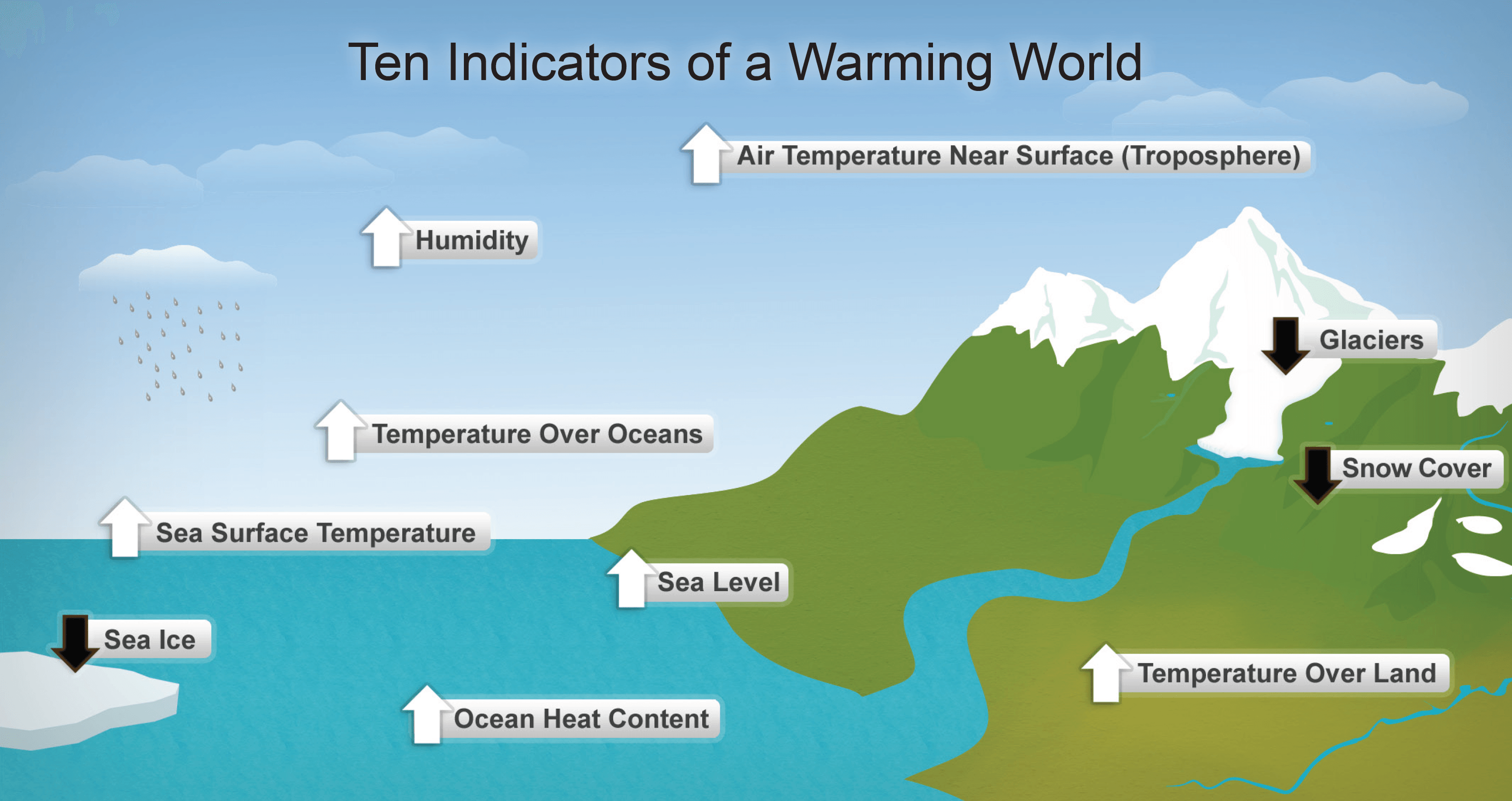

Weather fronts usually cause clouds and precipitation
True
False

What type of front does this symbol indicate?
Warm Front
Cold Front
Stationary Front
Occluded Front

What type of front does this symbol indicate?
Warm Front
Cold Front
Stationary Front
Occluded Front
What type of front causes thunderstorms in the summer?
Warm
Cold
Stationary
Occluded
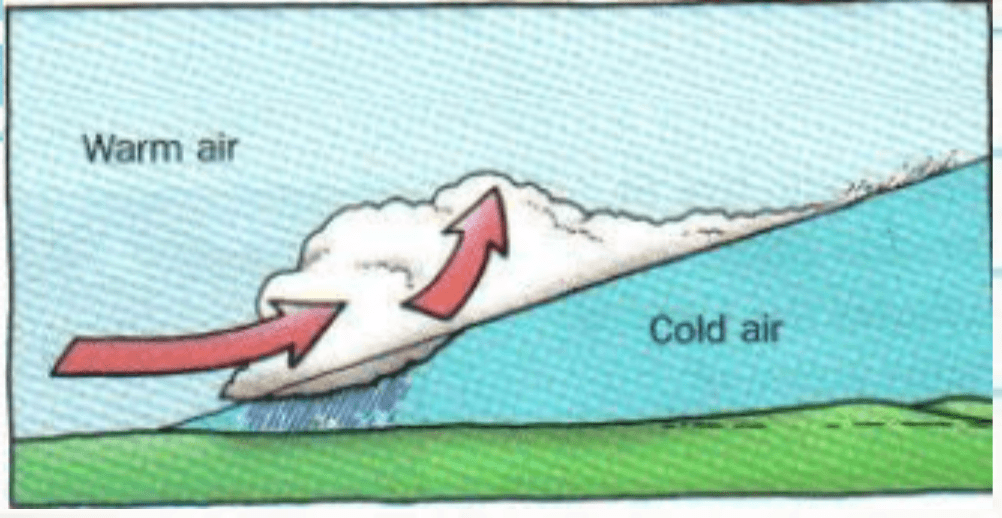
Name that front.
Cold Front
Warm Front
Stationary Front
Occluded Front
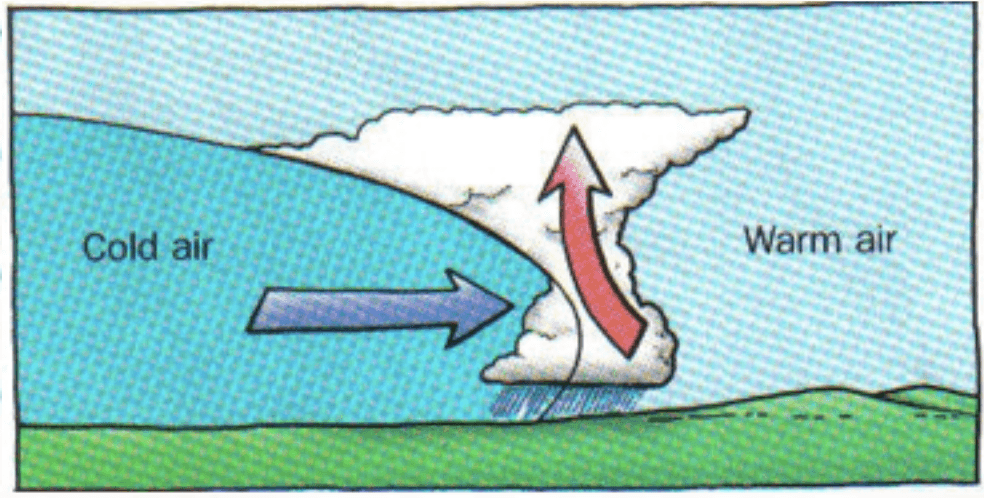
Name that front.
Cold Front
Warm Front
Stationary Front
Occluded Front
What kind of weather happens along a Warm Front?
Thunderstroms
Days of Rain!
Nothing
Wind
Earth --- around the Sun.
rotates
revolves
One complete spin on Earth's axis is a ---.
rotation
revolution
It takes Earth ___ to revolve around the sun.
1 day
365 1/4 days
one year
24 hours
At what angle is Earth titled?
90 degrees
23.5 degrees
29 degrees
What season is it in the southern hemisphere when the northern hemisphere is experiencing summer?
summer
spring
winter
fall
When does summer begin in the northern hemisphere?
December 21
March 20
June 21
September 22


If a diagram shows the Earth's movement around the Sun. What is this diagram demonstrating?
day and night
seasons


The Earth sits straight up and down (NO TILT).
true
false


What season in the Northern Hemisphere is represented by this diagram?
Fall
Summer
Winter
Spring

What date is represented by this diagram?
March 21st
September 23rd
June 21st
December 21st

What season in the Northern Hemisphere is represented by this diagram?
Spring
Fall
Summer
Winter

What date is represented by this diagram?
June 21st
March 21st
December 21st
September 23rd

What two seasons would be represented by this diagram?
Spring and Summer
Spring and Winter
Fall and Spring
Fall and Winter

Which location appears to be receiving more direct (and thus intense) insolation?
a
b

What statement best represents this relationship?
As the angle increases, the temperature decreases.
As the angle increases, the temperature increases.
As the angle decreases, the temperature increases.
There is no relationship.

January is when Northern Hemisphere is at closest distance to the Sun. Why Northern Hemisphere experience winter on this month?
Sun is ejecting less solar radiation.
Humans burn less fossil fuels during winter.
Greenhouse effect is lessened during winter months.
Northern Hemisphere is receiving very little solar radiation due to Earth's tilt.
It cause unequal heating of the earth that leads to four seasons
rotation
revolution
tilted Earth
solar radiation
Which type of plate boundary would cause mountains to form?
Transform
Convergent
Divergent
Reform


Which of the following choices best describes the diagram?
This is a divergent boundary between two continental plates.
This is a divergent boundary demonstrating sea floor spreading.
This is a convergent boundary resulting in the subduction of one plate under the other.
This is a transform boundary where an Earthquake will occur.

According to the diagram, why did a volcano form?
A continental plate melted and subducted under an ocean plate.
An oceanic plate melted and subducted under a continental plate.
Two plates of equal density collided and created a mountain.
An oceanic plate diverged from a continental plate.
Organize these options into the right categories.
Two plates separate from one another
Two plates collide
Two plates sliding past each other
Results in valleys
Results in mountains
Results in volcanoes
Results in Earthquakes
Creates new oceanic crust via sea floor spreading
Where subduction occurs
What type of plate boundary is responsible for the creation of new crust?
Transform
Convergent
Divergent
None of the above
What is the process called when an oceanic plate subducts beneath a continental plate?
Convection
Subduction
Divergence
Convergence
What is the result of a divergent boundary between two oceanic plates?
Formation of mountains
Formation of deep sea trenches
Formation of a new sea floor
Formation of earthquakes
What is the result of the collision between two continental plates?
Formation of a deep sea trench
Formation of a mountain range
Subduction of one plate
Both plates are destroyed
What happens at a CONVERGENT BOUNDARY between an oceanic and a continental plate?
The oceanic plate subducts and forms a trench
The continental plate subducts and forms a mountain range
Both plates move sideways
Both plates move apart
What type of plate boundary is represented by the San Andreas Fault?
Divergent
Convergent
Transform
None of the above
What happens at a convergent boundary between two continental plates?
Formation of deep sea trenches
Formation of a new sea floor
Formation of mountains
Formation of earthquakes
What is the primary cause of plate tectonics?
Gravitational forces
Convection currents in the mantle
Rotation of the Earth
Magnetic field of the Earth
What happens when an oceanic plate collides with a continental plate?
Both plates are destroyed
Formation of a mountain range
Subduction of the oceanic plate
Formation of a deep sea trench
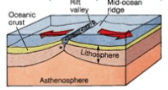
divergent
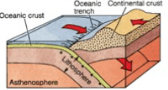
convergent
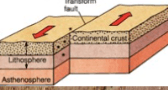
transform

The formation of Philippine achipelago is the result of the ___________?
Continental-oceanic convergence
Continental-Continental Convergence
Oceanic-Oceanic Convergence
Oceanic-Continental Convergence
Match the landform that is found at each boundary
Continental-continental convergent
Mountains
Continental-oceanic convergent
Continental volcano arc
Oceanic-oceanic convergent
Volcanic island arc
Continental-continental divergent
Rift valley
Oceanic-oceanic divergent
Mid-ocean ridge

