
 Worksheets
FL USH EOC Practice Part 2
Total questions: 18
Worksheet time: 9mins

What was one of the arguments used in favor of these changes seen on the timeline above?
American industries need raw materials and markets found overseas.
The system of imperialism is contrary to American democratic principles.
Colonial peoples are inviting American leadership to develop their economies.
Imperialist expansion threatens to bring the U.S. into conflict with European powers.

How did this event contribute to the United States' entry into the Spanish-American War?
It led to anti-government demonstrations in the U.S.
It enraged Cuban Americans in Florida who had lost their relatives.
It revealed that the U.S. needed to have colonies in the Caribbean.
It became difficult for President McKinley to resist demands to intervene in Cuba.
“We hold that the policy known as imperialism is hostile to liberty and tends toward militarism, an evil from which it has been our glory to be free. We regret that it has become necessary in the land of Washington and Lincoln to reaffirm that all men, of whatever race or color, are entitled to life, liberty and the pursuit of happiness. We maintain that governments derive their just powers from the consent of the governed. We insist that the subjugation of any people is “criminal aggression” and open disloyalty to the distinctive principles of our Government.” —Platform of the American Anti-Imperialist League, 1899
Which action would the American Anti-Imperialist League most likely consider 'criminal aggression'?
declaring war on Spain
occupying the Philippines
constructing the Panama Canal
the purchase of Alaska

Why does this cartoon depict Roosevelt carrying his 'big stick' through the Caribbean?
Roosevelt believed that an aggressive foreign policy was needed to prevent Caribbean nations from incurring major debts with European nations.
Roosevelt believed that a strong military presence in the Caribbean was needed to protect the U.S. from attack by Latin American nations.
Roosevelt felt that the U.S. had a moral responsibility to protect citizens from civil unrest in Caribbean nations.
Roosevelt wanted to seize control of resources available in the Caribbean to promote U.S. business interests.

What was the effect of the message shown in this cartoon?
"Ruthless warfare at sea. Ships enter blockade zone at their risk. Pledges as to warnings cancelled."
Germany announced it would not attack passenger ships or merchant ships without warning.
The United States declared war after the U.S.S. Maine was blown up in Havana Harbor.
The U.S. declared war after Germany sank American ships in the blockaded zone.
The Zimmerman telegram offered Texas and California to Mexico in exchange for an alliance.
What caused the scene described in this excerpt?
“It was at first impossible for any one to realize what had actually happened. The smoke and fumes hid everything from sight, and hundreds of men were thrown into a comatose or dying condition, and within an hour the whole position had to be abandoned, together with about fifty guns." – British Field Marshal Sir John French, report on the second battle of Ypres, 1915
A tank attacking soldiers on a battlefield
An aerial bombing of an infantry unit
A poison gas attack on soldiers in the trenches
A submarine attacking a docked ship
Which federal agency is correctly paired with its achievements during World War I (1917-1919)?
War Labor Board --> helped to settle several wartime strikes by union members
Railroad administration --> preserved private ownership and private control of railroads during the war
Food Administration -> sponsored Victory Gardens, rationed food, and distributed ration coupons
Committee of Public Information --> made pamphlets and newsreels and sent "four-minute" men to promote the war effort

Which best describes how American women reacted to American participation in World War I?
Some protested but most supported the war effort and many filled men's jobs.
Because of a shortage of enlisted men, many women served in combat for the first time.
Women's continuing protests for women's suffrage dangerously impeded the war effort.
Large numbers of women were forced to move from their homes to meet wartime needs.

Why did many U.S. Senators object to this article?
They had plans to seize new overseas territories for the U.S.
They were afraid that the League would be controlled by hostile powers.
They feared Americans would be required to act against aggression in Europe.
They thought it demanded that Americans grant Philippine independence.

What was the primary cause of the changes to the unemployment rate in the U.S. in 1920 and 1921?
The effects of demobilization
The impact of the 'Red Scare'
The passage of the Emergency Quota Act
The Bolshevik victory in the Russian Civil War
What did the Washington Naval Conference, the Nine-Power Treaty, and the Kellogg-Briand Pact have in common?
They were attempts at promoting world peace without the League of Nations.
They created secret alliances between the former Allied and Central Powers.
They were a series of naval disarmament treaties involving the Allied Powers of WWI.
They were disarmament treaties that limited the number of tanks, use of poison gas, and airplanes.

Use your knowledge of U.S. history and the political cartoon below to select which statement best summarizes the economic relationship between the U.S. and Europe during the 1920s.
Regardless of the fact that our market was in short supply of numerous goods post-WWI, we suggested open door policies with European countries.
As European countries struggled to recover post-WWI, they approached a dominate U.S. market that was in possession of numerous supplies
Although Europe countries established a stable economic market post-WWI, they approached the U.S. with a need for agricultural items.
European countries refused to trade agricultural goods with U.S. post-WWI due to the fact that Russia was omitted from the Treaty of Versailles

What factor contributing to Florida's growth in the 1920s is missing from the graphic?
Decreasing levels of crime
Grand opening of Walt Disney World
Increasing cultural diversity
Real estate boom

Which event do these newspapers describe?
Cold War
Red Scare
Prohibition
Great Migration

Based on the chart, which statement describes the economic condition of American farm workers during the 1920s?
The entry of more women into the workforce meant fewer women were available for farm work.
Overproduction reduced crop prices and kept farm workers from enjoying the general prosperity of the times.
Subsidies and other government programs allowed farm workers' incomes to match those in industry.
Higher prices for farm products resulted in a higher standard of living for all farm workers.
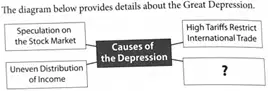
Which phrase completes the diagram?
War in Europe
Agricultural drought
Overproduction of goods
Introduction of new technologies
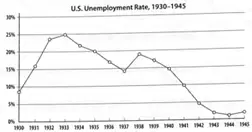
Based on the graph, what conclusion can be made about government policies in the 1930s?
President Hoover's policies were more effective than the New Deal in dealing with the Depression.
By 1938, the New Deal had successfully brought unemployment back down to pre-Depression levels.
New Deal policies failed to improve the economy because of the interference of the Supreme Court.
Despite Roosevelt's New Deal policies, the unemployment rate remained high throughout the 1930s.
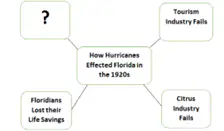
What factor resulting from hurricanes in the 1920s is missing from the graphic?
Cattle industry fails
Cigar industry fails
Land prices increased
Housing boom ends

