
 Worksheets
CAB Remediation
Total questions: 147
Worksheet time: 4hrs 22mins
What is the difference between distance and displacement?
Displacement is the total length of the path traveled
Distance is the same as displacement
Distance is the total length of the path traveled, while displacement is the shortest distance between the initial and final positions.
Distance is the shortest distance between the initial and final positions
Define speed and average velocity.
Speed is the distance traveled per unit of time, while average velocity is the displacement divided by the time taken.
Speed is the rate of change of position, while average velocity is the rate of change of displacement.
Speed is the displacement divided by the time taken, while average velocity is the distance traveled per unit of time.
Speed is the magnitude of velocity, while average velocity is the total distance traveled.
If an object is moving with a constant speed of 20 m/s, what is its velocity?
30 m/s
10 m/s
40 m/s
20 m/s
What is acceleration and how is it different from velocity?
Acceleration is the same as velocity.
Acceleration is the rate of change of velocity over time.
Acceleration is a constant value.
Acceleration is the rate of change of speed over distance.
A car starts from rest and reaches a speed of 30 m/s in 5 seconds. Calculate its acceleration.
3 m/s^2
10 m/s^2
6 m/s^2
15 m/s^2
If an object is moving with a velocity of 10 m/s, what is its speed?
5 m/s
20 m/s
10 m/s
15 m/s
How is instantaneous velocity different from average velocity?
Instantaneous velocity is the velocity of an object at rest
Instantaneous velocity is the velocity of an object at a specific point in time.
Instantaneous velocity is the same as average velocity
Instantaneous velocity is the velocity of an object over a long period of time
Explain the relationship between distance, displacement, and speed in one dimension motion.
Distance is the change in position, displacement is the total length covered, and speed is the acceleration of the object.
Distance is the total length covered by an object, displacement is the change in position from the initial to the final point, and speed is the rate at which the object covers the distance.
Distance is the total length covered by an object, displacement is the rate at which the object covers the distance, and speed is the change in position from the initial to the final point.
Distance is the rate at which the object covers the distance, displacement is the total length covered, and speed is the change in position from the initial to the final point.
The sum of all movements from start to the end of motion is best described as____.
distance
displacement
motion
donkey
The change in an objects position from the final position to initial position.
displacement
distance
motion
reference point
A man walks 5 miles forwards, 6 miles backwards and then 2 miles forwards. What is his displacement?
1 mile forward
13 miles
3 miles forward
1 mile
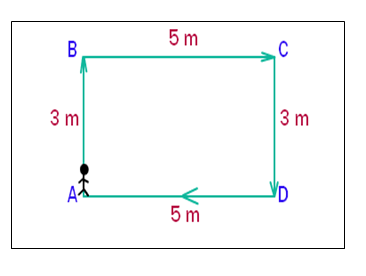
Bill runs 400 meters to Andy's house, turns around, and runs 400 meters back home. What is Bill's displacement?
A cross-country skier moves 10 meters eastward, then 14 meters westward, and finally 6 meters eastward.
What is the magnitude and direction of the displacement?
30 meters east
16 meters east
2 meters west
2 meters east
Mr. D decided that it was time to get his fat-self in shape so he decided to go and run a mile around the track (4 laps). However, after running just one lap, he collapsed in the same spot he started.
What was the displacement?
0 mi
1/4 mi
1/4 mi east
unknown
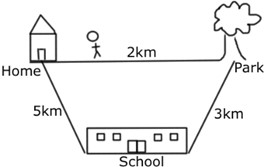
Jerry walked from home to school, then from the school to the park. What is his total distance?
2 km
5 km
8 km
10 km
Scalar quantities
only need a number
Need a number and direction
Need scales
Vector quantities
only need a number
Need a number and direction
Need arrows
A dog walks 12 meters to the east and then turns around and walks 16 meters back to the west.
What is the displacement of the dog?
28 meters
4 meters
4 meters west
4 meters east
Jerry walked from home to school, then from the school to the park. What is his total displacement?
2 km east
5 km
8 km
2 km
800
400
0
200
Jerry walked from home to school, then from the school to the park. What is his total distance?
2 km
5 km
8 km
10 km
Jerry walked from home to school, then from the school to the park. What is his total displacement?
2 km E
5 km N
8 km S
10 km W
82 meters N
18 meters N
18 meters S
82 meters S
A car drives 84 meters forward. It's displacement and distance would be the same magnitude.
True
False
A place or object (like a stop sign or mailbox) used for comparison to determine if another object is in motion is called a
comparison point
frame of reference
point of view
motion detector

Relative motion
the motion of an object in comparison to other objects in a specific frame of reference
the point of view used to measure the position and movement of objects
how fast something moves
the distance
The best reference points are stationary (not moving).
true
false
If you walk to your friends house 500 meters down the street. What is the DISTANCE you have traveled?
500 meters
1000 meters
250 meters
0 meters

Click on image to make it bigger.
A
B
C
D

You go on a hike on the blue path from point A to point B. (Click on image to make it larger)
What DISTANCE did you travel?
4.6 km
9.2 km
10.3 km
0 km
Speed = _______________
Distance + time
Distance – time
Distance x time
Distance / time
This occurs when an object speeds up, slows down, or changes direction.
Speed
Velocity
Acceleration
Another way to explain the speed and direction of a object would be to describe it’s ________
Speed
Velocity
Acceleration
Velocity = _______________
Speed – direction
Speed + direction
Speed x direction
Speed / direction

At what speed would a car have to move in order to travel 20 kilometers in 2 hours.
5 km/hr
10 km/hr
20 km/hr
40 km/hr

Which of the following is a unit of speed?
km/hr
Minutes
Centimeters
meters
A car initially traveling at 8.0 meters per second doubles its speed while traveling in a northeast direction.
Students used a table to record the initial and final conditions for speed and velocity.
Which table is correct?


Which statement best describes the motion of the toy vehicle during the first 30 seconds of the investigation?
The vehicle was traveling at a constant speed
The vehicle was accelerating at a constant rate
The speed of the vehicle was increasing
The acceleration of the vehicle was increasing

Which statement best describes the cart?
The cart was stationary with a velocity of 0 m/s for the entire 7 seconds
The cart was stationary except for a short burst of acceleration of 0.5 m/s2
The cart moved at a constant velocity of 0.5 m/s for the entire 7 seconds
The cart accelerated at a constant rate of approximately 0.8 m/s2
Match the following
Speed
30 m/s
Velocity
30 m/s east
Acceleration
30 m/s2
Which of the following best describes the velocity of an object?
30 (a)
What is the difference between the velocity and the speed of an object?
Velocity is the change in distance over time, while speed is the change in velocity over time.
Velocity has a direction associated with it, while speed has no specific direction
Velocity has no direction associated with it, while speed has a specific direction
Velocity is the change in speed over time, while speed is the change in distance over time

The pickup truck has a changing velocity because the pickup truck -
can accelerate faster than the other two vehicles
is traveling in the opposite direction from the other two vehicles
is traveling on a curve in the road
needs a large amount of force to move
Which TWO of the following are vectors?
Distance
Displacement
Speed
Velocity
Which of the following is an acceptable velocity measurement?
25 m/s North
25 m/s
25 m
25 m North
An object travels 100 m North then 50 m South. What total distance did it travel?
150 m
50 m North
50 m South
150 m North
An object travels 100 m North then 50 m South. What is its total displacement?
150 m
50 m North
50 m South
150 m North
A runner runs 2 laps around a track with a circumference of 400 m. What is their total distance?
800 m
0
400 m
400 m North
A runner runs 2 laps around a track with a circumference of 400 m. What is their total displacement?
800 m
0
400 m
400 m North
Which of these is defined by the slope of a position-time graph?
velocity
speed
distance
displacement

Which graph shows an object moving forward at a constant speed?
A
B
C
D
Which graph shows an object moving backward at a constant speed?
A
B
C
D
Which graph shows an object at rest?
A
B
C
D
Which graph shows an object accelerating while moving forward?
A
B
C
D

Which position-time graph represents the fastest speed (assume all graphs use the same scale)?
A
B
C
D
The speedometer in your car measures __________________ speed.
average
instantaneous
light
ludicrous

Which shows an object moving at constant speed?
A
B
C
Which shows an object speeding up?
A
B
C
Which shows an object slowing down?
A
B
C

What is the difference between speed and velocity?
Speed involves a runaway city bus, while Velocity involves motorcycle racing
Speed stars Keanu Reeves and Sandra Bullock, while Velocity stars a bunch of people I have never heard of
speed does not involve a direction, while velocity does
Speed was released in 1994, Velocity in 2007
Velocity (as opposed to speed) can be found from the slope of a position-time graph because...
the sign of the slope indicates the direction.
direction is not needed.
velocity is a scalar and speed is a vector.
slope has no direction.
Average speed/velocity for a trip can always be found by calculating the mathematical average of the individual speeds/velocities.
True
False




A roller coasters accelerates from an initial speed of 6.0 m/s to a final speed of 70 m/s over 4 seconds. What's the acceleration?
24 m/s2
18 m/s2
16 m/s2
16 m/s

Acceleration is just when an object speeds up?
True, only objects speeding up is acceleration
False, objects speeding up and slowing down is acceleration.
Along with speeding up and slowing down, if you travel a constant speed you can be accelerating if you are __________ __________.
(a)
Choose all ways an object can accelerate.
speed up
slow down
change direction
stay at a constant speed and never change direction
Acceleration and velocity are the same thing.
True, they both measure speed
False, acceleration is the rate at which velocity changes. Velocity is the speed AND direction of an object.
Natalie drops her skateboard into a bowl speeding up from 0 m/s to 4 m/s in 2.5 s. What is her average acceleration?
4 m/s
1.6 m/s/s
1.6 m
2.5 m/s/s

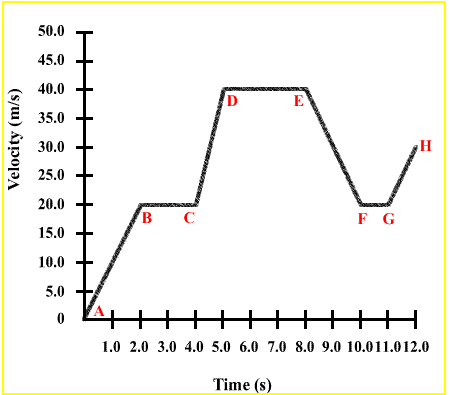
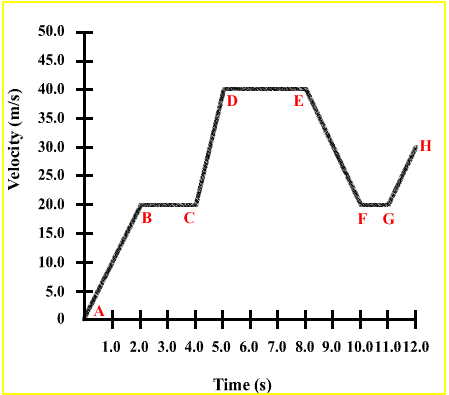
What kind of motion is taking place between points D and E?
constant acceleration
constant de
changing acceleration
constant speed
What kind of motion is taking place between points A and B?
constant acceleration
constant de
changing acceleration
constant speed
What kind of motion is taking place between points C and D?
constant acceleration
constant deceleration
not moving
constant speed
Mark slams on the brakes after traveling 25 m/s. It takes him 3 seconds to come to a complete stop. What is his acceleration?
8.33 m/s2
-8.33 m/s2
75 m/s2
-75 m/s2
How much time did it take Matthew to slow down to a complete stop, after traveling at 30 m/s. His acceleration is -12 m/s2
2.5 s
360 s
.4 s
-2.5 s
If Anthony was running for 300 s after starting at rest, what was his final velocity if he had an acceleration of 0.05 m/s2
.25 m/s
.01 m/s
100 m/s
15 m/s

Mars’ gravitational force is less than that of Earth’s . If an astronaut drops a hammer and its speed increases from 0 to 15 m/s in 4.04 s, what is the acceleration due to gravity on Mars?
9.8 m/s2
0.269 m/s2
60.6 m/s2
3.71 m/s2


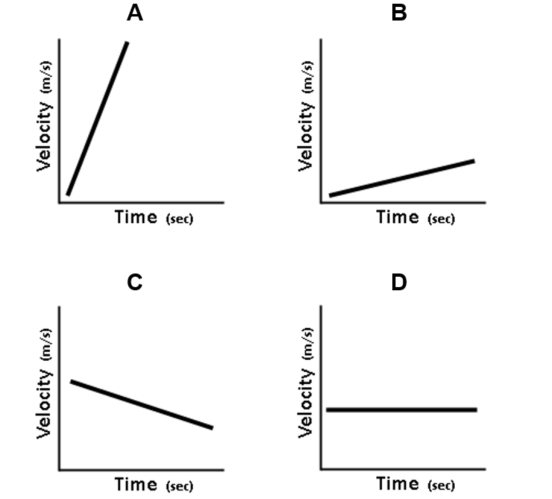
What is the motion shown in this velocity time graph?
moving with a constant positive velocity
Speeding up in the positive direction
slowing down in the positive direction
speeding up in the negative direction

What is the motion shown in this velocity time graph?
moving with a constant positive velocity
Speeding up in the positive direction
slowing down in the positive direction
speeding up in the negative direction

What is the motion shown in this velocity time graph?
moving with a constant positive velocity
Speeding up in the positive direction
slowing down in the positive direction
speeding up in the negative direction

Describe the motion that this motion map shows
speeding up in the negative direction
slowing down in the negative direction
speeding up in the positive direction
slowing down in the positive direction

Describe the motion that this motion map shows
speeding up in the negative direction
slowing down in the negative direction
speeding up in the positive direction
slowing down in the positive direction

Describe the motion that this motion map shows
speeding up in the negative direction
slowing down in the negative direction
speeding up in the positive direction
slowing down in the positive direction
Falling objects drop with an average acceleration of 9.8 m/s2 . If an object falls from a tall building, how long will it take before it reaches a speed of 49 m/s?
5 s
480.2 s
0.2 s
58.8 s
How long would it take Jesse with an acceleration of -2.50 m/s2 to bring his bicycle with an initial velocity of 13.5 m/s to a complete stop?
0.20 s
32.5 5
5.4 s
16 s
The elevators in the Landmark Tower, in Yokohama, Japan are among the fastest in the world. They accelerate upward at 3.125 m/s2 for 4.0 s to reach their final speed. If these elevators start from rest, what is their final speed?
0.781 m/s
7.125 m/s
1.28 m/s
12.5 m/s
Justine is ice-skating at the Lloyd Center. What is her final velocity if she accelerates at a rate of 2.0 m/s for 3.5 seconds?
1.5 m/s
5.5 m/s
7 m/s
1.75 m/s
Kaya is riding her dirt bike eastward on a dirt road. She spots a pothole ahead. Kaya slows her car from 14.0 m/s to 5.5 m/s in 6.0 s. What is her acceleration?
-1.4 m/s2
+ 1.4 m/s2
0.7 m/s2
14.5 m/s2
Acceleration is
the rate at which velocity changes.
the change in velocity
the rate of change
when you speed up only
Velocity has two components
(pick 2 below)
direction
change in speed
speed up
slow down
In science, acceleration refers to
increasing speed
decreasing speed
changing direction
increasing speed only
What does it mean when a change in velocity is negative?
The object is speeding up.
The object is slowing down.
The object is changing direction.
The object is falling down.
If velocity is measured in meters/second and time is measured in seconds, the unit of acceleration is
m/s/s
m/s2
m/s
m
If velocity is measured in kilometers/hour and time is measured in seconds, the unit of acceleration is
km/s/s
km/s2
km/h/s
km
If velocity is measured in miles/hour and time is measured in seconds, the unit of acceleration is
mi/h/s
mi/s2
mi/h2
mi
While driving at an average velocity of 15.6 m/s down the road, a driver slams on the brakes to avoid hitting a squirrel. The car stops completely in 4.2 seconds. What is the average acceleration of the car?
What should your answer's final unit(s) for this problem be?
m/s/s
m/s2
m/s
m
A sports car is advertised as being able to go from 0 to 60 mi/h in 6.00 seconds. What is the sports car’s average acceleration?
What should be your answer's final unit(s) be for this problem?
mi/h/s
m/s/s
m/s
mi/h
In the video #What is Acceleration?", what was the symbol/abbreviation they used for initial velocity?
u
vi
v1
v
In the video #What is Acceleration?", what was the for the acceleration problem she worked?
2 m/s
2 m/s2
5 m/s2
5 m/s
A plane lands on the runway and slows from 758 km/hr to 30 km/hr in 0.013 hours. What is the plane's acceleration in m/s2?
56,000 m/s2
17857 m/s2
-17857 m/s2
-56,000 m/s2
What is the final velocity of a rocket that travels for 4 seconds, has an initial velocity of 12 km/s and an acceleration of 2 km/s2?
-4 km/s
10 km/s
20 km/s
-10 km/s
The building with the highest occupiable floor is currently the Sears Tower in Chicago. The top floor of the Sears Tower is 110 stories (436 m) above street level, and the roof of the tower is 442 m above the street. Assume a golf ball is thrown downward from the roof of the Sears Tower. Neglecting air resistance, the golf ball accelerates at 9.8 m/s2 and lands on the pavement after 9.2 s. If the ball’s final speed is 93.0 m/s, what was the speed with which the ball was initially thrown?
3 m/s
12 m/s
19.9 m/s
34.2 m/s
Which of the following is not accelerating?
a ball being juggled
a woman walking at 2.5 m/s along a
straight road
a satellite circling Earth
a braking cyclist
The light turns red, and you ease to a halt. Checking your stopwatch, you see that you stopped in 4.5 seconds. Your acceleration was 1.23 x 10⁻³ miles per second2 in a direction opposite to your original velocity.
What was your original speed in miles per hour?
19.9 mi/h
34 mi/h
29 mi/h
39.0 mi/h

