
 Worksheets
✔️Fungi, Protists, Bacteria
Total questions: 33
Worksheet time: 17mins
Name
Class
Date
1.
1. Why would your doctor swab your throat to see if you have strep throat?
a)
Your doctor needed to practice looking under the microscope for different types of cells.
b)
Your doctor needed to be sure you had a bacterial infection before he or she prescribed an antibiotic.
c)
Your doctor needed to be sure if you had Covid.
2.
2. Bacteria are microscopic members of planet Earth that are neither plant nor animal.
a)
True
b)
False
3.
3. Bacteria, Fungi, and protist all have unique characteristics and belong to their own groups or kingdoms.
a)
True
b)
False
4.
4. What are examples of Protists? (3)
a)
amoeba
b)
euglena
c)
paramecium
d)
molds
e)
mushrooms
5.
5. According to the charts, Kingdoms Fungi, Bacteria, and Protista all have organisms that can be either unicellular or multicellular.
a)
True
b)
False
6.
6. prokaryotes
a)
unicellular organisms that have simple structures without a distinct nucleus and without membrane-covered organelles
b)
multicellular organisms that have simple structures without a distinct nucleus and without membrane-covered organelles
c)
unicellular organisms that have complex structures without a distinct nucleus and without membrane-covered organelles
d)
multicellular organisms that have complex structures without a distinct nucleus and without membrane-covered organelles
7.
7. eukaryotes
a)
organisms without a nucleus and membrane-bound organelles
b)
organisms with a nucleus but no membrane-bound organelles
c)
organisms with a nucleus and membrane-bound organelles
d)
organisms with no nucleus but many membrane-bound organelles
8.
8. Examples of harmful bacteria: (2)
a)
staph
b)
flagellum
c)
strep
d)
enzymes
9.
9. Examples of helpful bacteria would be those _____.
a)
that are pilliated
b)
that aid in digestion
c)
that move using flagella
d)
that secrete enzymes
10.
10. Bacteria cannot eat directly; they must first secrete enzymes that break down nearby food sources, and then the bacteria can absorb the nutrients.
a)
True
b)
False
11.
11. Bacteria move about using a whip-like tail called a ______, or they can propel themselves with many tiny, hairlike structures called _______.
a)
flagellum, pili
b)
pili; flagellum
12.
12. Bacteria can respond to their surroundings.
a)
True
b)
False
13.
13. Fungi are unicellular organisms that exist in many different types and sizes.
a)
True
b)
False
14.
14. Fungi are predators that depend on dead things for food.
a)
True
b)
False
15.
15. Yeasts are fungi ______.
a)
used in cheese production
b)
that are found growing in the yard or wooded areas
c)
that grow on old breads
d)
used in making bread rise
16.
16. Molds are types of fungi _____. (3)
a)
used in cheese production
b)
that are found growing in the yard or wooded areas
c)
that grow on old breads
d)
used in making bread rise
e)
help produce penicillin
17.
17. A mushroom is actually the reproductive structure of some fungi.
a)
True
b)
False
18.
18. How do fungi “eat” to get energy?
a)
Although many fungi can eat directly but also feed by releasing enzymes outside their bodies which break down substances that are then absorbed.
b)
Although many fungi cannot eat directly but feed by releasing enzymes outside their bodies which break down substances that are then absorbed.
c)
Although all fungi can eat directly and feed by releasing enzymes outside their bodies which cannot break down substances.
19.
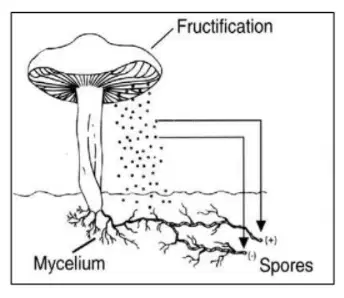
19. Once digested, the molecules of food can then be absorbed into the fungi through many tiny filaments called _______, which branch into mycelium. The _______ filaments respond to their environment by growing toward food or water.
a)
hyphae; mycelium
b)
mycelium; hyphae
20.
20. The mushroom cap and stem are actually the “fruit” of the fungi. Just as fruit has seeds that make new fruit, the spores of the mushroom produce new fungi. The tiny spores are located in the _____inside the cap and can be shaken out.
a)
gills
b)
hyphae
c)
mycelium
d)
spores
21.
21. Yeast gets its energy from the sugar in this bread dough. The by-products are ______ gas and alcohol, which make the bread rise and smell good.
a)
oxygen
b)
carbon dioxide
c)
nitrogen
d)
sulfuric
22.
22. Most fungi are not dangerous, but there are some types of fungi that can be harmful to human health and well-being.
a)
True
b)
False
23.
23. Some common examples of infections caused by fungi are ___________. These fungal infections feed off our bodies and are difficult to get rid of.
a)
athlete’s foot, ringworm, and yeast infections
b)
colds, flu, and other viruses
c)
stomach bug, mushrooms, and yeast
d)
mushrooms, yeast, and flu
24.
24. As with bacteria, all fungi are harmful. Mushrooms and yeast, both fungi, are never used in the food and drinks we consume.
a)
True
b)
False
25.
25. Many protists are classified in this kingdom because they do not fit in any of the others.
a)
True
b)
False
26.
26. Protists vary greatly in their ________________.
a)
ability to shape-shift and go without food for years at a time
b)
absorption of dead materials and movement
c)
appearance but not reproduction or obtaining food
d)
appearance, mobility, reproduction, and methods for obtaining food
27.
27. Euglena, Paramecium, and amoeba are three types of protists that have a nucleus and membrane-covered organelles; however, they move and obtain food very differently.
a)
True
b)
False
28.
28. a small whip called a ________
a)
cilia
b)
flagellum
c)
pseudopod
d)
pili
29.
29. tiny hairs called _____ that vibrate rapidly
a)
cilia
b)
flagellum
c)
pseudopod
d)
pili
30.
30. oozing along with __________ or false feet
a)
cilia
b)
flagellum
c)
pseudopod
d)
pili
31.
31. Euglena are autotrophic protists which means they are “plant-like” protists.
a)
True
b)
False
32.
32. Paramecia eat tiny algae, bacteria, or yeast by trapping food with their cilia and whisking it into their “mouth” opening where it is stored in a ___________.
a)
muscle
b)
stomach
c)
vacuole
33.
33. The amoeba uses its______________ to wrap around small microscopic algae or bacteria and absorb the food to store in vacuoles. The paramecium and amoeba are “animal-like” protists.
a)
tentacles
b)
pseudopods
c)
cilia
d)
arms
100 %

