
NEW
Font size
 Worksheets
Benchmark 2 Study Guide-6th grade
Total questions: 20
Worksheet time: 10mins
Most of Earth's freshwater is located in....
lakes and ponds
river systems
wetlands
ice caps and glaciers
We know that 3% of Earth's water is freshwater, but we can only use 1% of it. Most of the freshwater we can use is located in....
groundwater
river systems
wetlands
lakes and ponds
The sun is the driving force behind the water cycle. Why?
Heat from the sun causes rainfall, and without rain the Earth would run out of water.
Heat from the sun causes evaporation and without evaporation, the water cycle would not happen.
Heat from the sun causes water to condense into clouds.
Heat from the sun warms the soil on Earth's surface so the water is absorbed.
Water moves down and is absorbed into the soil. What is the name for this process?
runoff
groundwater
infiltration
collection
What is the relationship between light, temperature and pressure as we get deeper into the ocean zones?
Light would decrease, temperature and pressure would increase.
Light would decrease, temperature would not change and pressure would increase.
All three would decrease, but pressure would not decrease much
Light and temperature would decrease, but pressure would increase.
What is the name of the landform that takes up about 70% of the seafloor?
mid-ocean ridge
abyssal plain
continental shelf
continental slope
In order to have a high tide on Earth, which picture matches the way the Sun, Moon and Earth need to in relation to one another?


The Sun's impact on the Earth's tides is less than the Moon's impact on the Earth's tides. Why?
The tides only happen at night.
The moon is brighter than the sun.
The moon is more dense than the sun.
The moon is closer to the Earth than the sun.
Which type of soil does not hold water effectively (well)?
loam
clay
silt
sand
Which characteristic of soil tells us that it has a high amount of humus?
rough texture
ability to hold water
dark color
size of the particles
If we suspect that a huge environmental change has taken place, which evidence below supports our idea?
marine fossils in a desert
marine fossils in a freshwater lake
bird fossils on a mountain
dinosaur fossils near a river
Fossils that belong to plants that grow in warm areas were found in Alaska. What conclusion can we make?
The area used to be underwater.
The area used to have a warmer climate.
The area used to have dryer air.
The area used to have more trees.
Which of these is an example of weathering?
Flowing water transports rocks to the ocean.
Pieces of rock pile on top of each other in layers.
Wind and rain break large rocks into smaller pieces.
Wind blows small pieces of rock from one area to another.
What process forms a delta?
deposition of sediments by water
erosion of rock by wind
weathering of rock by water
deposition of sediments by wind
Abrasion is caused by wind and water. Can you explain how this happens?
The wind or water cool the rock down, causing cracks to form.
Particles in the wind or water scrape against the rock's surface.
Water fills the cracks in a rock, then the wind freezes the water.
Wind and water carry rocks to other locations.
Oxidation is one form of chemical weathering. Which element in the air reacts with minerals and rocks to cause oxidation?
nitrogen
hydrogen
argon
oxygen
When tightly packed sediment hardens into sedimentary rock, we call that process ________.
cementation
deposition
compaction
crystallization
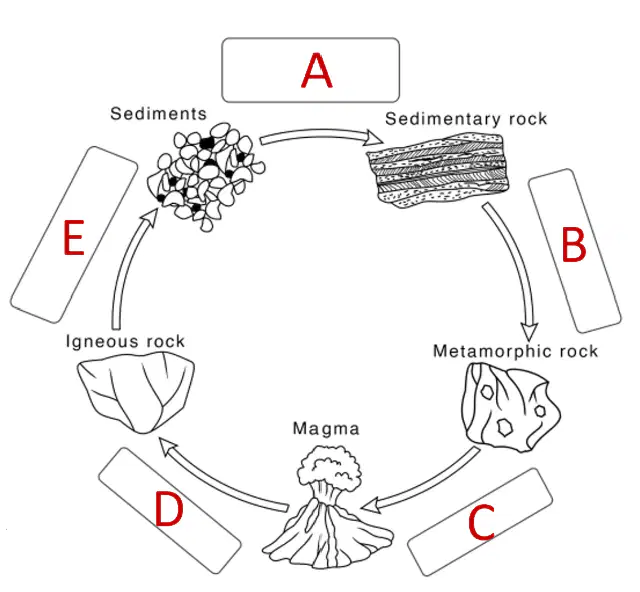
This diagram shows the rock cycle. What is happening at D?
heat & pressure
crystallization
weathering
compaction
You found two minerals that look exactly the same. Which two ways can you figure out what mineral you have?
Shine a light on them and see how they break
See how they break and test their hardness
Test their hardness and test their streak
Test their streak and see if their color changes in water.
There are 5 traits we learned about minerals. Which of these did we NOT learn about?
forms naturally
contains organic material
has a regular crystal structure
has a fixed chemical composition

