
 Worksheets
Unit 8 Formative #1 Review- DNA and Replication
Total questions: 18
Worksheet time: 10mins
Where does DNA replicate in eukaryotic cells?
The ribosomes
The cytoplasm
The plasma membrane
The nucleus
Why does DNA replicate?
To make new cells
To make new proteins
To ensure the proper number of chromosomes after cell division
To ensure that mutations are not passed on to future generations
Which image correctly displays semiconservative DNA replication?


The base adenine pairs with...
Cystosine
Guanine
Thymine
Uracil
The base guanine pairs with...
Cytosine
Adenine
Thymine
Urasil
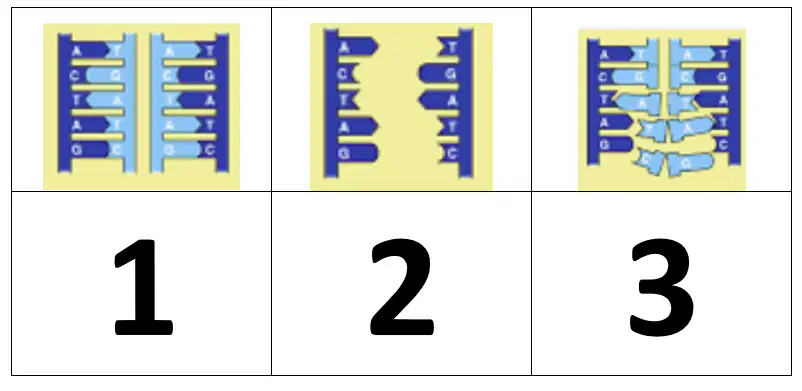
Which choice below correctly places the images of DNA replication in the correct order.
1, 2, 3
1, 3, 2
2, 3, 1
3, 1, 2
Make the complementary DNA strand to:
AAA- CGA- TAA- TGG
TTT- GCT- ATT- ACC
AAA- CGA- TAA- TGG
TTT- GGT- TAA- ACC
TTT- GCT- ATT- TGG
Select ALL of the following that are bases found in DNA.
Cytosine
Adenine
Urasil
Deoxyribose
Select all of the following that make but a nucleotide.
Fatty Acid
Sugar
Phosphate
Base
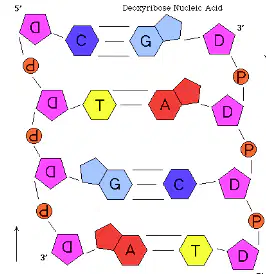
How many nucleotides are on the following DNA molecule?
4
1
8
16
What makes up the steps of the double helix?
Sugar
Bases
Phosphate
Bonds
What makes up the sides of the double helix
Sugar
Phosphate
Sugar-Phosphate backbone
Bases
If there are 30% Guanine bases then what percentage would you have of Cytosine bases?
20%
30%
60%
40%
Genes for medically important proteins can be cloned and inserted into bacteria.
Why can bacteria recognize a human gene and then produce a human protein?
DNA replication in bacteria and humans is the same.
Bacterial cells contain the same organelles as human cells.
Bacterial cells and human cells contain the same kind of chromosomes.
The basic components of DNA are the same in humans and bacteria.
How does the process of DNA replication impact mutations in an individual?
Since replication keeps the old strands as templates mutations may be carried into future strands.
Replication only produces new DNA strands so the old stand with the mutation is destroyed.
Mutations are often lost since the cell will die during the replication process if the DNA is mutated.
All DNA replication stops when there is a mutation so the mutation won't hurt the individual.

Which of the following segments would pass on a mutation?
1
2
3
4
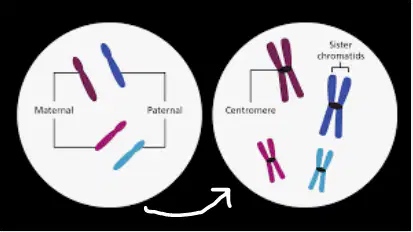
What took place in the cell?
Photosynthesis
Cellular Respiration
DNA Replication
Protein Synthesis
Which type of bond holds the bases together on a DNA molecule?
Hydrogen
Covalent
Ionic
Biological

