
 Worksheets
Final Exam Review - Math 1000
Total questions: 100
Worksheet time: 7hrs 10mins

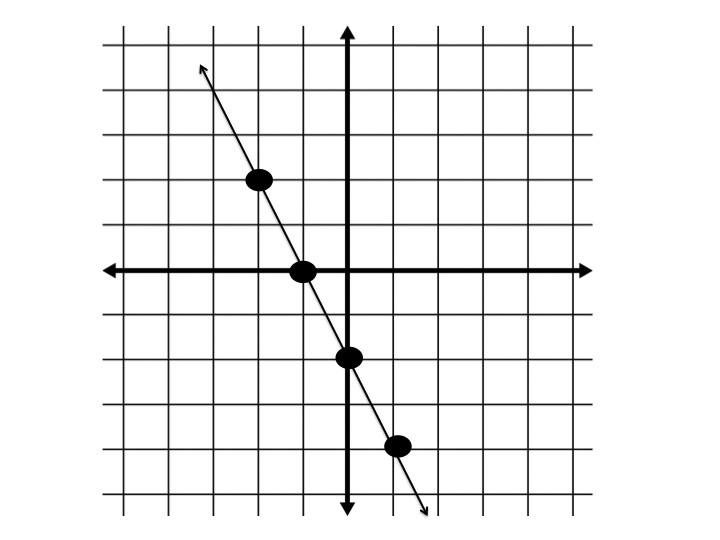
(1, 0)
(2, 0)
( -1, 0)
(-2, 0)
3x + y = 5
3x + 8y = 24
Write the equation of the line that passes through the point (1, -1) and has a slope of -4.
y = -4x + 3
y = -4x - 3
y = -4x + 5
y = -4x - 5
Are the lines given by the equations parallel, perpendicular, or neither?
y=−47x+8
y=47x−9
Parallel
Perpendicular
Neither
Are the lines given by the equations parallel, perpendicular, or neither?
y=−43x+13
y=34x−8
Parallel
Perpendicular
Neither
Are the lines given by the equations parallel, perpendicular, or neither?
y=83x+12
y=38x+4
Parallel
Perpendicular
Neither
If a line has a slope of 3/4 a line that is parallel has a slope of what?
3/4
4/3
-3/4
-4/3
If a line has a slope of 2/3 a line that is perpendicular has a slope of what?
-3/2
3/2
2/3
-2/3
How is the distance formula correctly written:
d = (y1 − y2)2 −(x2 − x1)2
d = (x2 − x1)2 + (y2 − y1 )2
d = (y1 − y2)2 + (x2 − x1)2
d = (x)2− (y)2
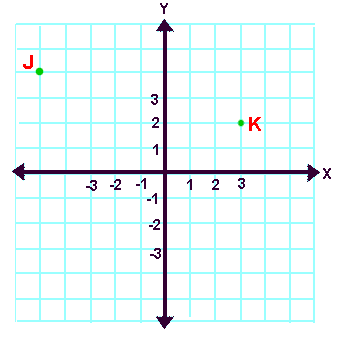
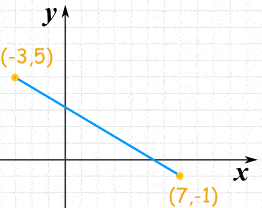
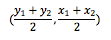
Which of the following is the correct midpoint formula given two endpoints (x1, y1) and (x2, y2)?
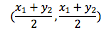
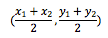

Find the midpoint of the line segment with the given endpoints (1,1) and (9,9)
(5,5)
(1,9)
(17,17)
(-4,-4)
Find the midpoint: (2,−7),(10,1)
(-3,6)
(6,-3)
(4,4)
none
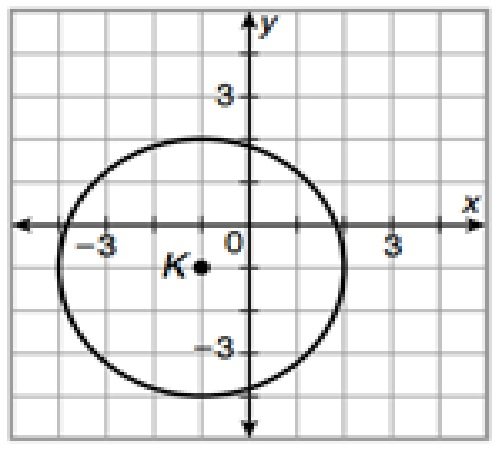
What does (h,k) stand for in the standard circle equation?
(h,k) is the center of the circle
(h,k) is a point on the circle.
(h,k) is a point that we guess and find
(h,k) is the distance of the circle
Write the following in interval notation.
x < 8
(8, -∞)
(-∞, 8]
(-∞, 8)

What interval notation does the number line graph represent?
[∞, -5)
(∞, -5)
[-5, ∞)
Write the following in interval notation.
x ≥ 100
(0, 100]

Look at the Graph. Write the inequality in interval notation.
[-4, -1)
(-4, -1)
(-4, -1]
[-4, -1]

Look at the picture. Which number line corresponds to [-2, 5]?
Graph 1
Graph 2
Graph 3
Graph 4

Look at the picture. Select the correct interval notation for the given number line.
(-∞, -8) U (-4, ∞)
(-∞, -8] U [-4, ∞)
(-8, -4)
[-8, -4]

On which interval(s) is the given function increasing?
(-∞, 2) U (-2, ∞)
(-2, 2) U (-2, ∞)
(-∞, -2) U (0.5, ∞)
(0, 2) U (0.5, ∞)

Describe the intervals over which the given function is decreasing.
(-∞, 0) U (2, ∞)
(5, -4) U (2, -3)
(-3, 0) U (2, 3)
(5, -4) U (0, -3)

Describe the range of the given function using interval notation.
(-∞, ∞)
(-4, 5)
[-3, 5]
[-4, 5]

Determine the domain of the function.
(5, -∞)
(-∞, 5]
[5, ∞)
[5, -∞)

What is the range of the given function?
[-1, 1]
(-1, 1)
(∞, -∞)
(-∞, ∞)


√45
√200


Match the graph with the correct equation.


Evaluate f(3)=
-1
-7
4
5
Evaluate f(-3)=
-1
-7
4
5
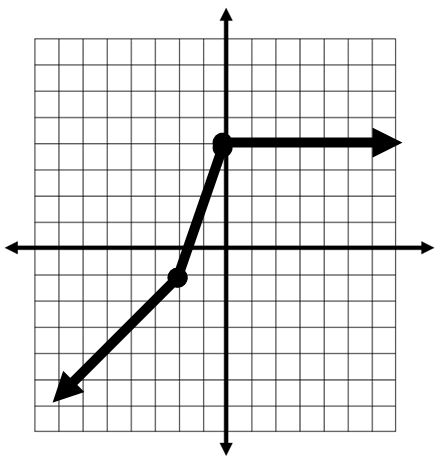


Select the correct graph for the following piecewise function.


Simplify:
x2−x−20x2+10x+24
x+4x+6
(x+6)(x+4)
x+6
x−5x+6
8(x+9)(x+8)⋅(x+8)(x−1)(x−1)
8(x+9)
8(x−1)
81
8(x+9)(x+8)
x−3x2−x−6⋅x+2x+9
x+9
x−2x−3
x+2x+9
x−3
Simplify:
7(a+2)a−8⋅a+27(a+2)
a+27(a+2)
a+2a−8
7a+2
7a−8
Simplify the expression.
x−12+x+14
(x−1)(x+1)6x+6
(x−1)(x+1)6x−2
2x6x−2
x3x−1

Simplify the expression.


Simplify the expression.


If f(x) = x - 1 and g(x) = 5x - 2, then (f + g) (x) =
5x2 + 1
5x3 - 3
6x + 1
6x - 3
g(x) = x+3,
Find f(x) * g(x)
h(x)=3x-1
Find g(h(x))

A
B
C
D
l x−6 l + 4= 10
| x + 9 | = -5
Solve. Select BOTH solutions.
∣x−1∣=3
-2
2
4
-3
Solve. Select BOTH solutions.
∣3x∣+2=8
310
2
−2
−34
l 4x−3 l = 17


|x + 4| - 8 > 2
|p + 3| ≥ 10
What is i?
1
-1
√-1
√1
Find the Sum
3i + 2i
5i
5i2
6i
-5
Find the sum.
(5-2i) + (-7+8i)
-2+6i
12+6i
-35-16i2
-35 -16i
Simplify:
(10+ 15i) - (48 - 30i)
58 - 45i
58 - 15i
-38 - 15i
-38 + 45i
(3+8i)(-2-i)
2-19i
23-i
34+5i
23-i
(1−7i)2
(a)
even functions are symmetric with respect to the
y-axis
x-axis
origin
none of the above
odd functions are symmetric with respect to the
y- axis
x - axis
origin
none of the above
f(x) = x4 + x2
f(x)=x3-x2
f(x) = x2 + 2
y=x2+3x+9
Even Function
Odd Function
Neither even nor odd
Not a function
Solve by the Quadratic Formula:
−12q2+3q+7=0
24−3±345
−243±345
243±345
243±i39
2m2=−2m+12
Solve using the quadratic formula.
x=2,−3
x=3,−2
x=1±13
No Solution
Describe the transformation from the parent absolute value function:
y=∣x∣−5
Shift up 5 units
Shift down 5 units
Shift right 5 units
Shift left 5 units
Describe the transformation from the parent quadratic function:
y=(x−2)2
Shift up 2 units
Shift down 2 units
Shift right 2 units
Shift left 2 units
Describe the transformation from the parent square root function:
y=x+4
Shift up 4 units
Shift down 4 units
Shift right 4 units
Shift left 4 units
Describe the transformation from the parent cubic function:
y=−x3+3
* Select TWO answers *
Shift up 3 units
Shift down 3 units
Reflection over the y-axis
Reflection over the x-axis
Describe the transformation from the parent absolute value function:
y=−∣x+4∣−3
* Select THREE answers *
Reflection over the x-axis
Translation 4 units left
Translation 4 units up
Translation 3 units left
Translation 3 units down

Describe the transformation from the parent graph
Reflect over x, right 3, down 4
Reflect over y, right 3, down 4
Reflect over x, right 3, up 4
Reflect over y, left 3, down 4

