
Font size
 Worksheets
Fall 2023 Astro 150 Final Review Part 2
Total questions: 18
Worksheet time: 13mins
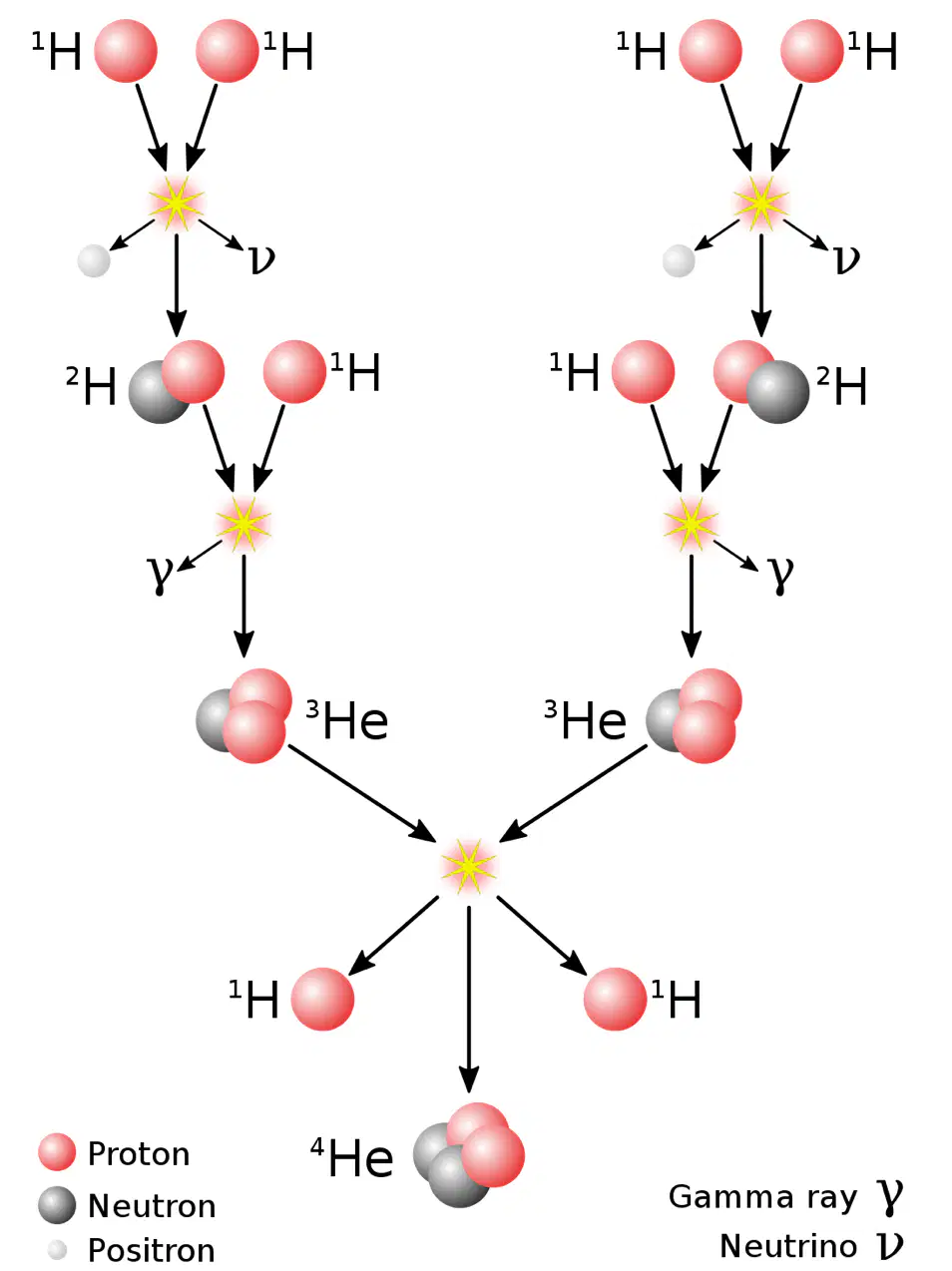
What stage of evolution does a 1 solar mass star spend the most time on?
Formation
Main Sequence
Red giant
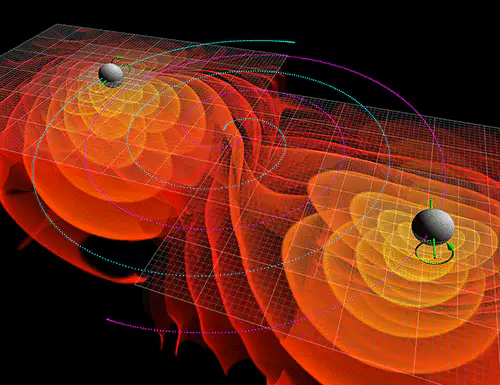
Which types of black holes do we have evidence for, or think we do?
Stellar Mass Black Holes
Intermediate Mass Black Holes
Supermassive Black Holes
Primordial Black Holes

What is our primary source of gold in the Universe?
Merging neutron stars
The US Olympic teams
Supernovae
Nuclear fusion

With our current estimates of the different parts of the Drake equation, which of the following is most likely true?
Number of communicating civilizations ≈ the number of habitable exoplanets per solar system
Number of communicating civilizations ≈ number of exoplanets per solar system
Number of communicating civilizations ≈ fraction of intelligent organisms that develop on a planet × number of planets that allow life to develop
Number of communicating civilizations ≈ Years that this civilization has been communicating

What time and place is the final at?
December 11, 12 PM - 2 PM, Physics room 3
December 11, 12 PM - 2 PM, Physics room 3
December 11, 12 PM - 2 PM, Physics room 3
January 9, 3 AM - 6 AM, International Space Station

What is the escape velocity of a black hole?
11.3 km/s
600 km/s
300,000 km/s
200,000 km/s
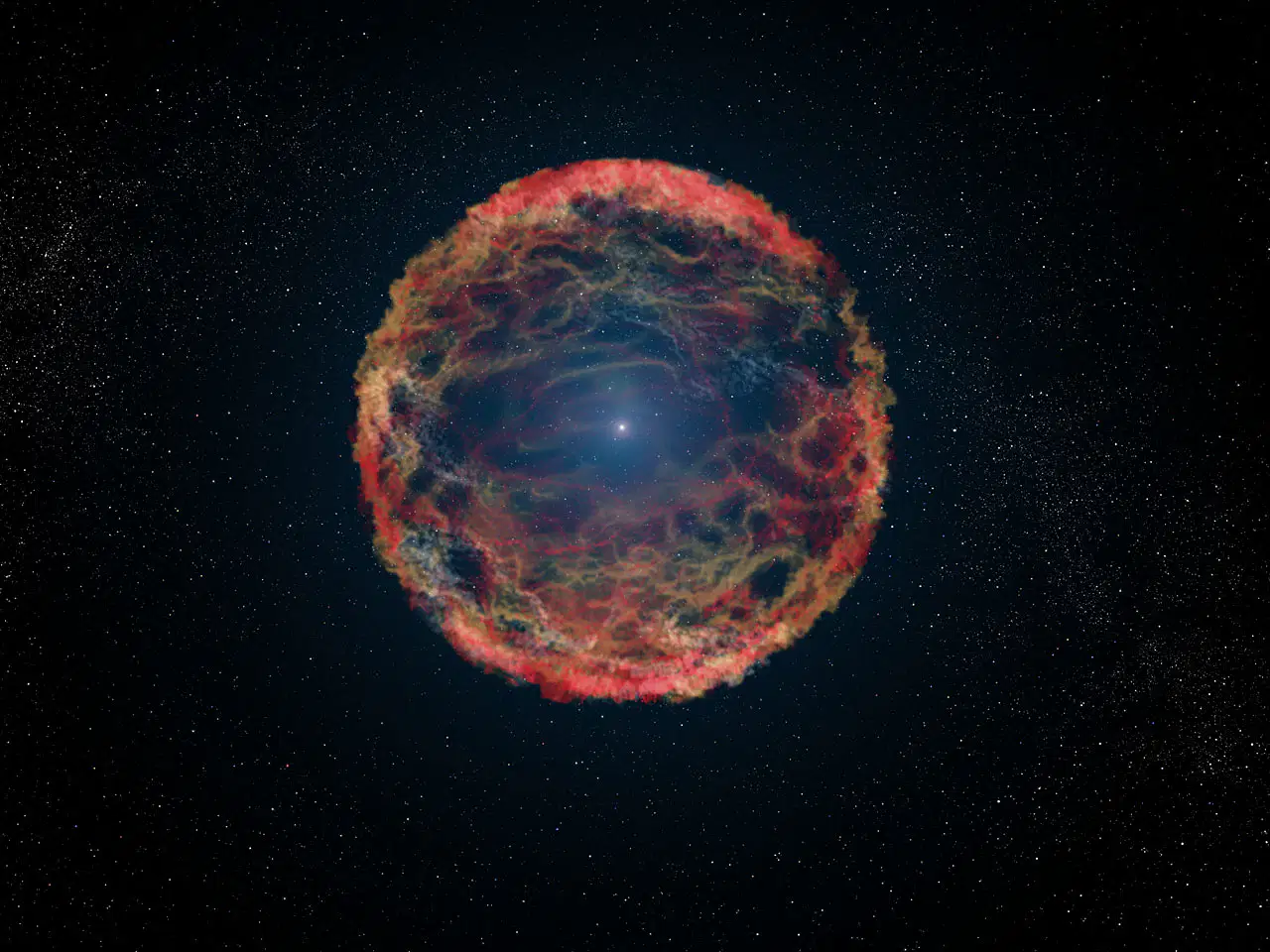
What happens to a star at the end of its life given its initial mass was between 8 and 25 solar masses?
It goes supernova and its core becomes a black hole
It goes kilo-nova and its core becomes a neutron star
It goes supernova and its core becomes a neutron star
Its core becomes a white dwarf and produces a planetary nebula

How does time appear to pass for an astronaut falling into a black hole from the perspective of an outside observer?
Time passes the same
Time passes slower
Time passes faster
Time reverses
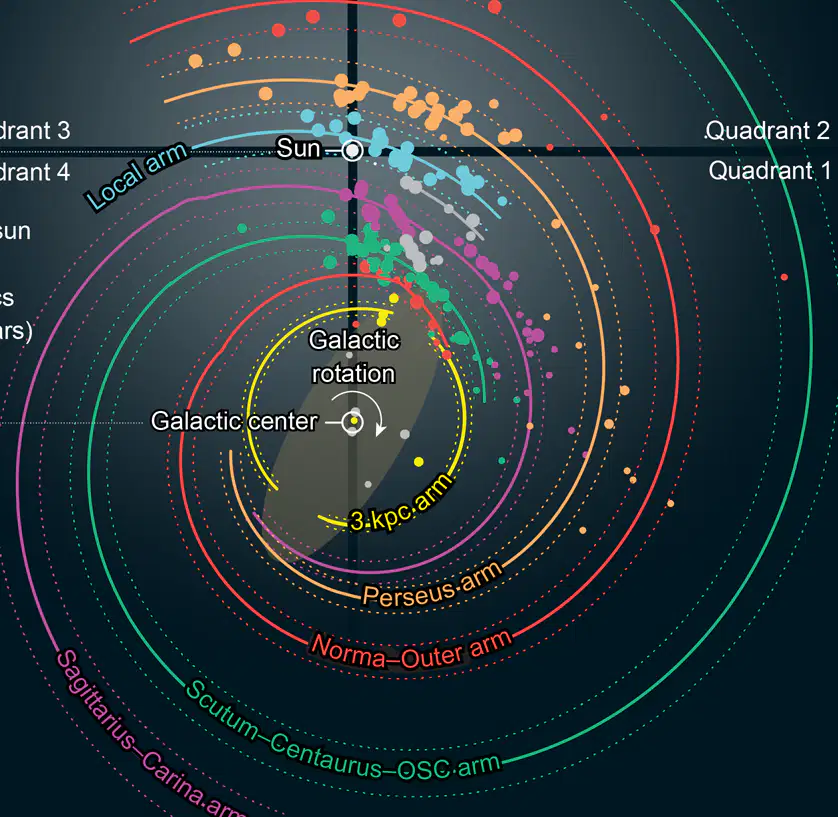
Which of the following does not contribute to our understanding of the shape of the Milky Way?
Looking at stars and HI (21 cm) emission lines
Use distances (e.g., via parallax)
The kinematics of Andromeda
Determine positions and velocities of clouds and stars
Use Doppler shifting

How do we know that dark matter exists within the Milky Way?
We do no have evidence to support this idea
We see a large halo of material around the Milky Way that obscures our view of distant galaxies
Stars near the central bulge are moving faster than expected
Stars at the far edge of the disk are moving faster than expected

Which of these is NOT true about the Cosmic Microwave Background
For a while, knowledge of the CMB cast great doubt on the Big Bang theory
The CMB shows the Universe as it was when it wasn't even 1 million years old
The CMB is one of the greatest pieces of evidence of the Big Bang
The CMB would have been in higher energy wavelengths in the earlier Universe

Why isn't the Universe shrinking?
The energy from the Big Bang is still pushing the Universe apart
It IS shrinking
Dark energy is pushing the Universe apart
Dark matter is pushing the Universe apart
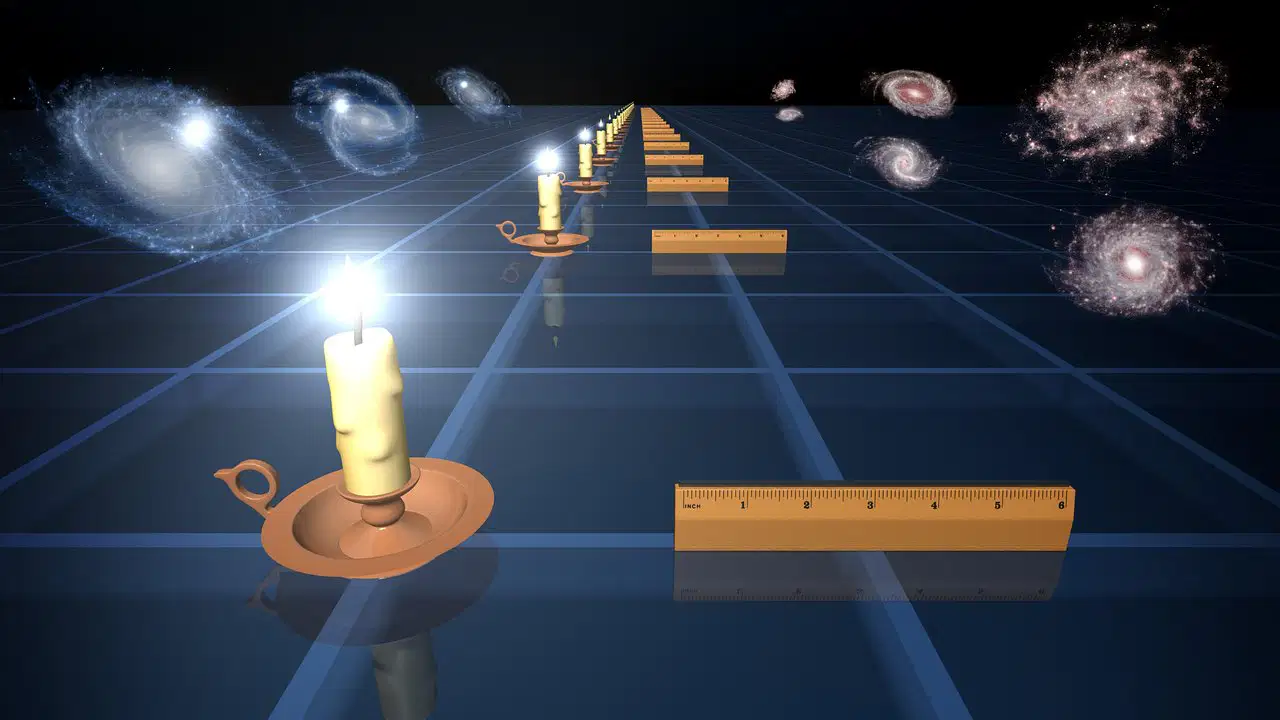
Which of the rungs on the Cosmic Distance Ladder uses Standard Candles?
Hubble's Law
Variable Stars
Type-Ia Supernova
Stellar Parallax

How do we think that giant elliptical galaxies form?
From the collapse of a giant molecular cloud
From the merger of smaller spirals
From ram pressure stripping of irregular galaxies
Spiral galaxies simply evolve into ellipticals through conservation of angular momentum

What is the geometry of the Universe?
Spherical
Flat
Saddle-shaped
Mobius strip
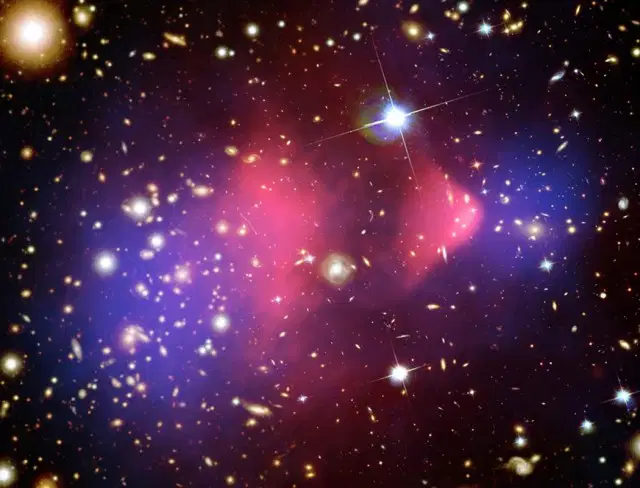
Which of the following is not evidence for dark matter within galaxy clusters?
Galaxy velocities within clusters
Strong emission from WIMPs
Hot gas between cluster members
Gravitational Lensing

What method has detected the most exoplanets?
Radial velocity
Pulsar timing variation
Direct imaging
Transit method

What causes the fluctuations seen in the CMB?
Gravitational interactions between galaxies eventually created those irregularities
The Big Bang was a very uneven explosion
Particles knocking each other around in the early Universe naturally introduced irregularities
Tiny irregularities in the early Universe amplified during inflation

