
 Worksheets
Chapter 13b Solubility
Total questions: 11
Worksheet time: 6mins
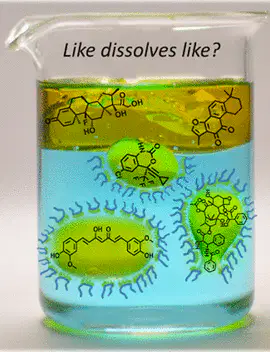
Like dissolves like means that:
polar solvents dissolve non-polar solutes
and
non-polar solvents dissolve polar solutes.
True
False
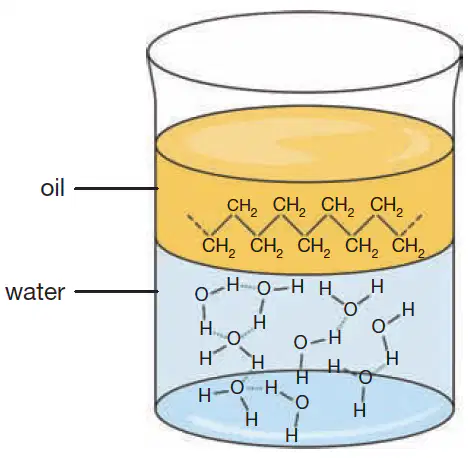
Oil does not dissolve in water because
both oil and water are polar.
both oil and water are non-polar.
oil is non-polar and water is polar.
oil is polar and water is non-polar.
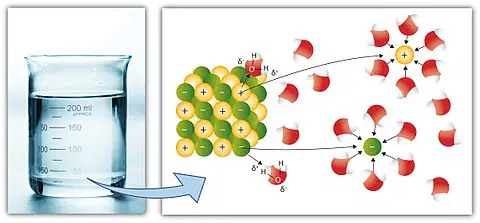
Substances that dissolve in water must interrupt the intermolecular hydrogen bonding in water and then form other bonds with water.
True
False
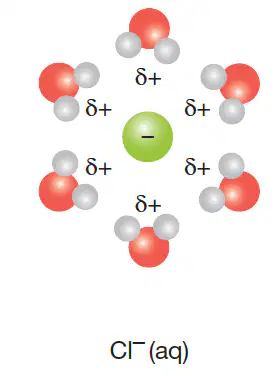
The chemical bonds that form between chloride ions and water molecules are best described as
chloride-water bonds.
ion-dipole bonds.
negative-positive bonds.
ionic bonds.
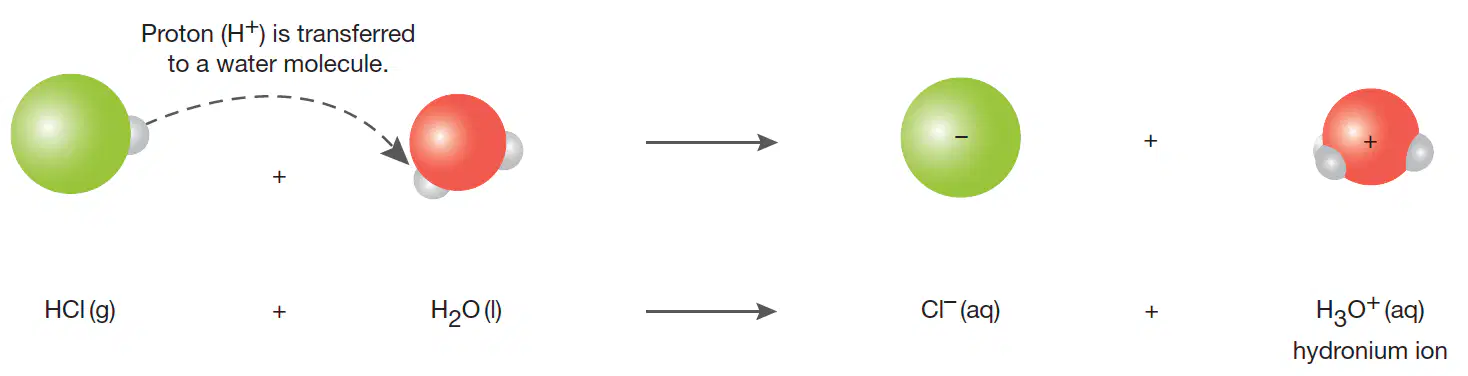
The process of HCl dissolving into water is best described as
ionisation.
dissolution.
precipitation.
fragmentation.

The bonds formed between water and ammonia molecules are best described as
hydrogen bonds.
covalent bonds.
dipole-dipole bonds.
intermolecular bonds.

To remove sulfate ions (SO42-) from a solution by precipitation you could add
Ca2+.
Na+.
Ba2+.
Fe3+.
To remove chloride ions (Cl-) from a solution by precipitation you could add
K+.
Fe2+.
Ag+.
Al3+.
To remove magnesium ions (Mg2+) from a solution by precipitation you could add
OH-.
NO3-.
SO42-.
Cl-.
A balanced ionic precipitation reaction for removing phosphate ions with aluminium ions is
Al3+(aq) + PO43-(aq) → AlPO4(s)
Al2+(aq) + PO43-(aq) → Al3(PO4)2(s)
Al2+(aq) + PO42-(aq) → AlPO4(s)
Al3+(aq) + PO4-(aq) → Al(PO4)3(s)
A correctly written and balanced ionic precipitation equation for the reaction between iron (III) and carbonate ions is
2Fe3+(aq) + 3CO32-(aq) → Fe3(CO3)2(s)
2Fe3+(aq) + 3CO32-(aq) → Fe2(CO3)3(s)
2Fe3+ + 3CO32- → Fe2(CO3)3
Fe3+(aq) + CO32-(aq) → Fe(CO3)(s)

