
Font size
 Worksheets
not hard
Total questions: 129
Worksheet time: 6hrs 51mins

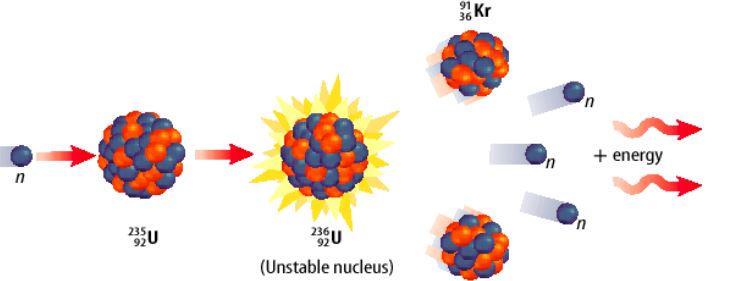
This is an example of...
Chain reaction
Fusion reaction
Decomposition reaction
Decay
What would be the advantage(s) of using nuclear fusion to produce energy?
no radioactive waste and more energy produced
safer
requires less regulation
more controlled energy produced, less radioactive waste produced

Hydrogen bombs are created from which process?
Fusion
Fission
Which process, fusion or fission, is considered a natural process?
Fission
Fusion

Daughter atom
the original, unstable radioactive element
stable atom that results from the decay of a radioactive atom
The time it takes for one half of the radioactive atoms in a sample to decay
parent atom
the original, unstable radioactive element
the time it takes for one half of the radioactive atoms in a sample to decay
a subatomic particle that has no charge and is located in the nucleus
What is decay?
a subatomic particle that has no charge located in the nucleus of an atom
a stable atom that results from a radioactive atom
a process in which a radioactive atom releases particles and energy
What is a Geiger counter?
an instrument that uses sonar to bounce sound waves off the ocean bottom
an instrument that measures vibrations in the ground
an instrument that detects the particles emitted or given off by decaying atoms
What is an isotope?
one of several forms of the same atoms; same number of protons but have different number of neutrons
a particle that has no charge and is located in the nucleus of an atom.
energy in the form of waves or particles that is emitted from an object and travels through space or air
What is the Law of Superposition used for?
to tell the absolute age of a rock or fossil
to tell the relative age of a rock or fossil based on where it is in the strata
to tell that all rocks and minerals are super
What is radiometric dating used for ?
to tell absolute age of a rock or fossil
to tell the relative age of a rock or fossil
a way to tell the age of materials based on measuring radioactive atoms and daughter atoms
What is a half-life?
the time required for one half of the radioactive atoms in a sample to decay
the time required for one third of the radioactive atoms in a sample to decay
When the radioactive atoms in a sample decay by half...
alpha decay
Beta decay
half-life
What is the energy that are waves or particles that are given off from an object?
radiation
decay
radiometric dating
isotope

This man was poisoned by
half-life
radiation
daughter atoms
Geiger Counter
Marie Curie discovered
Thorium
Polonium
uranium
How can radiation hurt us?
by exposing us to X-rays
Can make us spend money
destroys our cells and DNA
Radiation can help us by
treating cancerous masses in our body
X-ray
changing out cellular DNA
helping us learn and pass our Scantron and LEAP
Uranium238 take _________________for one half-life.
5730 years
20 billion
1.65 million
4.5 billion
If one has 12 kg of Polonium and it undergoes two half-lives, how much do you have left?
12 kg
3 kg
6 kg
After every half-life, a radioactive atom is
reduced by 50%
decreased by 1/4
increased by 1/2
The positive charge inside an atom
neutron
electron
proton
Does the rate of radioactive decay stay at a constant rate?
no
yes
When is the rate of radioactive decay the fastest?
end
beginning
middle
Earth elements decay and change into another element in a process called_____________.
radiation
isotope
radioactive decay
half-life
Geologist use the time it takes for a radioactive isotope to decay to half its original mass called a___________.
radioactive decay
isotope
half-life
carbon dating
The moon was made from a piece of _________ .
Moon
Earth
radioactive rocks
rock
Who's the better football team?!
Kentucky Wildcats
Georgia Bulldogs
Notre Dame Fighting Irish
Austin Peay Governors
Georgia Tech Yellow Jackets
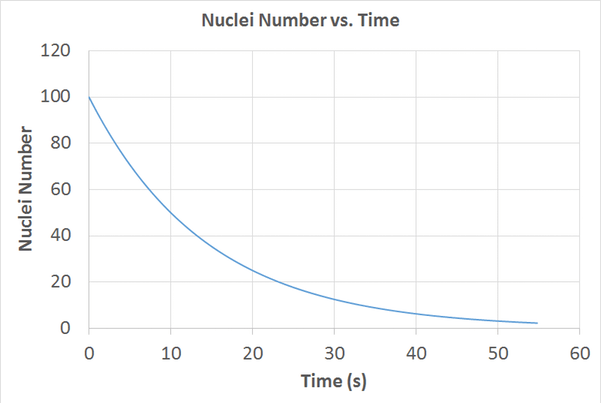
What is the Half life of this isotope?
5 seconds
10 seconds
15 seconds
20 seconds
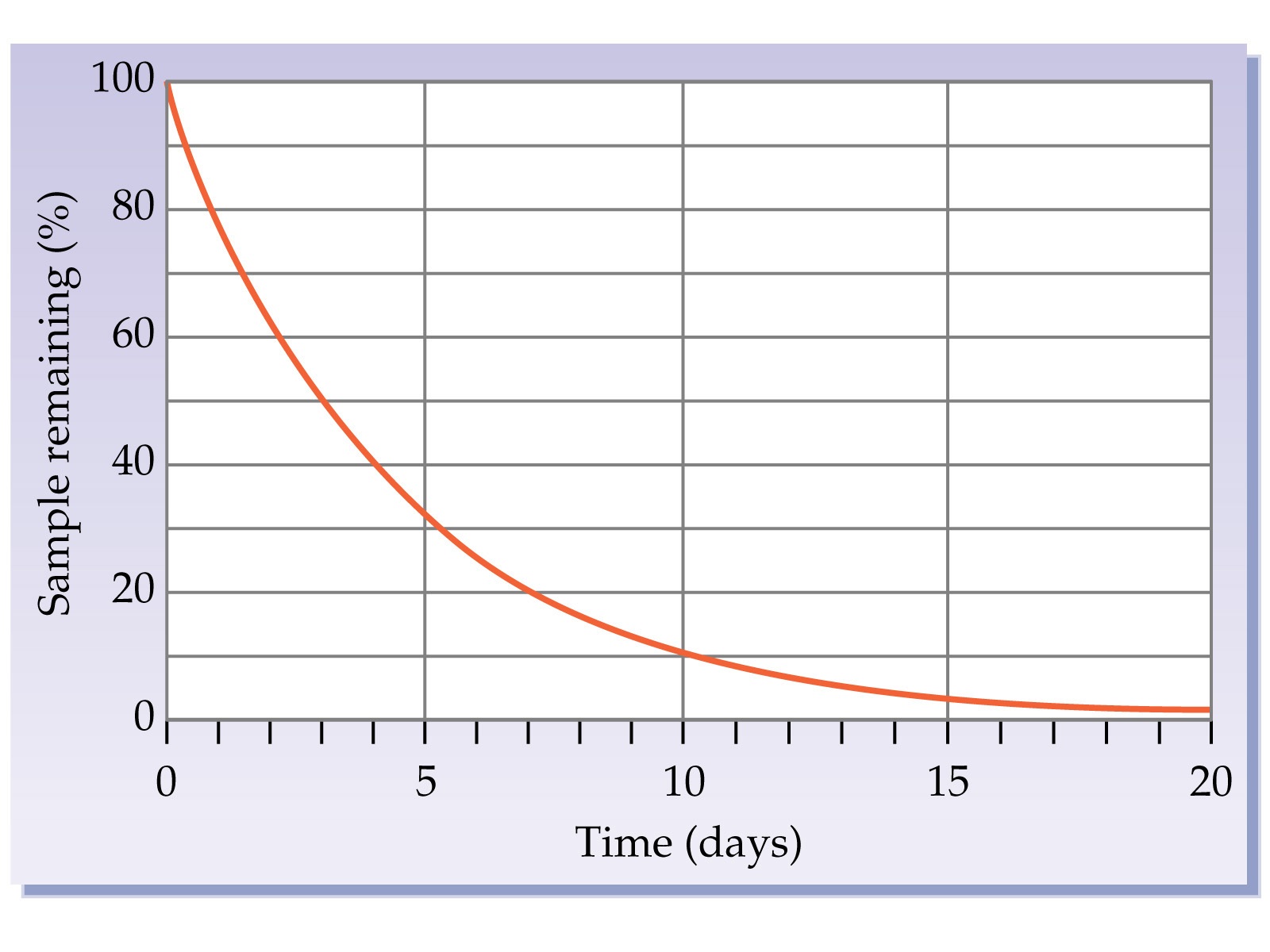
What is the Half Life of this isotope?
3 days
5 days
8 days
10 days

Which diagram best represents the percentage of this radioactive isotope sample that will remain after 2 half-lives?


How many grams are left after 1 half life?
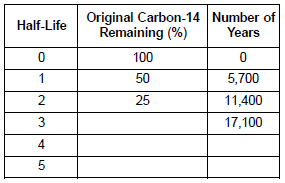
After 22,800 years, approximately what percentage of the original carbon-14 remains?
15%
12.5%
6.25%
3.125%

Geologist use the time it takes for a radioactive isotope to decay to half its original mass called a___________.
radioactive decay
isotope
half-life
carbon dating

Can be stopped by aluminum foil; has no mass and negative charge.
beta particle
alpha partcle
gamma ray
half-life
Powerful radiation that can cause biological damage.
beta particle
alpha particle
gamma ray
carbon dating
Using the decay of an isotope to find the age of a once-living object [fossil].
carbon dating
alpha particle
gamma ray
half-life
A helium nucleus; low energy.
gamma ray
carbon dating
half-life
alpha particle
Time necessary for 50% of a radioactive sample to decay.
carbon dating
half-life
alpha particle
gamma ray
Who was the first woman to win a Nobel Prize for her work with radioactivity?
Lise Meitner
Marie Curie
Jane Goodall
Judy Blume
The type of radioactive particle that can be stopped by a sheet of paper is the ____.
alpha particle
uranium
beta particle
gamma ray
The most penetrating type of radiation is the _______.
beta particle
gamma ray
uranium
alpha particle
One type of radioactive device that indicates the intensity of radiation with a clicking sound that increases in frequency as more radiation is present is a(n) ____.
bubble chamber
cloud chamber
electroscope
Geiger counter
Which subatomic particle seems to have a stabilizing effect on an isotope?
protons
neutrons
electrons
quarks

Which type of reaction does the diagram illustrate?
Fission
Fusion
Alpha Decay
Beta Decay
In which process does a heavy nucleus split into two lighter nuclei?
freezing
condensation
fission
fusion
What occurs in both fusion and fission reactions?
Small amounts of energy are converted into large amounts of matter.
Small amounts of matter are converted into large amounts of energy.
Heavy nuclei are split into lighter nuclei.
Light nuclei are combined into heavier nuclei.
In which type of reaction do two lighter nuclei combine to form one heavier nucleus?
combustion
oxidation
nuclear fission
nuclear fusion
This is an example of...
Chain reaction
Fusion reaction
Decomposition reaction
Decay
Which process, fusion or fission, is considered a natural process?
Fission
Fusion
Two nuclei with low masses are combined to form one nucleus of larger mass is called what?
Nuclear fission
Nuclear fusion
Nuclear half-life
Half-life
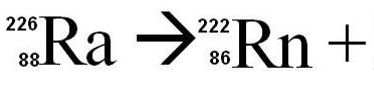
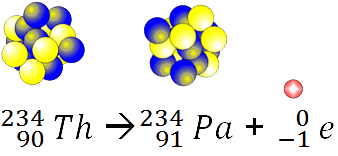
Which of the below are isotopes?


Which type of reaction does the diagram illustrate?
Fission
Fusion
Alpha Decay
Beta Decay

For the balanced equation, which particle is represented by X?
0-1 e
11 H
42 H
10 n
Which reaction represents fusion?




Which reaction represents fission?



