
 Worksheets
Chapter 4: Thermal Dynamics (PH)
Total questions: 12
Worksheet time: 11mins
One mole of an ideal gas does 3000 J of work on its surroundings as it expands isothermally to a final pressure of 1.00 atm and volume of 25.0 L. Determine the initial volume of the gas (in m3).
(a)
A gas is compressed at a constant pressure of 0.800 atm from 9.00 L to 2.00 L. In the process, 400 J of energy leaves the gas by heat. What is the work in Joules done on the gas?
(a)
A gas is compressed at a constant pressure of 0.800 atm from 9.00 L to 2.00 L. In the process, 400 J of energy leaves the gas by heat. What is the change in its internal energy?
(a)
A heat engine performs 200 J of work in each cycle and has an efficiency of 30.0%. For each cycle, how much energy is taken in?
(a)
An ideal gas is enclosed in a cylinder with a movable piston on top of it. The piston has a mass of 8 000 g and an area of 5.00 cm2 and is free to slide up and down, keeping the pressure of the gas constant. How much work in Joules is done on the gas as the temperature of 0.200 mol of the gas is raised from 20.0°C to 300°C?
(a)
A Carnot engine has a power output of 150 kW. The engine operates between two reservoirs at 20.0°C and 500°C. How much energy is lost per hour in its exhaust?
(a)
A Carnot engine has a power output of 150 kW. The engine operates between two reservoirs at 20.0°C and 500°C. How much energy does it take in per hour?
(a)
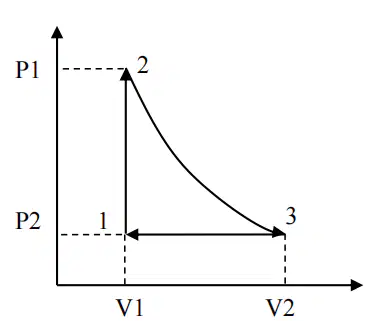
1 mole of an ideal gas follows the cycle shown in the figure. 1-2
is isochoric process, 2-3 is adiabatic process and 3-1 is isobaric
process. V1, P1 are given; V2 = 2V1, P2 = P1/3.
Determine (according to P1, V1): Adiabatic coefficient δ
(a)
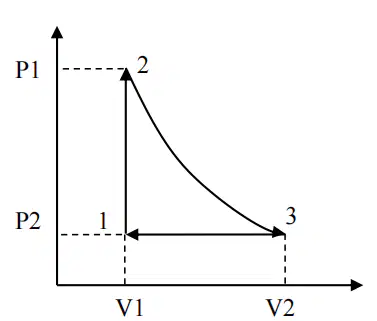
1 mole of an ideal gas follows the cycle shown in the figure. 1-2
is isochoric process, 2-3 is adiabatic process and 3-1 is isobaric
process. V1, P1 are given; V2 = 2V1, P2 = P1/3.
Determine (according to P1, V1): molar specific heats Cv
(a)
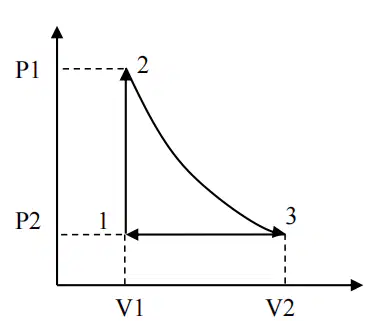
1 mole of an ideal gas follows the cycle shown in the figure. 1-2
is isochoric process, 2-3 is adiabatic process and 3-1 is isobaric
process. V1, P1 are given; V2 = 2V1, P2 = P1/3.
Determine (according to P1, V1): molar specific heats Cp
(a)
15 moles of oxygen are at the initial state with pressure p = 105 Pa and volume V = 0.35 m3 . The gas
expands quasistatically to V = 0.70 m3 . What is its final equilibrium temperature if the process is adiabatic?
T= 102.4 K
175.2 K
212.8 K
305.7 K
Calculate the heat Q produced during the isobaric cooling process of ideal gas sample with adiabatic
coefficient γ of 1.4, if the work W done by the compression is 16 J.
Q= 56 J
Q= 72 J
Q= 12 J D
Q= 25 J

