wayground logo

Free Printable Worksheets

Font size

S
M
L
XL
Worksheets

Final Exam Review Q1 Math 2 Honors

Total questions: 180

Worksheet time: 9hrs 10mins

Name
Class
Date
1.

Identify the angles of rotation that maps the image of the regular polygon to itself.

a)

multiples of 72°

b)

multiples of 180°

c)

multiples of 144°

d)

multiples of 45°

2.
Identify the angles of rotation that maps the image to itself.
a)
multiples of 120°
b)
multiples of 180°
c)
multiples of 90°
d)
multiples of 60°
3.
What are the angles of rotation for a square?
a)
multiples of 30
b)
multiples of 45
c)
multiples of 90
d)
multiples of 180
4.
What are the angles of rotation for an octagon?
a)
multiples of 45
b)
multiples of 51.4
c)
multiples of 60
d)
multiples of 72
5.

A transformation that does not change the size or shape of a pre-image (pre-image and image are congruent) is called

a)

isometry

b)

reflections

c)

rotations

d)

dilation

6.
Which is NOT an Isometry?
a)
Relection
b)
Dilation
c)
Rotation
d)
Translation
7.
Which of the following letters does not have a line symmetry, but has a rotational symmetry:
a)
H
b)
I
c)
Z
d)
X
8.
Which of the following letters does not have a line symmetry?
a)
H
b)
I
c)
Z
d)
X
9.
How many lines of symmetry does this shape have?
a)
2
b)
4
c)
6
d)
8
10.
How many lines of symmetry does this trapezoid have?
a)
0
b)
1
c)
2
d)
3
11.
What is the Algebraic Notation for this Reflection?
a)
(x, y) → (y, x)
b)
(x, y) → (-x, y)
c)
(x, y) → (-y, -x)
d)
(x, y) → (x, -y)
12.
B(-2, -4)
Reflect over the line y = x
a)
(2, -4)
b)
(-4, 2)
c)
(-4, -2)
d)
(4, 2)
13.

State a sequence of rigid motions that would map Quad QRST onto Quad PLKJ.

a)

A reflection over the x-axis followed by a reflection over the y-axis

b)

A rotation 180 degrees followed by a translation 2 units to the right

c)

A reflection over the y-axis followed by a translation 7 units down

d)

A reflection over the x-axis followed by a translation 6 units to the right and 3 units down

14.

If the red triangle is rotated 180 degrees, then reflected over y=2 what is the final image?

a)

Green Triangle

b)

Blue Triangle

c)

Orange Triangle

d)

Red Triangle

15.

A reflection over the x- and y-axes is the same as a ____________ of ______.

a)

Rotation of 180 Degrees

b)

Rotation of 90 Degrees

c)

Reflection over the x-axis

d)

Reflection over the y-axis

16.

What is the transformation from Triangle ABC to Triangle A''B''C''?

a)

Reflection x-axis, then rotation of 180 Degrees

b)

Reflection over y-axis, then rotation of 90 Degrees

c)

Rotation of 90 Degrees, then reflection over x-axis

d)

Rotation of 180 Degrees, then reflection over y-axis

17.

Point A (4, -2) is reflected over the line y = x, rotated 270 degrees CCW and reflected over the y-axis. What is A'''?

a)

Point A''' is (4, -2)

b)

Point A''' is (4, 2)

c)

Point A''' is (-2, 4)

d)

Point A''' is (-4, 2)

18.

Describe the transformation.

a)

translation by (x - 1, y + 6)

b)

reflection across x = -2

c)

translation by (x + 6, y - 1)

d)

reflection across y = -2

19.

Determine how to translate triangle ABC to triangle A'B'C'.

a)

(x + 2, y - 9)

b)

(x - 2, y + 9)

c)

(x - 9, y + 2)

d)

(x + 9, y - 2)

20.

If you were to rotate ABCD 90° counterclockwise about the origin, what would the coordinate of A' be?

a)

(-5, 5)

b)

(-3, 5)

c)

(-5, 3)

d)

(-3, 3)

21.

A nonagon is a nine-sided polygon. If a regular nonagon was rotated about its center point, which angle of rotation would not map the figure onto itself?

a)

120°120\degree

b)

80°80\degree

c)

60°60\degree

d)

40°40\degree

22.
What transformation is happening?
(x, y) ----> (x + 2, y - 3) 
a)

translation up 2, left 3

b)

translation right 2, up 3

c)

translation right 2, down 3

d)

translation left 3, right 2

23.
Identify the transformation.
a)
Reflection across y axis
b)
Reflection across x-axis
c)
180 Rotation
d)
Translation 2 units down
24.

Which series of transformations were performed in the figure?

a)

Translation 5 units down, reflection over the y-axis

b)

Reflection over the x-axis, translation 6 units right

c)

Rotation 90o clockwise, reflection over the x-axis

d)

Rotation 180o clockwise, reflection over the y-axis

25.

What are the final coordinates of B after a reflection over the x-axis and a translation <2 , 2>?

a)

(3, 1)

b)

(-3, -1)

c)

(-1, -3)

d)

(1, 3)

26.

What is the image of B(2,-3) after the translation (x,y)→ (x−2,y+4)?

a)

(0,1)

b)

(4,-7)

c)

(4,-12)

d)

(1,1)

27.

Point K has coordinates of (3, -4). What the coordinates of K' after being reflected across the y-axis?

a)

(-4,3)

b)

(-3,-4)

c)

(-4,-3)

d)

(3,4)

28.

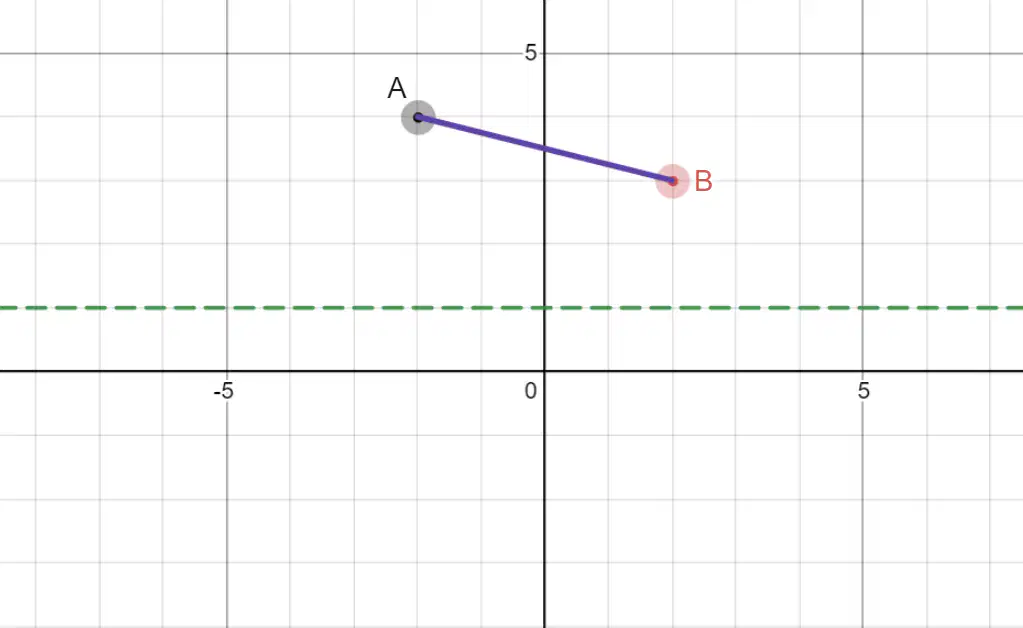
What are the coordinates of B' if Line Segment AB is reflected over the line y=1?

a)

(-2,-2)

b)

(2,-3)

c)

(2,-1)

d)

(-2,-4)

29.

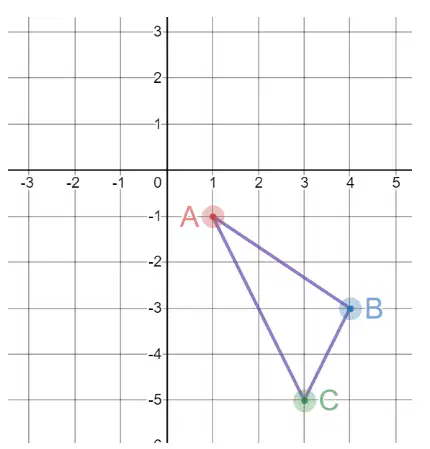
Find the coordinates of B' if Triangle ABC with coordinates A(1, -1), B(4, -3), C(3, -5) is rotated 270 degrees clockwise about the origin. 

a)

(4,3)

b)

(3,4)

c)

(-4,-3)

d)

(3,-4)

30.
Rotate the point (-3,-4) around the origin 180 degrees. State the image of the point.
a)
(-4,-3)
b)
(-4,3)
c)
(4,-3)
d)
(3,4)
31.

Given the vertex A(-2, 5), what are the coordinates of A' after the vertex has been

(a) rotated 270 degrees counterclockwise, and

(b) reflected about the y-axis?

a)

A'(-5, 2)

b)

A'(-5, -2)

c)

A'(2, -5)

d)

A'(-2, -5)

32.
The point (3,-2) is reflected across y = -x.  What are the coordinates after the transformation?
a)
(-2, 3)
b)
(3, -2)
c)
(2, -3)
d)
(2, 3)
33.

∆CAT contains the points: C(4, 2) A(5, 1) T(3,7). If the triangle is reflected across the line y= -x, what will C' be?

a)

C'(-4, 2)

b)

C'(4, -2)

c)

C'(2, 4)

d)

C'(-2, -4)

34.

What is going to be the coordinate of point Q?, if you rotate 90º clockwise about (-1,-2)

a)

Q' (-3, -5)

b)

Q' (3, -5)

c)

Q' (-5, 3)

d)

Q' (-2, -4)

35.

What is going to be the coordinate of point H?, if you rotate 180º about (-1,-1)

a)

H' (1, -5)

b)

H' (-5, 2)

c)

H' (0, -2)

d)

H' (0, -5)

36.

What is going to be the coordinate of point P?, if you rotate 90º counterclockwise about (-2,-1).

a)

P' (1, -2)

b)

P' (-1, -3)

c)

P' (1, 3)

d)

P' (-3, -2)

37.

What are the coordinates of the image of the quadrilateral EIQX? If you rotate 90º clockwise around point (1, -2)

a)

I' (1, 2); E' (0, 2); Q' (-1, -3); X' (-2, -1)

b)

I' (1, -2); E' (0, -2); Q' (1, -3); X' (-2, 1)

c)

I' (1, 3); E' (1, 2); Q' (-1, 3); X' (2, -1)

d)

I' (1, 3); E' (0, 3); Q' (-1, -2); X' (-2, 0)

38.

Rotate 90º counterclockwise point A (4, 1) around point (-1, 3).

a)

A' (-1, -8)

b)

A' (1, 8)

c)

A' (2, -8)

d)

A' (-2, 8)

39.
How many diagonals does a quadrilateral have?
a)
1
b)
2
c)
3
d)
4
40.
How many diagonals does a triangle have?
a)
0
b)
1
c)
2
d)
3
41.
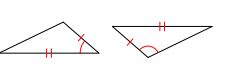
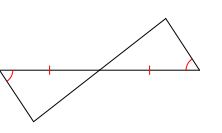
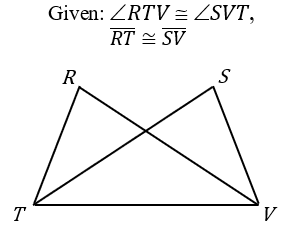
Are the triangles congruent, if yes, why?
a)
SAS
b)
ASA
c)
AAS
d)
Not congruent
42.
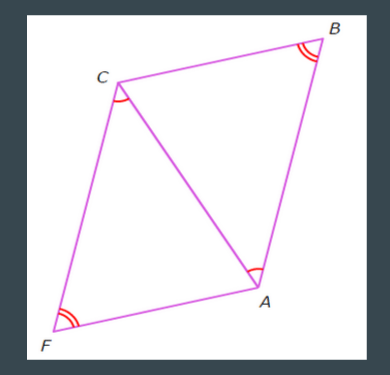
Are the triangles congruent, if yes, why?
a)
SAS
b)
ASA
c)
AAS
d)
Not Congruent
43.
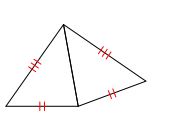
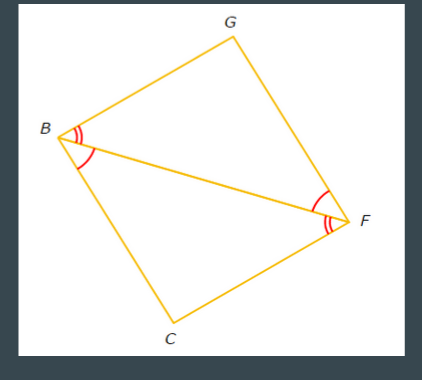
Are the triangles congruent, if yes, why?
a)
SSS
b)
SAS
c)
ASA
d)
Not Congruent
44.
Are the triangles congruent, if yes, why?
a)
SSS
b)
ASA
c)
AAS
d)
Not Congruent
45.
Are the triangles congruent, if yes, why?
a)
SSS
b)
SAS
c)
AAS
d)
Not Congruent
46.
Are the triangles congruent, if yes, why?
a)
SAS
b)
ASA
c)
AAS
d)
Not Congruent
47.
Are the triangles congruent, if yes, why?
a)
SSS
b)
SAS
c)
ASA
d)
AAS
48.
Are the triangles congruent, if yes, why?
a)
SSS
b)
SAS
c)
ASA
d)
AAS
49.
Are the triangles congruent, if yes, why?
a)
SSS
b)
SAS
c)
ASA
d)
Not Congruent
50.
What would be the correct "given" statements for this diagram?
a)
∡A≅∡C, and segment DB is the angle bisector of ∡CDA
b)
BD=BD, and DB=DB
c)
∡A≅∡C, and segment DB is the angle bisector of ∡CBA
d)
∡B≅∡D, segment DB is the angle bisector of ∡DCA.
51.
What would be the correct "given" statements for this diagram?
a)
T is the midpoint of segment BG and
∡B≅∡G
b)
∡B≅∡G and ∡A≅∡W
c)
T is the midpoint of segment BG and ∡A≅∡W
d)
T is the midpoint of segment AW and ∡A≅∡W
52.
What is the "statement" for step 2 of the proof?
a)
AD=AD
b)
AD=DA
c)
HD=DN
d)
HD=ND
53.
What is the "statement" for step 3 of the proof?
a)
AD=DA
b)
AD=AD
c)
HD=ND
d)
HD=DN
54.
What is the "reason" for step 4 of the proof?
a)
SAS
≅ theorem
b)
ASA
≅ theorem
c)
SSA
≅ theorem
d)
CPTCT
 theorem
55.
What is the "reason" for step 5 of the proof?
a)
Vertical Angle Theorem
b)
proof
c)
def. of angle bisector
d)
CPCTC Theorem
56.
Which of the following is not a valid reason to prove congruent triangles?
a)
ASA
b)
SAS
c)
SSS
d)
AAA
57.
Which of the following is not a valid reason to prove congruent triangles?
a)
SSA
b)
AAS
c)
SAS
d)
SSS
58.
What is the "statement" for step 3 of the proof?
a)
HA=HA
b)
HA=AH
c)
MA=AM
d)
MA=MA
59.
What is the "statement" for step 5 of the proof?
a)
HM=AT
b)
HM=TA
c)
∆MAH≅∆THA
d)
∡MAH≅∡THA
60.
What is the "reason" for step 5 of the proof?
a)
Angle Bisector Theorem
b)
Reflexive property
c)
CPCTC Theorem
d)
Proof
61.
Identify the  missing statement or reason
a)
LN≅MJ
b)
JK≅NK
c)
MK≅LK
d)
∠JKM≅∠NKL
62.
Identify the  missing statement or reason
a)
Reflexive Property
b)
Definition of Midpoint
c)
Given
d)
Vertical Angles Theorem
63.
Identify the  missing statement or reason
a)
Given
b)
Vertical Angles Theorem
c)
Definition of Angle Bisector
d)
Alternate Interior Angles Theorem
64.
Identify the  missing statement or reason
a)
Definition of Angle Bisector
b)
Alternate Interior Angles Theorem
c)
Reflexive Property
d)
Definition of Midpoint
65.
What does the word BISECT mean?
a)
To cut something into more than five pieces.
b)
It is a plane with two sets of wings.
c)
A shape that has three sides. 
d)
To cut something into two congruent pieces or in half.
66.
Are these triangles congruent? If so, state the rule which you used to determine congruence.
a)
Yes by ASA
b)
Yes by AAS
c)
Yes by SSA
d)
Not congruent
67.
Congruent by
a)
SSS
b)

Not Congruent

c)
ASA
d)
AAS
68.
Congruent by
a)
SSS
b)
SAS
c)
ASA
d)
AAS
69.
Congruent by
a)
SSS
b)
SAS
c)
ASA
d)
AAS
70.
Congruent by
a)
SSS
b)
SAS
c)
ASA
d)
AAS
71.
Congruent by
a)
SSS
b)
SAS
c)
ASA
d)
AAS
72.
Congruent by
a)
SSS
b)
SAS
c)
ASA
d)
AAS
73.
How are these two triangles congruent?
a)
AAS
b)
ASA
c)
Not enough information
d)
SAS
74.
How are these triangles congruent?
a)
AAS
b)
ASA
c)
SAS
d)
Not enough information
75.
How are these triangles congruent?
a)
AAA
b)
Not enough information
c)
ASA
d)
HL
76.
How are these two triangles congruent?
a)
Not enough information
b)
SAS
c)
ASA
d)
SSA
77.
What postulate proves these triangles congruent?
a)
SAS
b)
HL
c)
AAS
d)
ASA
78.
What additional information is needed to prove these triangles congruent?
a)
AC≅FE ; SAS
b)

AC ≅ DF ; HL

c)
AB≅ED ; HL
d)

AC≅DF ; SAS

79.
Name the postulate, if possible, that makes the triangles congruent.
a)
SSS
b)
ASA
c)
SSA
d)
HL
80.
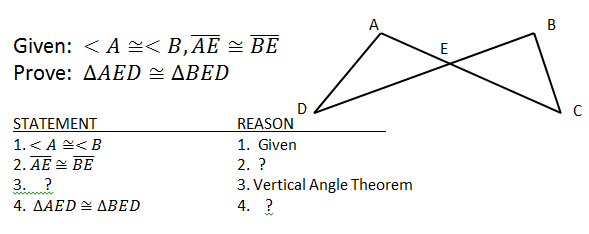
What is the "statement" for step 3 of the proof? 
a)
∡EDA≅∡DCB
b)
∡AED≅∡BEC
c)
DE=CE
d)
∡AED≅∡CED
81.
What is the "statement" for step 2 of the proof?
a)
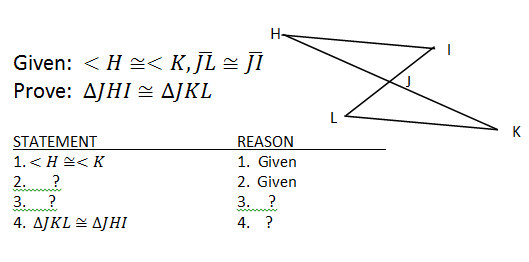
∡JHI≅∡JKL
b)
JL=JI
c)
∡H≅∡K
d)
HI=KL
82.
Fill in the missing proofs.
a)
Transitive Property, SAS(Side-Angle-Side)
b)
Reflexive Property, SAS(Side-Angle-Side)
c)
Reflexive Property, Vertical Angles Thm.
d)
Transitive Property, SSS(Side-Side-Side)
83.
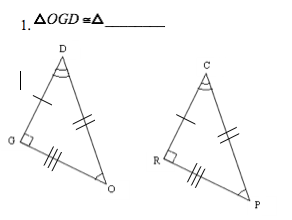
Complete the congruence statement.
a)
CRP
b)
PCR
c)
RPC
d)
PRC
84.
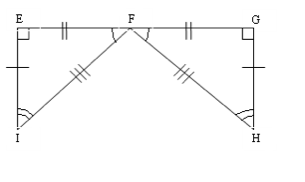
Which segment is congruent to EF? 
a)
HG
b)
HF
c)
GF
d)
IE
85.
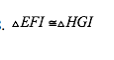
Use the congruency statement to answer the following: 
<F = ___
a)
<H
b)
<I
c)
<G
d)
not congruent to another angle
86.
Are these triangles congruent?
a)
Yes, by ASA
b)
Yes, by SAS
c)
No they are not congruent
d)
Not enough information to know for sure
87.
Are these triangles congruent?
a)
Yes, by AAS
b)
Yes, by ASA
c)
No they are not congruent
d)
Not enough information to know for sure
88.

What is #4 Reason?

a)

Alternate Interior Angles

b)

Vertical Angles

c)

Reflexive Property

d)

Angle Bisector

89.

What is #3 Reason?

a)

Alternate Exterior Angles

b)

Alternate Interior Angles

c)

Vertical Angles

d)

Angle Bisector

90.

What is #5 Statement?

a)

∠QPR ≌ ∠STR

b)

∠PQR ≌ ∠STR

c)

∠QRP ≌ ∠TSR

d)

∠QRP ≌ ∠SRT

91.
What is the measure of ∠ABC?
a)
25°
b)
75°
c)
108°
d)
150°
92.
If angle P measures 60 degrees, what is the measure of angle C?
a)
60 degrees
b)
30 degrees
c)
120 degrees
93.
Find L
a)
∠L=51°
b)
∠L=129°
c)
∠L=180°
d)
∠L=39°
94.
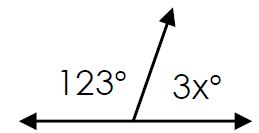
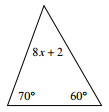
Solve for x. 
a)
8
b)
-10
c)
7
d)
4
95.
Solve for x. 
a)
8
b)
-5
c)
11
d)
-7
96.

What value of x will make m parallel to n?

a)

113

b)

166

c)

19

d)

133

97.
Solve for x.
a)
9
b)
-7
c)
4
d)
6
98.
Solve for x.
a)
4
b)
11
c)
9
d)
7
99.
Find the value of x.
a)
15
b)
16
c)
18
d)
19
100.
Solve for x
a)
5
b)
90
c)
25
d)
10
101.
Find the measure of the missing angle.
a)
90o
b)
100
c)
130o
d)
50o
102.
Find the measure of the indicated angle. 
a)
26
b)
36
c)
85
d)
144
103.

What is the measure of angle a?

a)

36o

b)

56o

c)

63o

d)

117o

104.

Find the indicated angle measure. (What is ?)

a)

51°

b)

37°

c)

167°

d)

41°

105.
Solve for x.
a)
16
b)
11
c)
50
d)
6
106.
Solve for x.
a)
8
b)
-10
c)
-7
d)
6
107.
Solve for x.
a)
6
b)
8
c)
15
d)
13
108.

If the  m7 = 115°,m\angle7\ =\ 115\degree,  find the measure of  2.\angle2.  

a)

115°115\degree  

b)

65°65\degree  

c)

180°180\degree  

d)

Cannot be determined

109.
a)

A

b)

B

c)

C

d)

D

110.

Find the measure of angle A

a)

A

b)

B

c)

C

d)

D

111.
a)

A

b)

B

c)

C

d)

D

112.

Find m∠B.

a)

150°

b)

67°

c)

54°

d)

57°

113.
Find the measure of the indicated angle. 
a)
35 degrees
b)
40 degrees
c)
25 degrees
d)
30 degrees
114.
What is the measure of angle A in the triangle?
a)
116*
b)
25*
c)
62*
d)
54*
115.

Find. 

mV.m\angle V.  

a)

52°

b)

55°

c)

90°

d)

45°

116.

Find

mRHG.m\angle RHG.  

a)

128°

b)

80°

c)

105°

d)

124°

117.

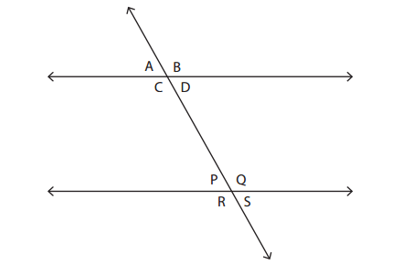
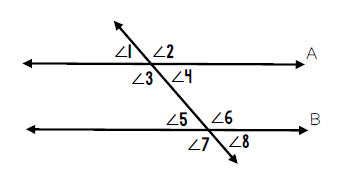
What pair of angles are vertical angles?

a)

r and s\angle r\ and\ \angle s   

b)

m and n\angle m\ and\ \angle n  

c)

p and q\angle p\ and\ \angle q  

d)

q and r\angle q\ and\ \angle r  

118.

Which pair of angles are consecutive interior angles?

a)

1 and 7\angle1\ and\ \angle7 

b)

3 and 5\angle3\ and\ \angle5

c)

5 and 4\angle5\ and\ \angle4

d)

8 and 1\angle8\ and\ \angle1

119.

Which pair of angles are alternate interior angles?

a)

p and q\angle p\ and\ \angle q

b)

q and o\angle q\ and\ \angle o

c)

t and m\angle t\ and\ \angle m

d)

n and o\angle n\ and\ \angle o  

120.

What type of angle pair is ∠1 and ∠3?

a)

Alternate interior angles

b)

Linear pair

c)

Corresponding angles

d)

Vertical angles

121.

Name the corresponding angle to 4\angle4

a)

8\angle8  

b)

6\angle6  

c)

2\angle2  

d)

5\angle5  

122.

Name the relationship.

a)

Alternate Exterior

b)

Vertical

c)

Alternate Interior

d)

Corresponding

123.

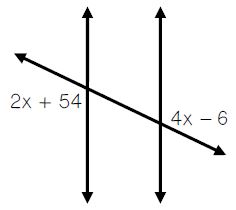
Find x.

a)

x = 45

b)

x = 30

c)

x = 20

d)

x = 25

124.

Solve for x. Then find the measure of the missing angle.

a)

x = 18; 60°60\degree

b)

x = 18; 120°120\degree

c)

x = 120, 60°60\degree

d)

x = 24, 120°120\degree

125.
Solve for x
a)
20
b)
60
c)
80
d)
120
126.
What is the value of y?
a)
29
b)
119
c)
58
127.
What is the length of DC
a)
4
b)
1
c)
2
d)
3
128.
Find the length of AD
a)
2
b)
4
c)
6
d)
8
129.
Find x, then the measure of AC
a)
x=2, AC=8
b)
x=2, AC=16
c)
x=4, AC=8
d)
x=4, AC=16
130.
Find m< JKM
a)
90
b)
76
c)
38
d)
83
131.
Does the graph have a minimum or a maximum?
a)
minimum
b)
maximum
132.
Does the graph have a minimum or maximum?
a)
minimum
b)
maximum
133.
Which of the following is the vertex of the graph?
a)
(2, 0)
b)
(-2, 0)
c)
(0, 4)
d)
(-1, 3)
134.
Which of the following is the vertex of the graph?
a)
(0, 3)
b)
(3, -6)
c)
(1, 10)
d)
(4, -5)
135.

Find the vertex of
y = x2 + 4x + 1

a)
(0, 0)
b)

(-2, -3)

c)
(2, 13)
d)
(0.375, 6.0625)
136.
Find the vertex of
y = 4x2 + 4x + 4
Use the equation in the picture!
a)
(0, 0)
b)

(-0.5, 3)

c)
(0.5, 4)
d)
(0.375, 6.0625)
137.
What would the equation
y = x2 - 6
do to the graph?
a)
move left 6
b)
move up 6
c)
move down 6
d)
move right 6
138.
What would the equation 
y = x2 + 15 
do to the graph?
a)
move down 15
b)
move up 15
c)
move left 15
d)
move right 15
139.
Which equation below matches the graph?
a)
y = x2 + 4x + 3
b)
y = x2 + 4x
c)
y = x2 + 3
d)
y = x2 + 3x + 1
140.
Which equation do you use to find the axis of symmetry? 
a)
y = mx + b
b)
x = -b / 2a
c)
x = a(b)x
d)
y = -b / 2a
141.
What is the axis of symmetry for this graph? 
a)
x = 2
b)
x = -4
c)
y = -4
d)
there is not one
142.
What is the "b" in this equation? 
a)
1
b)
4
c)
0
d)
x
143.
If y=0, what are the values of x?
a)
-1 and 3
b)
1
c)
0 and 2
d)
-3
144.
What direction is the following equation opening?
y=-3x2-7x+8
a)
Up
b)
Down
c)
Left
d)
Right
145.
A parabola has a vertex at (-3,2). Where is the axis of symmetry?
a)
y = -2
b)
x = 3
c)
x = -3
d)
y = 2
146.
Which answer choice describes  y = -3x2 +7x - 2 accurately?
a)
opens up with a maximum
b)
opens up with a minimum
c)
opens down with a maximum
d)
opens down with a minimum 
147.
The graph of a quadratic function is called a
a)
Parabola
b)
Vertex
c)
Axis of Symmetry 
d)
Vertex Form
148.

Identify the 'b' value:  y=16x28x24y=16x^2-8x-24  

a)

1616  

b)

8-8  

c)

88  

d)

24-24  

149.

Identify the 'a' value:  y=16x28x24y=16x^2-8x-24  

a)

1616  

b)

88  

c)

8-8  

d)

24-24  

150.
What's the axis of symmetry of y = 3x- 6x + 4
a)
x=1
b)
x=-6
c)
x=2
d)
x=-1
151.
Find the axis of symmetry for
f(x) = x2- 8x + 15.
a)
x = -4
b)
x = 4
c)
y = 4
d)
y = -4
152.
What is the vertex of y=x2+4x+3?
a)
(2,1)
b)
(-2,1)
c)
(0,0)
d)
(-2,-1)
153.
Find the y-intercept of f(x) = 2x- 2x + 1
a)

(0,2)

b)

(0,-2)

c)

(0,1)

d)

(0,-1)

154.

If the quadratic parent function, f(x)=x2, becomes g(x)= -3x2, what transformation(s) ocurred?

a)

shift left 3 units

b)

reflect across x-axis and vertical stretch by 3

c)

shift down 3 units and vertical compression by 1/3

d)

vertical compression by 3

155.

Which equation matches the graph shown here?

a)

y = 2(x - 4)2 + 5

b)

y = -2(x - 4)2 + 5

c)

y = 2(x + 4)2 + 5

d)

y = -2(x + 4)2 + 5

156.

Which equation has a vertex at (7, -6)?

a)

f(x) = -2(x - 7)2 - 6

b)

f(x) = -7(x + 7)2 + 6

c)

f(x) = 3(x - 7)2 + 6

d)

f(x) = 0.5(x + 7)2 - 6

157.
Does this parabola have a minimum or maximum and what is its value?
a)
minimum: 2
b)
maximum: 2
c)
minimum: 5
d)
maximum: 5
158.
What are the x- intercepts?
a)
x= 0 and x= -4
b)
x= 0 and x= 4
c)
y= 0
d)
x= 2
159.
What are the coordinates of the y-intercept?
a)
(-3, 0)
b)
(0, -3)
c)
(2, 1)
d)
y=-3
160.

Solutions to quadratic equations are called...

a)

Zeros, Roots

b)

Parabolas

c)

Vertexes

d)

Min & Max

161.

The Standard Form of a quadratic equation...

a)

y = ax2 + bx + c

b)

y = a(x - h)2 + k

c)

y = mx2 + b

d)

y - y1 = m(x - x1)

162.

What is the y-intercept of the graph shown above?

a)

all real numbers

b)

(0,6)

c)

(0,2)

d)

(0,-6)

163.
What is the vertex?
f(x) = 2(x - 5)2 + 12
a)
(-5, -12)
b)
(5,-12)
c)
(5, 12)
d)
(-5, 12)
164.
What is the y-intercept?
f(x) = 2(x - 5)2 + 12
a)
(0, -5)
b)
(0,12)
c)
(0, 62)
d)
(0, 212)
165.
a)
A
b)
B
c)
C
d)
D
166.
a)
A
b)
B
c)
C
d)
D
167.

Which of these shows a parent function of a quadratic equation moved 1 unit down?

a)

f(x)=(x-1)2

b)

f(x)=(x+1)2

c)

f(x)=1x2

d)

f(x)=x2-1

168.

Which of these shows a parent function of a quadratic equation moved 5 units to the right?

a)

f(x)=(x-5)2

b)

f(x)=(x+5)2

c)

f(x)=5x2

d)

f(x)=x2+5

169.

Which of these shows a parent function of a quadratic equation vertically stretched by 2?

a)

f(x)=(x+2)2

b)

f(x)=x2+2

c)

f(x)=2x2

d)

f(x)=(x2)2

170.
Write the equation of a parabola with vertex (1, -2), passing through point (3, 10) 
a)
y= 3(x-1)2+2
b)
y= 3(x+1)2-2
c)
y= -3(x-1)2-2
d)
y= 3(x-1)2-2
171.
Write the equation of the parabola with a vertex of (-3,5) passing through a point (-6,-4)
a)
y= -(x-3)2+5
b)
y= -1/9(x+3)2-5
c)
y= -(x+3)2+5
d)
y= 1/9(x+3)2+5
172.
A quadratic graph has a vertex of (2, 5) and passes through the point (1, 1), what is the a-value?
a)
a = 2
b)
a = 5
c)
a = -4
173.
Identify the vertex and whether the graph opens up or down.
a)
(5, 2); opens up
b)
(5, 2); opens down
c)
(-5, 2); opens up
d)
(-5, 2); opens down
174.

What is the vertex form of a quadratic function?

a)

f(x) = 2a(x-h)2 + k

b)

f(x) = a(x-h)2 + k

c)

f(x) = (x+h)2 + k

d)

f(x) = a(x-h) - k

175.

Given f(x) = (x + 6)² - 2 , how did we transform from the parent function?

a)

Horizontal shift left 6, vertical shift up 2

b)

Horizontal shift left 6, vertical shift down 2

c)

Horizontal shift right 6, vertical shift down 2

d)

Horizontal shift right 6, vertical shift up 2

176.

Given f(x)=14x2f\left(x\right)=\frac{1}{4}x²  how did we transform from the parent function?

a)

Vertical compression (wider)

b)

Vertical stretch (narrower)

c)

Vertical compression (wider) and reflection over x-axis

d)

Vertical stretch (narrower) and reflection over x-axis

177.

Describe the transformation below: (x+3)2+6-\left(x+3\right)^2+6  

a)

reflect over the x-axis

b)

reflect over the x-axis, left: 3, up: 6

c)

stretch, left: 3, down: 6

d)

left: 3, down: 6

178.

Identify the a, h, and k term from the following equation: (x+3)2+2\left(x+3\right)^2+2  

a)

a=-1, h=3, k=2

b)

a=3, h=3, k=3

c)

a=1, h=-3, k=2

d)

a=1, h=-3, k=-2

179.

Identify the a, h, and k terms in the following equation: 2(x+4)212\left(x+4\right)^2-1  

a)

a=2, h=-4, k=-1

b)

a=-2, h=4, k=1

c)

a=2, h=4, k=1

d)

a=-2, h=-4, k=1

180.

Determine the vertex from the following equation: 3(x4)2+1-3\left(x-4\right)^2+1  

a)

Vertex: (4,1)

b)

Vertex: (-4, -1)

c)

Vertex: (4, -1)

d)

Vertex: (-4, 1)