
 Worksheets
Final Semester 1 Review
Total questions: 130
Worksheet time: 3hrs 33mins
Contains only one kind of atom.
Element
Compound
Mixture
Contains more than one type of atom held together by a chemical bond.
Element
Compound
Mixture


A ______ is the smallest building block of matter.
compound
element
atom
The center of an atom is called a ______.
electron
proton
nucleus
A group of the same atoms that are bonded together is called...
element
compound
mixture
The students measured length during a science experiment, they got 12 cm. But the actual measurement was 14.25 cm. What was the percent error?
15.79%
18.75%
2.25%
18%
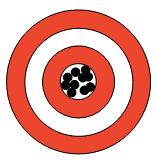


Choose the best description below for the image
physical change
chemical change
What kind of change occurs if matter changes in amount, size, or shape?
substance change
chemical change
physical change
elemental change
1) True or False: Intensive Properties change as the amount of substance changes.
True
False
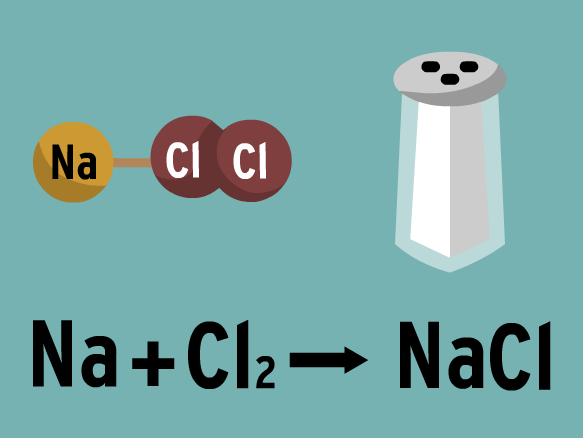
In a chemical reaction, 4 grams of sodium must combine with how many grams of chlorine to produce 10 grams of table salt?
4 grams
6 grams
8 grams
10 grams
Determine the number of oxygen atoms in Al(OH)3
1
2
3
4
Calculate the molar mass of CuBr2
143.45 g/mol
223.35 g/mol
287.30 g/mol
307.90 g/mol
What is the percent by mass of Cu in CuBr2?
50%
71.6%
28.4%
44.3%
What is the percent by mass of Br in CuBr2?
50%
71.6%
28.4%
44.3%
How many H atoms are in (NH4)3PO4?
4
7
12
15
What did Rutherford discover about atoms?
An atom is always negatively charged.
An atom is mostly empty space, but has a dense positively charged center(nucleus).
An atom is always positively charged.
All particles will pass straight through gold foil with no change in path.
Rutherford's "gold-foil" experiment using alpha particle scattering concluded that
the center of the atom is empty
atomic mass is spread over the whole atom
the center of the atom has a negative charge
most of the atom is empty space
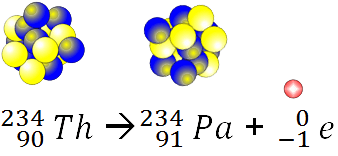


Why does alpha decay occur?
The nucleus is too large to be stable
The proton to neutron ratio is unstable
The nucleus is in an excited state. This usually follows other types of decay.
Why does beta decay occur?
The nucleus is too large to be stable
The proton to neutron ratio is unstable
The nucleus is in an excited state. This usually follows other types of decay.
Why does gamma decay occur?
The nucleus is too large to be stable
The proton to neutron ratio is unstable
The nucleus is in an excited state. This usually follows other types of decay.
gamma waves
has a high penetrating power
has a lower penetrating power
has a medium penetrating power
if Phosphorus-32 decay into beta reaction the result will be:
Sulfur- 28
Sulfur-32
Al-32

How many protons are in Sodium?
11
22
12
33

How many electrons are in Aluminium?
40
27
13
14

How many neutrons are in Phosphorus?
16
15
31
46
Different isotopes of an element contain different numbers of ___.
protons
neutrons
electrons
elements
If a proton is added or removed from an atom, what happens?
It becomes a different element.
It becomes a different isotope.
Nothing happens.
What is the difference between Neon-20 and Neon-22?
They have different numbers of electrons.
They have different numbers of neutrons.
Only 1 is radioactive.
No difference.

Which EM waves have the longest wavelength?
radio
x-rays
ultraviolet
gamma rays
Which EM waves have the shortest wavelength?
radio
x-rays
ultraviolet
gamma rays
Which EM waves are have a SHORTER wavelength than visible?
radio
none
infrared
x-rays
Which EM waves are have the highest energy & are the most dangerous?
radio
gamma rays
infrared
x-rays
The relationship between wavelength and frequency
direct relationship
straight relationship
inverse relationship
no relationship
The full range of frequencies of electromagnetic radiation is called
visible light.
radio waves.
the electromagnetic spectrum.
invisible radiation.

Calculate the energy of the photons in a type of electromagnetic radiation if the frequency is 4,5 x 10¹⁸ Hz.
2,98 X 10¹⁵ joules
1,47 x 10-52 joules
6,79 x 1051 joules
2,98 X 10⁻¹⁵ joules
Which two terms describe the dual nature of light?
particle and solid
wave and flat line
transverse and longitudinal
wave and particle

Which example shows a violation of Hund's Rule?
A
B
C
D
An aluminium ion would have which electron configuration?
1s2 2s2 2p6 3s2
1s2 2s2 2p6 3s2 3p1
1s2 2s2 2p6 3s2 3p6
1s2 2s2 2p6
Which ion is this an electron configuration of: 1s22s22p63s23p6
Na+
O2-
P3-
Rb+

This orbital diagram represents
Nitrogen
Oxygen
Carbon
Neon


1s22s22p63s23p64s23d10
Zinc (Zn)
Copper (Cu)
Nickel (Ni)
Germanium (Ge)
What element has the following electron configuration:
1s22s22p63s23p64s23d104p5
Bromine (Br)
Chlorine (Cl)
Calcium (Ca)
Manganese (Mn)


Which one is NOT TRUE about isotopes of an element?
The amount of protons stays the same.
The amount of neutrons may be different
The mass changes based on the total of protons and neutrons
A new element is made with every neutron added.
The _______________electrons are the electrons on the outer most energy level of the atom.
valence
core
excited
ground state
Elements of the same ______________ have the same number of valence electrons, which determines the elements chemical properties.
Period
Row
Group
Group 1: These metals are extremely reactive. They all have one valence electron. They are shiny and silver in color. They are soft and can be cut with a knife.
Transition Metals
Alkali Metals
Alkaline Metals
Lanthanides
Group 2: Slightly less reactive because they have 2 valence electrons. They are silver colored and more dense that Group 1 metals.
Transition Metals
Alkali Metals
Alkaline-earth Metals
Actinides
Group 17: All nonmetals. Very reactive. Poor conductors of heat and electricity. Tend to form salts with metals. Example NaCl: sodium chloride which is known as table salt. These elemtns have 7 valence electrons (Group # minus 10).
Boron Group
Oxygen Group
Nitrogen Group
Halogens
Group 18: Unreactive nonmetals. All are colorless, odorless gases at room temperature. These elements have a full outer energy level, usually 8 valence electrons, except for Helium which only has 2 valence electrons.
Nitrogen Group
Oxygen Group
Noble Gases
Halogens

Which pair of elements would most likely have similar properties?
Calcium (Ca) and cobalt (Co)
sodium (Na) and chlorine (Cl)
boron (B) and phosphorus (P)
oxygen (O) and sulfur (S)
Valence electrons are those that are
closest to the nucleus.
freely floating between atoms.
in the outermost energy level of the atom.
unable to become involved in chemical bonding.
Oxygen has six valence electrons. When forming an ion, oxygen will
lose six electrons and have a charge of +6.
lose six electrons and have a charge of -6.
gain two electrons and have a charge is +2.
gain two electrons and have a charge of -2.
Look at the periodic table. What should be the charge on the ion formed by calcium?
+1
+2
-1
-2
Atoms that have gained electrons form
cations.
anions.
negions.
positrons.
Most elements are most stable when their outermost energy levels contain ________ electrons.
2
6
8
18
Which of the following tend to gain electrons when forming ions?
metalloids
metals
nonmetals
cations
Which of the following groups on the Periodic Table will only form ions with positive charges?
Group 2
Group 15
Group 17
Group 18
Ionic bonds involve a transfer of electrons from a __________ to a ___________.
(a)
Which is the formula for aluminum oxide?
AlO
Al2O2
Al2O3
Al3O2
What is the formula for calcium oxide?
CaO
Ca2O2
CaO2
Ca2O
Why do transition metals get different rules for their names and formulas?
atoms are larger
cations have many different charges
they have more protons
they are rare elements

What is the correct name for this compound?
fluorine chlorine
iron chloride
iron(II) chloride
iron(I) chloride

What is the correct name for this formula?
lead(IV) iodide
lead iodide
lead iodine
lead(I) iodide
What is the formula for iron(III) oxide?
FeO
Fe(III) O
Fe2O3
Fe3O2

What is the name of this ion?
fluorine 3
iron(III) ion
iron(III)

What is the name of this ion?
copper(I) ion
copper
copper(+1) ion
What is the formula for copper(I) oxide?
Cu2O
CuO
CO
C2O
What is the name of this compound? Na2S
nitrogen(II) sulfide
sodium(II) sulfide
sodium sulfide
sodium(I) sulfide
In the compound TiO2, Titanium has a charge of
+4
+3
+2
+1
CrN

