
 Worksheets
Algebra 2 Midterm review quizziz
Total questions: 172
Worksheet time: 32hrs 59mins
What is the domain of this function?
y=x−1−3
{x ∣ x ≥ 1}
{x ∣ x ≤ 1}
{x ∣ x ≥ -3}
{x ∣ x ≥ -1}
What is the range of this function?
y=x−1−3
{y ∣ y ≥ 1}
{y ∣ y ≥ -1}
{y∣ y ≥ -3}
{y ∣ y ≤ -3}
Which of these equations shifts a radical equation right 5 units and down one unit?
y=x−5−1
y=x+5−1
y=x−5+1
y=x+5+1

What is the equation of the graph?
y=x+3
y=−x+3
y=−x+3
y=x+3

Determine the equation for the graph.
y=2x−4
y=−x−4
y=2x
y=2x+4
Describe the transformations of the equation y=−3x−2+1
Note: stretch means to grow and compress means to flatten
reflects over horizontal line, vertical stretch by 3, right 2, up 1
reflects over vertical line, vertical compression by -3, left 2, up 1
reflects over horizontal line, vertical stretch by -3, left 2, up 1
reflects over vertical line, vertical compression by 1/3, right 2, up 1

The extraneous solution of the equation is...
−5
−8
−10
−4
4132x=1
1/512
1/16
1/32
1/2
4x + 1 = 3
64
121
16
None of these
Find the inverse function of y=(x−4)2+3
y=x−3+4
y=x+3−4
y=x−3+4
y=3x+1
Find the inverse of f(x)=x+2+9
f(x)=(x−9)2−2
f(x)=(x+9)2+2
f(x)=x+9+2
f(x)=x−9−2
Find the inverse function of y=4+x−8
y=(x−4)2+8
y=(x+4)2−8
y=(x+8)2−4
y=(x−8)2+4

Describe the transformation.
Left 1unit, Reflect over x-axis, up 2 units
Left 1unit, Reflect over y-axis, down 2 units
Right 1 unit, Reflect over x-axis, up 2 units
Right 1unit, Reflect over y-axis, up 2 units

The solution of the equation is between...
−50 and −40
−20 and −10
−30 and −20
−40 and −30
(x+2)21+3=7
14
-14
98
0
2x−6−3x−14=0
8
-20
-8
20
29−x−1−9x=0
-17/7
-7
17/11
7
8−x=x−6
-7
7
4
-4


Find f[g(5)]
30
242
92
2

f(g(x))
3x - 16
3x - 2
3x - 26
4x - 2

Find h(f(-2))
0
2
-2
26
A relation that is one-to-one
passes both the vertical and horizontal line tests
has an inverse relation that is a function
has no repeating x values and no repeating y-values
All of these
f(1) = -3
f(2) = -2
f(-1) = 2
f(3) = -1

What is f°g°f−1(6)?
(a)

Determine the number of solutions to the given linear-quadratic system.
0 solutions
1 solution
2 solutions
3 solutions

What are the solutions to the graphed system?
(0,-2) and (3,1)
(-2,0) and (2,0)
(0,2) and (3,1)
(2,2) and (1,0)

A
B
C
D
Solve the system of linear and quadratic equations:
y = 5
y = 2x2 - 16x + 29
(6, 5) and (2, 5)
(2, 6)
(6, 2)
(5, 6) and (5, 2)

What is the solution to the linear-quadratic system graphed in the picture.
(0, 0)
(3, 0)
(2, -3)
(-3, 2)
A system that contains one linear function and one quadratic function can have 0, 1, or 2 solutions.
True
False
Cannot be determined
Nobody cares


What are the solutions to this quadratic/ linear system?
no solution
(3,0) and (4, 5)
(0,3) and (4, -5)
(3,4) and (0,-5)

What are the solutions to this quadratic/ linear system?
(-2, 0) and (3,0)
No Solutions
-6 and -10
(1,-6)
y = x2 - 4x + 6
y = x + 2
y = x2 + 3x - 5
y = x + 3


What are the solutions to the system:
y = x2 - 2x + 1
y = -2x + 2
(-1,0) and (1,4)
(1,0) and (-1,4)
(1,0) and (4,1)
(-1,0) and (-1,4)
Determine the number of solutions to the given system:
y = x2 + 4x - 5
y = -x + 2
0 solutions
1 solution
2 solutions
3 solutions
Simplify the expression:
(8 + 9i) + (4 − 6i)
17 + 3i
12 + 3i2
17 −2i
12 + 3i
Simplify the expression:
(5 + 14i) − (10 + 2i)
5 −16i
−5 + 16i
5 − 12i
−5 + 12i
Simplify the expression:
(5 + 4i) − (−1 − 2i)
6 +6i
4 + 2i
6 − 6i
4 − 2i
Simplify the expression:
(1 + 5i) + (1 − 5i)
2 + 10i
2 + 10i2
2
−8
Simplify
(12 - 4i) + (-2 + 8i)
8 + 104i
10 + 4i
14 - 4i
10 - 12i
Simplify the expression:
(5 + 4i) − (−1 − 2i)
6 +6i
4 + 2i
6 − 6i
4 − 2i
Simplify: 2i(4 + 3i)
−6 + 8i
6 + 8i
−6i + 8i
−1 + 8i
Simplify: (−2 + 7i)(4 − 2i)
6+ 32i
−6 + 32i
22+32i
6 + 24i
Simplify: 3i(3i−4)
−9 −12i
9i−12i
9−12i
−9+12i
Simplify 8i12
−813i
−47i
−23i
73i
Simplify 16i3
−163i
−83i
−4i
−2i
Simplify −9i11
911i
1311i
i
914i

What is the conjugate of 5 - 2i?
5 + 2i
-5 - 2i
5 - 2i
-5 + 2i
Simplify: i72
i
-i
1
-1
Simplify: i³¹
i
-i
1
-1

Solve this system of equations by substitution.
y = 2x + 1
y = 4x - 1
Solve the system by substitution.
5x + 4y= −14
y = −7x − 15
Solve by substitution:
y = 2x -11
-3y = -6x -15
Solve by substitution
x + 2y = 2
x = -4y + 2
Solve by substitution:
x - 3y = -13
4x + 2y = 4
Solve by substitution:
y = -6x + 5
-2x + y = 5
Solve by substitution:
y = -2x + 5
y = 2x - 11
Solve the following system by substitution:
y=6x−11
−2x−3y=−7
(2, 1)
(1, 3)
(2, 5)
(3, 2)
Solve the following system by substitution:
2x−y=−1
y=x−1
(−2,−3)
(4, 5)
(5, 3)
(3, 4)
MSP #1: Solve this system of equations by substitution:
2x−7=3y and 3x=2−4y
DO NOT TYPE SPACES, MAKE SURE YOUR ANSWER IS TYPED AS A COORDINATE!
(a)
y=−3(x+5)2−4
Convert the equation from vertex form to standard form.
y = 9x2 - 15x + 21
y = -3x2 - 75x - 4
y = 9x2 + 90x + 221
y = -3x2 - 30x - 79
y=−5(x+2)2−10
Convert the equation from vertex form to standard form.
y = -5x2 - 20x - 30
y = -5x2 - 4x - 10
y = 25x2 + 100x + 90
y = 25x2 - 10x - 30
y=−32(x−9)2−2
Convert the equation from vertex form to standard form
y=−32x2−12x−52
y=−32x2+12x−56
y=−32x2+18x−56
y=−32x2−18x+52


MSP#1
What is the value?
(number only)
(a)


MSP#3 SEPARATE ANSWERS BY A COMMA!
(a)
Which quadratic function in vertex form can be represented by the graph that has a vertex at (3,-7) and passes through the point (1,-10)?


Which function is best represented by this graph?


What is the equation in vertex form?
y = 4(x + 3)2 - 4
y = -4(x - 3) - 4
y = -4(x + 3)2 + 4
y = -4(x - 3)2 + 4
If given the equation y = 3(x + 5)2 - 4, what is the vertex of the parabola?
(5, -4)
(-5, -4)
(-15, -4)
(15, -4)

What is the domain of this quadratic graph?
y ≥ 3
y ≤ 3
ℝ
y ≤ 2
Write the equation of the quadratic function that has a x-intercepts at (2, 0) and (4, 0) and passes through the point (3, 4).
y = -4(x - 2)(x - 4)
y = -4(x + 2)(x + 4)
y = 4(x - 2)(x - 4)
y = -0.25(x - 2)(x - 4)
Let f(x)=x2−4x+2, and let
g(x)=6−x.
What is the sum of the possible values of k such that f(k)=g(k)
.
-1
4
3
-3
A rectangle has a perimeter of 50 m
and an area of 150 m2. What is the difference between the length and width?
5 m
10 m
15 m
20 m
Let f(x) = 2x2 – 4x + 1 and
g(x) = (x2 + 16)(1/2). If k is a negative number such that f(k) = 31, then what is the value of (f(g(k))?
31
-35
5
-81
Two consecutive positive multiples of three have a product of 54. What is the sum of the two numbers?
3
9
12
15
If f(x) = -x2 + 6x - 5, then which could be the value of a if f(a) = f(1.5)
-1
2.5
3.5
4.5
What is the solution of the quadratic inequality x2 - x ≥ 12?
{x / -3 ≥ x ≥ 4}
{x / -3 ≤ x ≤ 4}
{x / x ≤ -3 U x ≥ 4}
{x / x ≤ 4 U x ≥ -3}
Solve:
3x - x2 > 0
(−∞, 0) U (3, ∞)
(−∞, - 3) U (0, ∞)
(-3, 0)
(0, 3)
Solve: 5x - 10x2 < 0
(0, ½)
[0, ½]
(−∞, 0) U (½, ∞)
(- ½ , 0)
Solve:
2x2 + 5x ≥ 12
[-4, 1.5]
(−∞, -4) U (1.5, ∞)
(−∞, -4] U [1.5, ∞)
no solution
What are the zeros of the function f(x) = x2 + 64? (Hint: b=0)
-8 and 8
-8i and 8i
(-i√8) and (i√8)
-√8 and √8

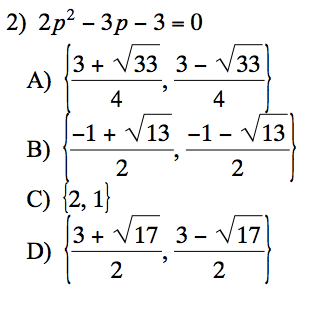
2x2 - 9x - 35 = 0

x2 + 4x + 3 = 0
Use the quadratic formula to find the solutions for
y = -x2 - 5x + 12
-4.9 and -0.1
-8.54 and 8.54
-0.45 and 3.55
-6.77 and 1.77
a, b, and c for
the quadratic equation:
4x2 – 8x = 3

This is an example of a
System of Quadratic Equations
Reduced Row Echelon Form
Augmented Matrix
A Canine Doing a Backflip

This is an example of
Row Echelon Form
Reduced Row Echelon Form
Really Reduced Echelon Form
Really Really Easy Form
Reduced Row Echelon Form is where ______________________
Zeroes in the first column of my matrix
Thel ast column has all zeroes
One's are in a diagonal pattern of my matrix with zeroes underneath the one's.before the augmented portion
One's are in a diagonal pattern of my matrix with zeroes above and below the ones before the augmented portion

What is the solution to the 4x5 Matrix?
( 3, 4, 9, 6 )
( 3, 4, 9, -6 )
( -6, 9, 4, 3 )
( 6, 9, 4, 3 )

What is the solution to the systems of equations represented by the 3x4 Matrix?
(4, 6, 2)
(-6, 2, 2)
All Real Numbers
No Solutions

(2,3,5,0)
(2,3,4,5)
All Real Numbers
No Solution

Using back-substitution, calculate the solution for the REF matrix.
(3, -6, 3)
(-6, -6, 3)
(6, -6, 3)
(-6, -6, 3)

Back-substitute to calculate the solution from the REF Matrix.
2, 4, (1/2)
(-1/5), 4, (1/2)
(1/2), 2, 1
(1/5) , 4, (1/2)

Johnny was using Gaussian Elimination to simplify the matrix. What did he do wrong in this step?
To get a zero for a number you should multiply the same row by its' reciprocal
If you multiply a number to a row you have to change that row too
He added the numbers incorrectly
Nothing. This step was correct.

Jessica is simplifying the matrix using Gaussian Elimination. Did she complete the step correctly?
No, she should have changed the 2 to a zero and multiplied -2 by R2 and added R1
No, she wanted to change the 3 to a zero so she should have multiplied R2 and added it to R3
Yes. When you need a zero you multiply by the number's reciprocal.
No. Just punch in the calculator. Who cares about Carl Gauss

Jeffrey wrote a matrix to represent his system of equations. What was his mistake
The z's are not aligned correctly
There should be a one in the top row for zero
There should be a zero in the second column of the third representing the y
Nothing. This is correct.

Which of the following is the correct representation for the system of equations?
A
B
C
D

What is the solution to the augmented matrix?
(3,6,2)
(3,-5,3)
(5,5,3)
((5/9), (105/9), (-23/9))

What is the solution to the system?
(-20, -6, -9)
(3, 2, 0)
All Real Numbers
No Solution

(4, 3, -1)
(3, 8, 9)
All Real Numbers
No Solution

(3, 9 -1)
(0, 3, 7)
All Real Numbers
No Solution

Jillian solved the matrix on the left. Jacob solved the matrix on the right. Who is correct?
Jillian, because she multiplied by the reciprocal.
Jacob, because he got the top left number to be a one.
Neither. They needed to take care of the one and make it a zero first.
Both. Each step is legal and takes care of the top left term

Jemima is in the process of reducing her matrix. Her next step is shown here. What was her mistake?
She should have multiplied the 3 by its' reciprocal
She has the bottom row already solved for
She multiplied her top row correctly, but that doesn't change the first row when we add it to another row
Nothing. She performed her step correctly.

Which equation matches the function shown in the graph above?
Quadratic
Absolute Value
Cubic
Rational

Which equation matches the function shown in the graph above?
f(x)=x2
f(x)=x
f(x)=x
f(x)=x3

Which equation matches the function shown in the graph above?
f(x)=∣x∣
f(x)=x
f(x)=x2
f(x)=x1

Which equation matches the function shown in the graph above?
f(x)=x2
f(x)=x
f(x)=x

Which equation matches the function shown in the graph above?
Square Root
Linear
Rational

Which equation matches the function shown in the graph above?
f(x)=x
f(x)=x3
Quadratic
Absolute Value
Choose the equation for the quadratic function that has been translated 1 unit to the right and reflected over the x-axis.
f(x)=−x2+1
f(x)=(x+1)2
f(x)=−(x−1)2
f(x)=−x2−1
List the transformations for the following quadratic:
f(x)=(x−2)2−4Right 2 units, up 4 units
Left 2 units, up 4 units
Left 2 units, down 4 units
Right 2 units, down 4 units
List the transformations for the following function:
f(x)=−2∣x+1∣−5Reflection, vertical stretch of 2, left 1 unit, down 5 units
Vertical shrink of 2, left 1 unit, down 5 units
Reflection, vertical stretch of 2, right 1 unit, down 5 units
Vertical shrink of 2, left 1 unit, up 5 units
List the transformations for the following absolute value function:
f(x)=−∣x−7∣Reflection, left 7 units
Reflection, down 7 units
Reflection, right 7 units
Vertical shrink 1, right 7 units
List the transformations for the following quadratic function:
f(x)=6x2+4Vertical stretch, horizontal shift right 4 units
Vertical stretch, vertical shift up 4 units
Vertical shrink, horizontal shift left 4 units
Vertical shrink, horizontal shift right 4 units
Identify the following function:
f(x)=x3−4x2+xLinear
Absolute Value
Cubic
Quadratic

List the zeros from the graph above.
x=0
x=0, 1
x=−2, 0

List the zeros from the graph above.
x=−3
None
x= −2, 1
Identify the following function:
f(x)=x1−4Rational
Linear
Quadratic
Square Root

Identify the domain:
(−∞,∞)
[2,∞)
(−∞,2]
[0,∞)

Identify the range:
(−∞,∞)
[0,∞)
[2,∞)
(−∞,0)

Identify the equation of the function:
f(x)=∣x+2∣
f(x)=∣x∣+2
f(x)=∣x∣−2
f(x)=∣x−2∣

Identify the interval of increase:
(−∞,2]
(−∞,0]
[2,∞)
[0,∞)

Identify the interval of decrease:
(−∞,2]
(−∞,0]
(−∞,∞)
[2,∞)

Identify the x-intercept(s):
x=43
y=2
x=2
y=43

Identify the y-intercept(s):
y=1.5
y=2
y=1
x=2

Identify the domain:
[−∞,∞]
(−∞,∞)
(−∞,−1]
[−1,−∞)

Identify the range:
(−1,−∞)
(−∞,∞)
[−1,−∞)
(−∞,−1]

Identify the y-intercept(s):
y=−3
y=−4
y=−10
Does not cross on graph

Identify the x-intercept(s):
None
x=−3
x=−4
x=0

Identify the end behavior that is true:
x→∞, y→−∞;x→−∞, y→−∞
x→∞,y →∞;x→−∞,y→∞
x→∞,y→∞;x→∞,y→−∞
x→∞,y→−∞;x→−∞,y→∞


|2/3 x - 1| - 3 = -x + 1
x = 3
x = 9
x = -3
x = -9/5
5|x - 2| + 15x = 5x - 20
x = -6
x = -2/3
x = 2
x = -2

Kristin spent $202 on tops. Tank Tops cost $12, Graphic T- shirts cost $28 and Hoodies cost $35. She bought twice as many tank tops as hoodies. If she bought a total of 9 then how many of each kind did she buy?
4 tank tops, 3 graphic tees, and 2 hoodies
6 tank tops, 3 graphic tees, and 3 hoodies
2 tank tops, 6 graphic tees, and 1 hoodies
Coach Anthony has a jar full of change. There are 37 nickels, dimes, and quarters. The total of the coins is $3.75. If there are twice as many nickels than dimes, how many of each does he have?
20 dimes, 10 nickels, 7 quarters
10 dimes, 20 nickels, 7 quarters
9 dimes, 18 nickels, 10 quarters
Macy is saving all her coins to buy the newest Iphone. She has 242 pennies, nickels, and dimes. The total of the coins is $5.10. If she has 10 times as many pennies than dimes, how many of each does she have?
150 pennies, 77 nickels, and 15 dimes
200 pennies, 22 nickels, and 20 dimes
100 pennies, 22 nickels, and 200 dimes

Use elimination or substitution to solve the systems.
(-2, -3, 3)
(-2, 3, 3)
(2, -3, 3)

Use elimination or substitution to solve the systems.
(4, 0, 2)
(-4, 0, -2)
(4, 0, -2)

Use elimination or substitution to solve the systems.
(1, 4, 4)
(1,- 4, 4)
(-1, -4, -4)

Use elimination or substitution to solve the systems.
(4, 2, 0)
(4, -2, 0)
(-4, -2, 0)

Use elimination or substitution to solve the systems.
(1,3,1)
(-1,3,1)
(1,-3,-1)

Use elimination or substitution to solve the systems.
(0, 0, 0)
Infinite
(0, 0, -3)
Mallory spent $320 on jeans, leggings, and shorts. The jeans were $55, leggings were $15, and the shorts were on sale for $20. She bought one less pair of shorts than leggings. If there were a total of 12 items, how many of each did she buy?
5 jeans, 4 leggings, and 3 shorts
3 jeans, 5 leggings, and 4 shorts
7 jeans, 3 leggings, and 2 shorts

