wayground logo

Free Printable Worksheets

Font size

S
M
L
XL
Worksheets

9 weeks test review 8th grade

Total questions: 116

Worksheet time: 2hrs 9mins

Name
Class
Date
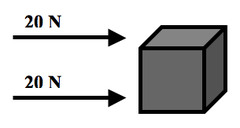
1.

In this picture the forces are...

a)

Balanced

b)

Unbalanced

2.

What is the net force in this picture?

(a)  

3.

In this picture the forces are...

a)

Balanced

b)

Unbalanced

4.

What is the net force in this picture? (just type the number)

(a)  

5.

What is the net force on this box? (size and direction)

a)

30 N to the left

b)

25 N to the right

c)

5 N to the left

d)

55 N to the right

6.

Which direction will this car move?

a)

Left

b)

Right

c)

It wont move

7.

What is the Net Force in this picture?

a)

10 N

b)

30 N

c)

0 N

d)

60 N

8.

What is the net force in this picture? (just write the number)

(a)  

9.

What is the net force in this picture? (size and direction)

a)

800 N up

b)

400 N down

c)

200 N up

d)

600 N down

10.

What is the net force in this picture? (size and direction)

a)

40 N to the left

b)

0 N (balanced forces)

c)

40 N to the right

d)

20 N to the left

11.

What is the net force in this picture?

a)

17 N

b)

6 N

c)

11 N

d)

12 N

12.

What is the net force in this picture? (just write the number)

(a)  

13.

What direction or directions will this box move? (you might need to click 2 answers)

a)

Up

b)

Down

c)

Left

d)

Right

14.

What direction or directions will this box move? (you might need to click 2 answers)

a)

Up

b)

Down

c)

Left

d)

Right

15.

What direction or directions will this box move? (you might need to click 2 answers)

a)

Up

b)

Down

c)

Left

d)

Right

16.

Speed = _______________

a)

Distance + time

b)

Distance – time

c)

Distance x time

d)

Distance / time

17.

This occurs when an object speeds up, slows down, or changes direction.

a)

Speed

b)

Velocity

c)

Acceleration

18.

Another way to explain the speed and direction of a object would be to describe it’s ________

a)

Speed

b)

Velocity

c)

Acceleration

19.

Velocity = _______________

a)

Speed – direction

b)

Speed + direction

c)

Speed x direction

d)

Speed / direction

20.
Avery likes to walk 30 feet in 10 seconds. What is her speed?
a)
3 feet/sec
b)
6 feet/sec
c)
10 feet/sec
d)
2 feet/sec
21.

At what speed would a car have to move in order to travel 20 kilometers in 2 hours.

a)

5 km/hr

b)

10 km/hr

c)

20 km/hr

d)

40 km/hr

22.
Changes in our speed, direction or both are called _________.
a)
gravity
b)
changes
c)
acceleration
d)
displacement
23.
What is the definition of velocity?
a)
A force that opposes motion
b)
Uniform circular motion
c)
The speed of an object in a particular direction
24.
If you slow down on your bicycle, you accelerate.
a)
TRUE
b)
FALSE
25.
Changing the speed and changing the direction of your bicycle are both examples of acceleration.
a)
TRUE
b)
FALSE
26.
You ride your bike around the block at a constant speed of 11 km/h.
a)
Acceleration occurred because speed increased.
b)
Acceleration occurred because speed decreased.
c)
Acceleration occurred because you changed directions.
27.
A measurement of how fast an object is moving
a)
Velocity
b)
Speed
c)
Vector
d)
Acceleration
28.

Which of the following is a unit of speed?

a)

km/hr

b)

Minutes

c)

Centimeters

d)

meters

29.

A car initially traveling at 8.0 meters per second doubles its speed while traveling in a northeast direction.

Students used a table to record the initial and final conditions for speed and velocity.

Which table is correct?

a)

b)

c)

d)

30.

Which statement best describes the motion of the toy vehicle during the first 30 seconds of the investigation?

a)

The vehicle was traveling at a constant speed

b)

The vehicle was accelerating at a constant rate

c)

The speed of the vehicle was increasing

d)

The acceleration of the vehicle was increasing

31.

Which statement best describes the cart?

a)

The cart was stationary with a velocity of 0 m/s for the entire 7 seconds

b)

The cart was stationary except for a short burst of acceleration of 0.5 m/s2

c)

The cart moved at a constant velocity of 0.5 m/s for the entire 7 seconds

d)

The cart accelerated at a constant rate of approximately 0.8 m/s2

32.

Match the following

a)

Speed

1.

30 m/s

b)

Velocity

2.

30 m/s east

c)

Acceleration

3.

30 m/s2

33.

Which of the following best describes the velocity of an object?

30 ​ (a)  

Choose from the below words
m/s east
m/s
m east
m/s2
34.

What is the difference between the velocity and the speed of an object?

a)

Velocity is the change in distance over time, while speed is the change in velocity over time.

b)

Velocity has a direction associated with it, while speed has no specific direction

c)

Velocity has no direction associated with it, while speed has a specific direction

d)

Velocity is the change in speed over time, while speed is the change in distance over time

35.

The pickup truck has a changing velocity because the pickup truck -

a)

can accelerate faster than the other two vehicles

b)

is traveling in the opposite direction from the other two vehicles

c)

is traveling on a curve in the road

d)

needs a large amount of force to move

36.
What does this graph show?
a)
Constant Positive Velocity
b)
Constant Acceleration
c)
Constant Negative Velocity
d)
An object with no motion
37.
What is the object's position at 3 seconds?
a)
20m
b)
30m
c)
40m
d)
50m
38.
Which line represents the graph of an object with a positive acceleration?
a)
A
b)
B
c)
C
d)
D
39.
For which time period, is there no motion?
a)
0-10 seconds
b)
10-15 seconds
c)
15-40 seconds
d)
40-50 seconds
40.
For which time period, is there a constant velocity of 10m/s?
a)
1-2 seconds
b)
2-5 seconds
c)
5-6 seconds
41.
At which point in time, does this person turn around?
a)
3 seconds
b)
5 seconds
c)
10 seconds
d)
25 seconds
42.
Which of the lines represent a constant velocity?
a)
A
b)
B
c)
C
d)
D
43.
Which of the lines represents a negative acceleration?
a)
A
b)
B
c)
C
d)
D
44.
What does this graph show?
a)
A constant positive acceleration of 4m/s/s
b)
A constant velocity of 4m/s
c)
Decceleration
d)
No motion
45.
What is a PUSH or PULL of an object?
a)
Motion
b)
Force
c)
Friction
d)
Gravity
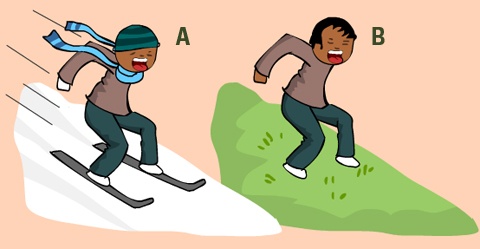
46.
Why is it harder for the boy in Image B to get down the hill?
a)
Motion
b)
Friction
c)
Work
d)
Displacement
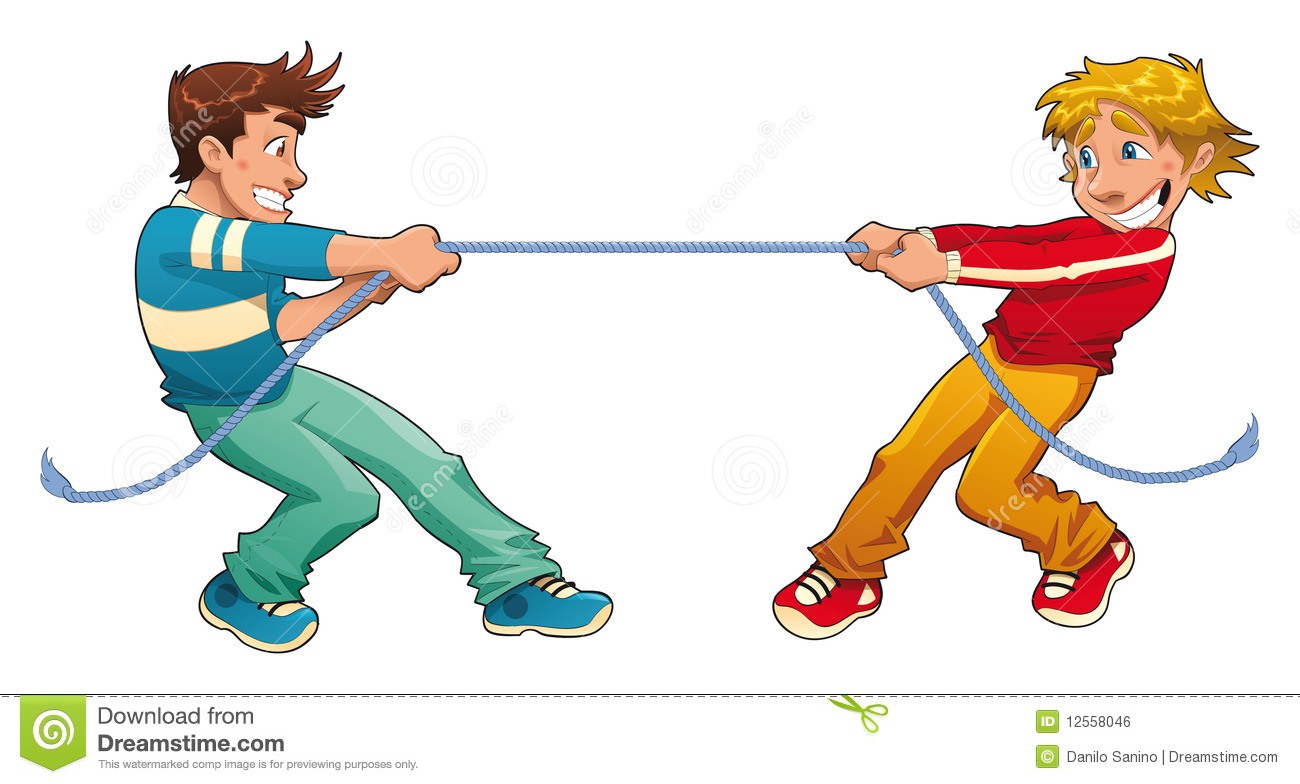
47.
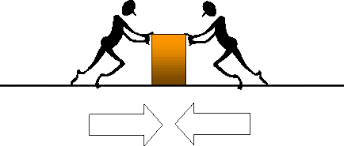
If these boys are pulling with the same amount of force.  What will happen?
a)
The boy in blue will win.
b)
They will not move at all.
c)
The boy in red will win.
d)
Both will fall down.
48.
Which force produces a change in motion?
a)
unbalanced force
b)
balanced force
c)
gravitational force
d)
frictional force
49.
At which point is potential energy greatest
a)
W
b)
X
c)
Y
d)
Z
50.
It takes more force to accelerate the iron man on the left than the iron man on the right because the iron man on the left has more mass. This best describes
a)
Newton's first law, the law of inertia
b)
Newton's second law, the law of acceleration
c)
Newton's third law, the law of action reaction 
d)
The law of universal gravitation
51.
The formula 
? = mass x acceleration
or 
? = m x a 
is used to find 
a)
Force
b)
Velocity
c)
Momentum
d)
Gravity
52.
For every action, there is an equal and opposite reaction.
a)
Newton's
1st
Law of Motion
b)
Newton's
2nd
Law of Motion
c)
Newton's
3rd
Law of Motion
53.
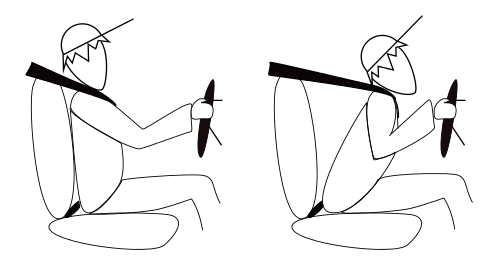
An automobile you are riding in suddenly stops, but you continue to go forward.
a)
Newton's
1st
Law of Motion
b)
Newton's
2nd
Law of Motion
c)
Newton's
3rd
Law of Motion
54.
a)
1st
b)
2nd
c)
3rd
55.
a)
1st
b)
2nd
c)
3rd
56.
a)
1st
b)
2nd
c)
3rd
57.
One object has twice as much mass as another object. The first object also has also twice as much...
a)
velocity
b)
gravitational acceleration
c)
inertia
d)
all of these
58.
What is the attractive force that exists between all objects that have mass?
a)
Weight
b)
Mass 
c)
Gravity
d)
Viscosity
59.
If an object is stationary (not moving) the forces acting upon it are _____________
a)
unbalanced
b)
weak
c)
balanced
d)
Hulk Smash!
60.
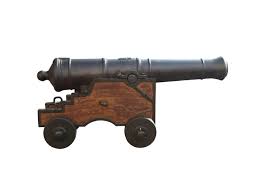
When a cannon fires a cannonball we observe Newton's third law. Which force is the reaction force?
a)
The cannon moving forward
b)
The cannonball moving forward
c)
The cannon moving backward
d)
The cannonball moving backward
61.
What Newtons law does this picture represent
a)
Newtons 2nd law 
b)
Law of gravity 
c)
Newtons 1st law
d)
Newtons 5th law
62.
When you push a boat off from the dock, you are demonstrating Newton's 3rd Law of Motion. It simply states that for every action there is an equal and opposite _______________?
a)
Motion
b)
Change
c)
Reaction
d)
Push
63.
What do each of the letters correctly represent?
a)
Funny, Monkeys, Arrive
b)
Force, Mass, Acceleration
c)
Free, Mass, Access
d)
Force, Magnesium, Arsenic
64.
Which is always a contact force?
a)
electric
b)
friction
c)
magnetic
d)
gravity
65.

Pangaea is a theory where all continents began as

a)

one big country

b)

one big continent

66.

South America and Africa look to fit together like a puzzle

a)

does not support the theory of Pangaea

b)

does support the theory of Pangaea

67.

Fossils can also give evidence for a Pangaea theory

a)

True

b)

False

68.

Pangaea is the name of an

a)

original fossil

b)

original continent

69.

When a fossil of an animal is found on almost all continents, then it supports

a)

the idea of a traveling animal

b)

the idea of a connected original continent

c)

the idea of a flying animal

70.

Plate tectonics is the theory that one continent separated

a)

on different tectonics

b)

on different oceans

c)

on different plates

71.

A plate tectonic is a

a)

slab of rock

b)

slab of lava

c)

slob

72.

A large, giant supercontinent land mass is called

a)

continental drift

b)

plate tectonics

c)

pangaea

d)

oceanic crust

73.

Plates that diverge or move apart from each other

a)

divergent

b)

transform

c)

convergent

d)

lithosphere

74.

Cracks or breaks in earth's crust where plates slip past each other

a)

subduction

b)

faults

c)

mid-ocean ridge

d)

san andreas

75.

Continental plate collides with another continental plate creates

a)

volcanoes

b)

earthquake

c)

trench

d)

folded mountains

76.

Occurs when a less dense plate slides under a more dense plate

a)

tectonic plates

b)

subduction

c)

continental drift

d)

landmass

77.

What type of plate boundary is shown in the picture

a)

convergent

b)

divergent

c)

transform

d)

faults

78.

Plates boundary where plates slide or move past each other

a)

divergent

b)

continental drift

c)

transform

d)

convergent

79.

The type of geological event that occurs under transform boundaries

a)

folded mountains

b)

earthquakes

c)

volcanoes

d)

tsunamis

80.

Ocean plate collides with ocean plate creates

a)

mid- ocean ridge

b)

sea floor spreading

c)

earthquakes

d)

volcanic ark of islands

81.

What plate boundary is shown in the picture?

a)

convergent

b)

divergent

c)

transform

d)

neither

82.

Which of the following geological events do not occur under divergent boundaries?

a)

sea floor spreading

b)

mid- ocean ridge

c)

volcanoes

d)

rift valley

83.

What type of plate boundary is shown in the picture?

a)

folded mountains

b)

transform

c)

convergent

d)

divergent

84.

Plates collide or converge into each other

a)

divergent

b)

convergent

c)

transform

d)

convection

85.

Which of the following answer choice describes an ocean plate vs continental plate?

a)

creates trench or volcano

b)

creates earthquakes at subduction zones

c)

creates folded mountains or new land

d)

creates rift valleys

86.

Which natural occurance causes the tectonic plates to move?

a)

ocean plates subducted under continental plates

b)

convection currents

c)

continental drift

d)

earthquakes

87.

Subduction occurs under which plate boundary?

a)

lithosphere

b)

divergent

c)

convergent

d)

transform

88.

The plastic like layer of the Earth where the plates move around on like a raft

a)

ecology

b)

tectonic plates

c)

asthenosphere

d)

lithosphere

89.

What is the lithosphere?

a)

upper most part of the crust and lower part of the mantle

b)

upper most part of the mantle and lower part of the crust

c)

mid mantle where convection current occur

d)

part of the liquid outer core

90.

The deepest part of the ocean floor located on both sides of a mid ocean ridge is called

a)

new forming rock under water

b)

oceanic plate

c)

mid ocean ridge

d)

ocean basin

91.

What is happening in the picture?

a)

layers of the Earth are changing positions

b)

the inner and outer core are solid

c)

convection currents are causing the tectonic plates to move

d)

the mantle is growing

92.

Observe the image. Between which 2 points is the slope steeper?

a)

A to B

b)

C to D

93.

How many peaks does this landform have?

a)

None

b)

1

c)

2

d)

3

94.

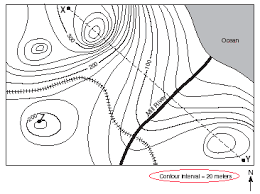
Which direction is the river flowing on this topo map?

a)

Northeast

b)

Southwest

c)

East

d)

North

95.

What is the elevation at sea level?

a)

1 million meters

b)

0 meters

c)

Whatever the contour interval says

d)

10 meters

96.

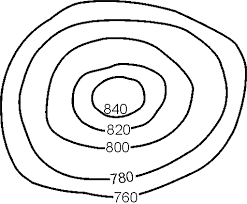
What is the difference in elevation between point A and B?

a)

760 m

b)

820 m

c)

60 m

d)

20 m

97.
Which direction is the stream flowing?
a)
northward
b)
southward
c)
westward
d)
eastward
98.
How many peaks are on the map? (hill tops)
a)
4
b)
3
c)
2
d)
1
99.
It is steep on a topographic map where __________.
a)
lines are closest together
b)
a river flows into a lake
c)
contours bend
d)
contours are far apart
100.
What are the darker lines called?
a)
roads
b)
index contour
c)
contour interval
d)
waves
101.
Determine the contour interval:
a)
5 m
b)
10 m
c)
15 m
d)
20 m
102.
If we were in a plane, Path B --> C is about the same distance as path E --> N. But, which path is the easier walk? 
a)
B --> C is the easier walk
b)
E --> N is the easier walk
c)
B --> C and E --> N are the same walking distance
103.
What is the contour interval of the topographic map below?
a)
400 m
b)
200 m
c)
100 m
d)
80 m
104.
When you move from one contour line to another, the elevation
a)
stays the same
b)
goes up or down
c)
disappears
d)
is below sea level
105.
If contour lines are close together, then the slope is
a)
gentle
b)
steep
c)
flat
d)
going up and down
106.
The height above sea level is called
a)
topographic
b)
contour
c)
elevation
d)
depth
107.
What is melted rock called that is below the Earth's surface?
a)
lava
b)
magma
c)
fossils
d)
crust
108.
What is melted rock called that is erupting from Earth's surface?
a)
lava
b)
magma
c)
fossils
d)
sedimentary rock
109.
Volcanic eruptions create new land by adding
a)
gases to the air
b)
heat to the soil
c)
new rock to Earth's surface
d)
water vapor to the air
110.
The outer layer of Earth's surface made of solid rock is called the
a)
mantle
b)
magma
c)
crust
d)
core
111.
Water flows fastest when
a)
there is a steep slope
b)
there is a gentle slope
c)
there is a long distance
d)
it has to move around boulders
112.

Match the topographic map to its profile.

a)
b)
c)
d)
113.

Match the topographic map to its profile picture.

a)
b)
c)
d)
114.
What is the elevation of point B?
a)
800 ft
b)
850 ft
c)
900 ft
d)
1000 ft
115.
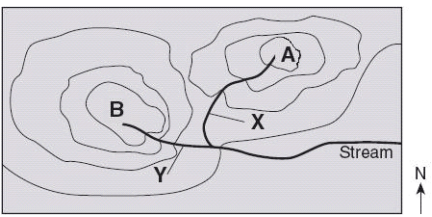
What is the difference in elevation between Point X and Point Y?
a)
120 m
b)
240 m
c)
360 m
d)
340 m
116.

What questions do you have about reading and understanding topographic maps?

4 lines