Wayground logo

Free Printable Worksheets

Font size

S
M
L
XL
Worksheets

PMA Q2 Review 2023

Total questions: 65

Worksheet time: 3hrs 46mins

Name
Class
Date
1.
A cell is...
a)
the basic unit of structure and function in living organism
b)
an organism
c)
a basic part of everything that we see
d)
found only in animals, not plants
2.
Which of the following are NOT found in animal cells
a)
chloroplasts and cytoplasm
b)
chloroplasts and cell wall
c)
cell wall and cell membrane
d)
mitochondria and nucleus
3.
The nucleus is like the ____________ of the cell.
a)
foot
b)
hand
c)
stomach
d)
brain
4.

Which of the following converts food into energy for the cell?

a)

vacuole

b)

mitochondria

c)

cytoplasm

d)

cell membrane

5.

The fluid that surrounds the organelles is... (hint... "Try to pull a fast one and..."

a)

chloroplast

b)

cytoplasm

c)

vacuole

d)

cell wall

6.
What do vacuoles do? 
a)
They actually do not have an important role
b)
They protect the cell
c)
They are the brain of the cell
d)
storage area for cells; water storage in plants 
7.

Which organelle takes in "sun light" and helps plants with the process or photosynthesis?

a)

Vacuole

b)

Mitochondria

c)

Cytoplasm

d)

Chloroplast

8.
If you were some bad guy trying to sneak into an animal cell, who would be there to stop you?
a)
nucleus
b)
mitochondria
c)
cell membrane
d)
cell wall
9.
Which of the following, found ONLY in plant cells, provides structure?
a)
cell wall
b)
chloroplast
c)
mitochondria
d)
vacuole
10.
The ____________________ is the body system that transports oxygen, nutrients, and waste through the body.  
a)
respiratory system 
b)
digestive system
c)
circulatory system 
d)
immune system
11.
The ____________ is a muscular organ that pumps blood to the body through blood vessels. 
a)
vein 
b)
artery 
c)
heart
d)
kidney
12.
What is your body's process of maintaining balanced conditions?
a)
photosyntheis
b)
homeostasis
c)
circulation
d)
regulation
13.
What is the main function of the respiratory system?
a)
regulate the body's functions by secreting hormones
b)
protect the inner organs of the body from harm
c)
coordinate the actions of the body
d)
exchange carbon dioxide & oxygen with the environment
14.
The following is an example of which two systems working together:
"The small intestine absorbs nutrients from our food and they are carried through the blood to the cells."
a)
Digestive and Circulatory
b)
Digestive and Respiratory
c)
Digestive and Skeletal
d)
Digestive and Nervous
15.

As your body works harder, what happens to your HEART rate?

a)

Increases

b)

Decreases

c)

Beats backward

d)

Stays the same

16.

Where does digestion start?

a)

stomache

b)

throat

c)

intestines

d)

mouth

17.

The human body system responsible for allowing you to move like walking, running and jumping?

a)

Nervous System

b)

Muscular System

c)

Circulatory System

d)

Digestive System

18.

Human body system is responsible for communicating with the body by sending electrical signals?

a)

Circulatory System

b)

Digestive System

c)

Muscular System

d)

Nervous System

19.

Which statement describes the difference between a noninfectious and an infectious disease?

a)

Noninfectious can be caused by environmental factors and infectious diseases are caused by pathogens.

b)

Noninfectious can be caused by bacteria and infectious diseases are caused viruses.

c)

Noninfectious can be caused by viruses and infectious diseases are caused bacteria and fungi.

d)

Noninfectious can be caused by pathogens and infectious diseases are caused environmental factors.

20.

What is one way in which a virus is different from a bacteria?

a)

A virus can't reproduce on its own.

b)

Only bacteria can cause disease.

c)

Viruses contain DNA, but bacteria don't.

d)

A bacteria is much smaller than a virus.

21.

Which disease is caused by a virus?

a)

Strep throat

b)

Common cold

c)

Athlete's foot

d)

Malaria

e)

Creutzfeldt-Jakob Disease

22.

Which disease is caused by a bacterium?

a)

Strep throat

b)

Common cold

c)

Athlete's foot

d)

Malaria

e)

Creutzfeldt-Jakob Disease

23.

A virus infects a host in order to:

a)

Take in Nutrients

b)

Make a Host Sick

c)

Destroy the Host's Cells

d)

Make copies of Itself

24.

Which disease is caused by a fungus?

a)

Strep throat

b)

Common cold

c)

Athlete's foot

d)

Malaria

e)

Creutzfeldt-Jakob Disease

25.

Unicellular organisms that have a cell wall.

a)

Bacteria

b)

Fungi

c)

Virus

d)

Pathogen

26.
Which system fights disease?
a)
excretory
b)
nervous
c)
immune
d)
digestive
27.

A fossil record can show history of life on earth

a)

True

b)

False

28.
Which process would be most effective in determining the age of fossils embedded in rock?
a)
relative dating
b)
absolute dating
c)
use of index fossils
d)
use of core sampling
29.
A scientist conducts a geological survey of an area and discovers fossils of Tropites in the sediment. Based on the evidence, approximately how long ago did the Tropites live?
a)
240 million years ago
b)
180 million years ago
c)
541 million years ago
d)
200 million years ago
30.
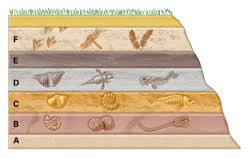
Which of the following orders the rock layers accurately from oldest to youngest?
a)
A, B, C, D, E, F, G, H
b)
B, F, G, C, D, H, A, E
c)
B, G, C, D, E, H, A, F
d)
F, A, H, E, D, C, G, B
31.
Which of these rock layers is relatively the newest?
a)
Kaibab formation
b)
Zoraster Granite
c)
Redwall limestone
d)
Unkar group
32.
Which of the following occurred relatively most recently?
a)
Basalt intrusion
b)
Breccia
c)
Conglomerate
d)
Sandstone
33.
Which of the following happened in first?
a)
Deer
b)
Dog
c)
Human
d)
Bear
34.
Which rock layer contains the newest fossils?
a)
F
b)
E
c)
B
d)
C
35.
States that younger rocks lie above older rocks if the layers have not been disturbed
a)
Law of crosscutting
b)
Law of superposition
c)
Relative Dating
d)
Unconformity
36.
A plate boundary where two plates move away from each other is called
a)
Divergent Boundary
b)
Convergent Boundary
c)
Transform Boundary
d)
Subduction
37.
Convergent Plate Movement can create
a)
Rifts
b)
Mountains
c)
Ocean Ridges
d)
Radiation
38.
When pressure builds between two tectonic plates, it can suddenly release causing a (an) ______________________
a)
Earthquake
b)
Volcano
c)
Convection Current
d)
Gravitational Pull
39.

What geologic feature will form at a hot spot?

a)

volcano

b)

folded mountain

c)

deep sea trench

d)

rift valley

40.

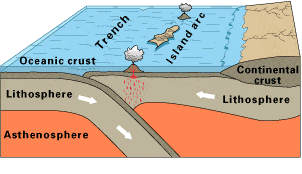
What type of plate boundary is represented in the picture?

a)

Athensphere

b)

Divergent

c)

Transform

d)

Convergent

41.

Observe this diagram of a plate boundary. One statement BEST describes what is happening. It is that

a)

the oceanic crust is melting.

b)

the denser ceanic crust is subducting under the less dense oceanic crust

c)

volcanic islands are forming.

d)

the tectonic plates are moving away from each other.

42.
The image illustrates what type of boundary?
a)
Divergent
b)
Convergent
c)
Transform
d)
Emergent
43.
The image illustrates what type of boundary?
a)
Divergent
b)
Convergent
c)
Transform
d)
Emergent
44.
The image illustrates what type of boundary?
a)
Divergent
b)
Convergent
c)
Transform
d)
Emergent
45.
Which layer of the Earth is shown in BROWN?
a)
Crust
b)
Mantle
c)
Inner Core
d)
Outer Core
46.
Which layer of the Earth is shown in YELLOW?
a)
Crust
b)
Mantle
c)
Inner Core
d)
Outer Core
47.
Which layer of the Earth is shown in ORANGE?
a)
Crust
b)
Mantle
c)
Inner Core
d)
Outer Core
48.
Which layer of the Earth is shown in RED?
a)
Crust
b)
Mantle
c)
Inner Core
d)
Outer Core
49.

Sound waves travel as ________ waves.

a)

Transverse

b)

Longitudinal

c)

Surface

50.

Sound waves CANNOT travel through which of these:

a)

Paper

b)

Milk

c)

Outer space

51.
Sound is a 
a)
Transverse Wave
b)
Combined Wave
c)
Seismic Wave
d)
Longitudinal wave
52.
Which of the following is true about waves?
a)
When wavelength increases frequency increases
b)
When wavelength decreases, frequency increases
c)
When wavelength decreases, frequency decreases
53.
Which is not correctly matched?
a)
1 - Wavelength
b)

2 - Trough

c)
3- Compression
d)

4 - Crest

54.

when light passes completely through a medium

a)

translucent

b)

transparent

c)

absorption

d)

opaque

55.

When SOME light passes through a medium

a)

translucent

b)

transparent

c)

reflection

d)

opaque

56.

Which word best describes how light reacts when passing from air through water?

a)

refraction

b)

reflection

c)

reconstroction

d)

retraction

57.

What causes the light to refract as it passes from air to water?

a)

a change in temperature of the light

b)

a change in illumination of the light

c)

a change in speed of the light

d)

a change in brightness of the light

58.

What does light travel fastest in?

a)

solid

b)

liqid

c)

gas

d)

vacuum

59.

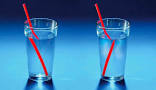
This image is an example of...

a)

reflection

b)

refraction

c)

absorption

60.

Which letter is an example of reflection?

a)

A

b)

B

c)

C

61.

Which letter is an example of absorption?

a)

A

b)

B

c)

C

62.

What is happening to every color but red?

a)

reflected

b)

absorbed

c)

refracted

63.

These can often be represented mathematically and provide no explanation why a phenomenon occurs

a)

theory

b)

law

64.

These describe a natural phenomenon or relationship that always occurs under specific conditions

a)

theory

b)

law

65.

Scientific theories/laws are based on the results of many investigations, are supported by large amounts of evidence, and are widely accepted by the majority of scientists in the given field of study

a)

True

b)

False