
 Worksheets
Checkpoint 2 Review (Force and Motion)
Total questions: 12
Worksheet time: 6mins
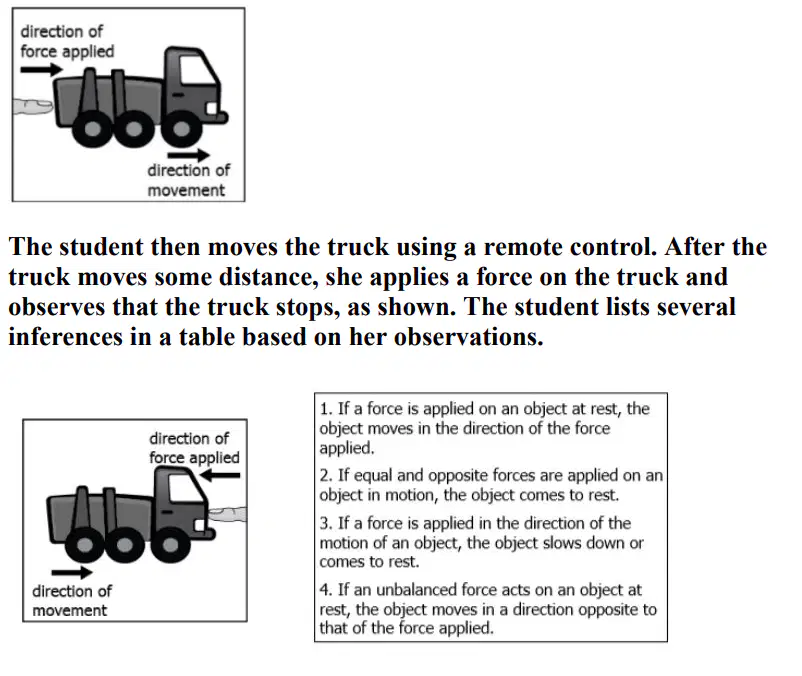
A student places a remote-controlled truck on the floor and pushes it forward. She observes that the truck moves, as shown.
Which inferences are correct?
1 and 2
1 and 3
2 and 4
3 and 4
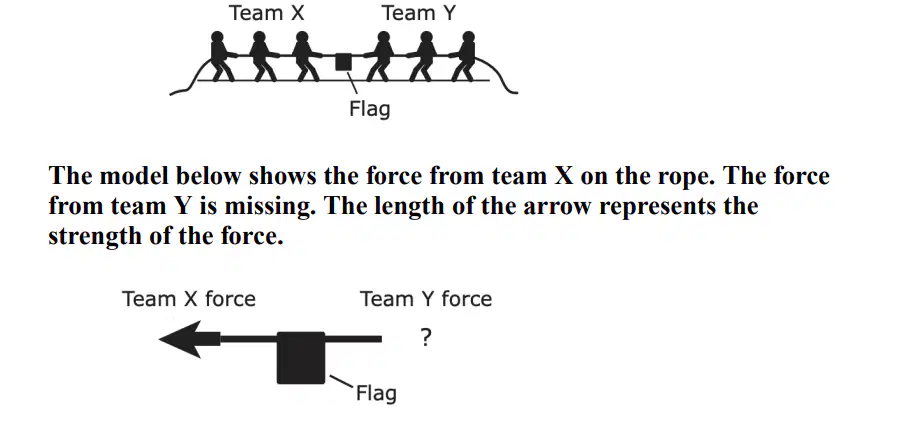
Two teams of students, team X and team Y, are playing tug of war, as shown. Both teams pull on the rope, but the flag in the middle does not move. The model below shows the force from team X on the rope. The force from team Y is missing. The length of the arrow represents the strength of the force. Which arrow should be added to the model to show the force from team Y on the rope?


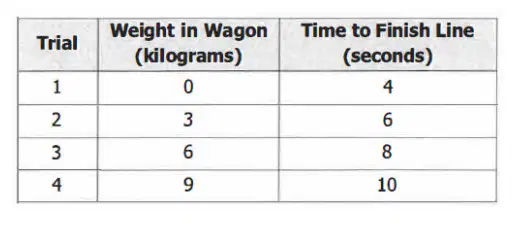
A wagon is pushed, and the time it takes to travel a set distance is measured. Weights are added to the wagon, and the wagon is pushed with the same amount of force. The action is repeated with different amounts of weights. The table contains the results.
A 12-kilogram weight is added to the wagon. How long will it take the wagon to travel to the finish line if it is pushed with the same amount of force?
more than 10 seconds
between 8 seconds and 10 seconds
between 6 seconds and 8 seconds
less than 4 seconds
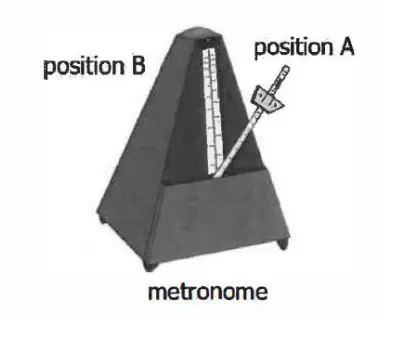
A metronome is a device that moves a rod back and forth continually at a set speed. A student sets the metronome so that the rod takes 1 second to move from position A to position B. If the metronome rod is at position B at 1 second, at which positions will the rod be at 5 seconds, 6 seconds, and 8 seconds?


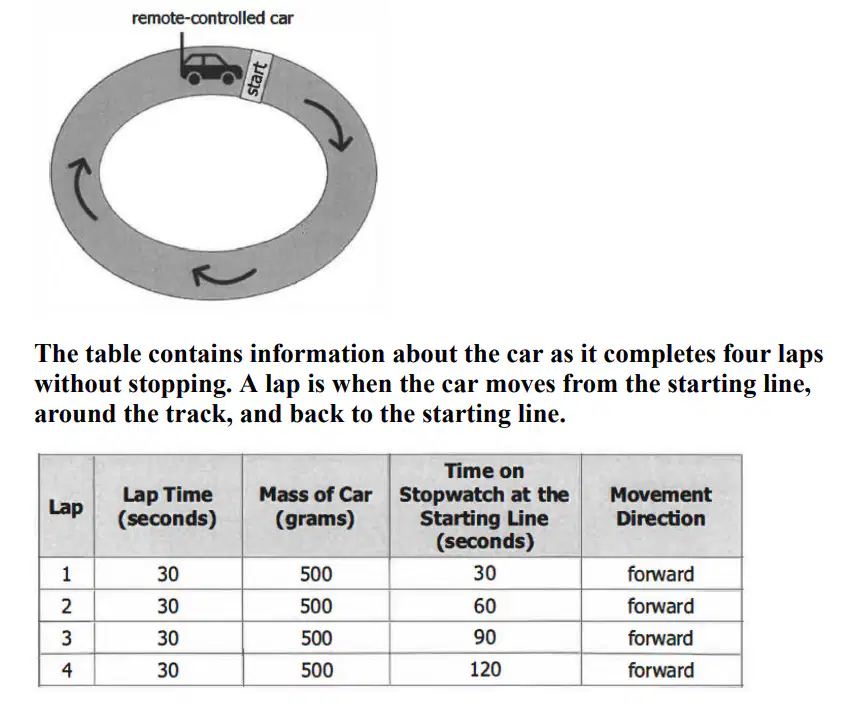
The image shows a remote-controlled car on a track. The table contains information about the car as it completes four laps without stopping. A lap is when the car moves from the starting line, around the track, and back to the starting line.
Which information allows a person to predict the time on the stopwatch at the starting line at the end of Lap 5, and what will that time be?
the direction of movement; 125 seconds
the direction of movement; 150 seconds
the mass of the car; 125 seconds
the lap time; 150 seconds
Four students observe that a baseball thrown into the air always returns to the ground. Each student makes a claim to explain their observation. Their claims are below.
Student 1 'The baseball is round.'
Student 2 'The baseball is pushed up and down by gravity.'
Student 3 'The baseball is pushed down by the surrounding air.'
Student 4 'The baseball is pulled to Earth's center.'
Which student's claim best explains their observation?
Student 1
Student 2
Student 3
Student 4
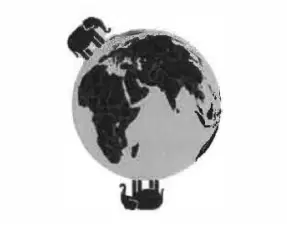
A student looks at a model of Earth and glues toy elephants in two locations. The toy elephant on the bottom of the model of Earth looks upside down. How can the student use the model to best explain Earth's gravity?
The model shows Earth's gravity pushes objects away from Earth's surface because gravity comes from Earth's center.
The model shows Earth's gravity causes objects to remain upright as shown by the elephants both standing on their legs.
The model shows Earth's gravity pulls objects toward its center, not just down, since the position of down can be different in different areas around the world.
The model shows Earth's gravity pulls objects in a down position because arrows drawn from each toy toward the bottom of the globe will point in the same direction.
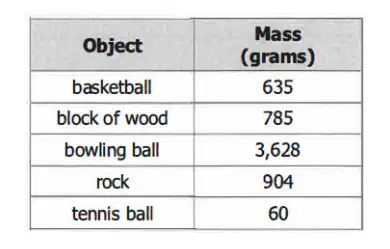
A student has five objects on the same shelf. The table lists the objects and their masses. The student tries to order the objects to show how strong Earth's gravitational force is on each object. Which list correctly orders the objects from greatest gravitational force to least?
block of wood, bowling ball, tennis ball, rock, basketball
bowling ball, rock, block of wood, basketball, tennis ball
bowling ball, rock, tennis ball, basketball, block of wood
tennis ball, basketball, block of wood, rock, bowling ball
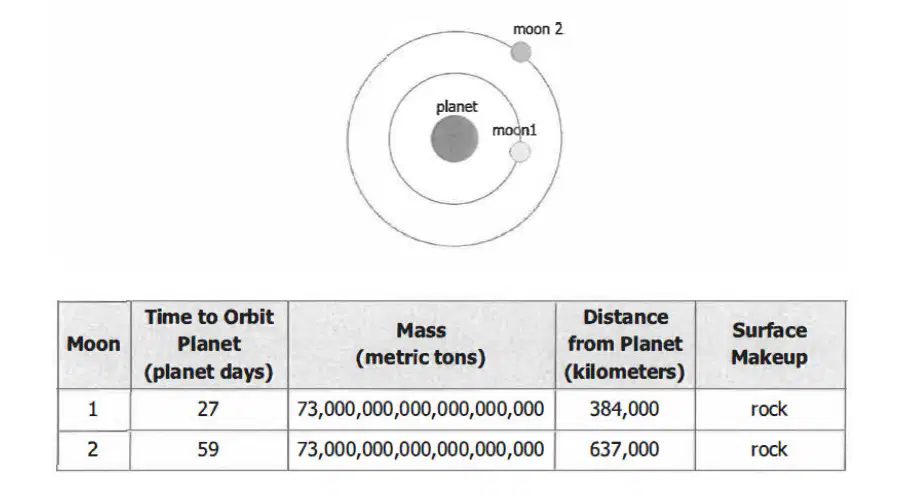
The diagram shows two moons orbiting a planet. Each moon experiences a different amount of gravitational force from the planet. The table lists information about the two moons. Which evidence can be used to prove the moons are experiencing different amounts of gravitational force from the planet?
The moons have different masses.
The moons have the same surface makeup.
The moons are different distances away from the planet.
The moons are orbiting the same planet.
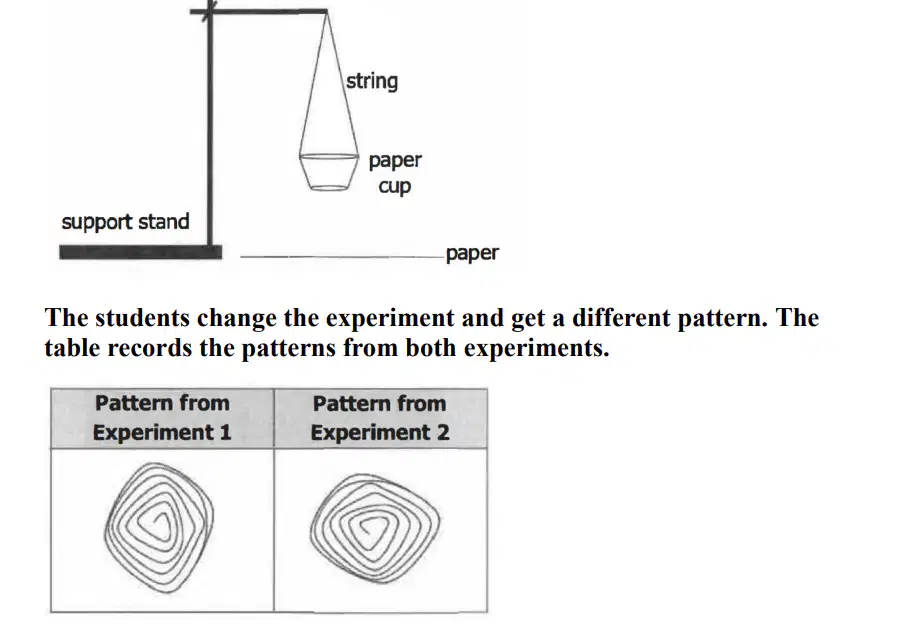
A group of students designs an experiment that will drip paint in a pattern onto a sheet of paper. The students attach a paper cup to a string and tie the string to a support stand. Paint is added to the cup, and a white sheet of paper is placed under the hanging cup. The students poke a hole in the bottom of the cup and then push the cup in a circular motion, allowing the paint to drip a pattern on the paper. A diagram of the experiment is shown. The students change the experiment and get a different pattern. The table records the patterns from both experiments. Which hypothesis are the students most likely testing to create the pattern from Experiment 2?
If the material from which the cup is made changes, the pattern will be different because the cup will release the paint easier.
If the amount of paint increases, the pattern will be different because the cup will deliver more paint.
If the length of the string increases, the pattern will be different because the cup will move a larger distance.
If the direction of the push changes, the pattern will be different because the cup will move in a different direction.
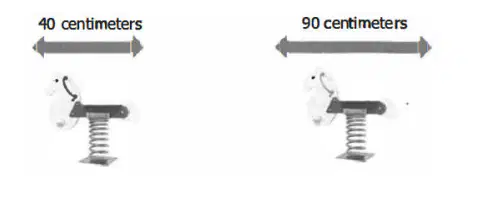
A playground has a spring horse toy. The rider sits on the horse, and the horse moves forward and backward on the spring. A young, small child sits on the toy horse and moves forward and backward. The distance between the forward and backward movement is 40 centimeters. An older, larger child sits on the toy horse, and the distance the horse moves forward and backward is 90 centimeters. The image shows both measurements. Which difference is responsible for the different motions of the toy horse?
The children's age; younger children produce a larger force on the spring.
The children's age; older children produce a larger force on the spring.
The children's size; larger children produce a larger force on the spring.
The children's size; smaller children produce a larger force on the spring.
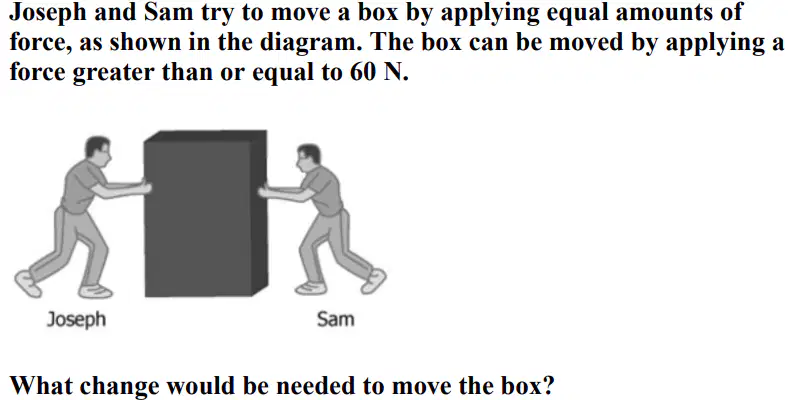
Joseph and Sam try to move a box by applying equal amounts of force, as shown in the diagram. The box can be moved by applying a force greater than or equal to 60N.
What change would be needed to move the box?
Joseph should apply a force equal to 30 N.
Sam should apply a force equal to 30 N.
Joseph and Sam should each apply a force of 30 N in the same direction.
Joseph and Sam should each apply a force of 30 N in the opposite direction of one another.

