
 Worksheets
BE Fall Final Study Guide
Total questions: 125
Worksheet time: 6hrs 15mins
What is the purpose of a mission statement?
To describe what a company wants to become
To analyze information and make decisions
To set timelines and make choices
To state the company's reason for existing now
Business whose goal is to provide a service rather than to make the profit is known as _____.
Business owned by stockholders is known as _____.
_______ include tools and equipment used to produce goods and services.
Capital Resources
Natural Resources
Human Resources
Why are policies and procedures important?
They help clarify things
Make customers purchase their products
They are the most important key in a business
Help employee do their job
When a customer is upset and yelling at you what's the best way to deal with it?
Let her finish and give her coupons.
Be rude and ignore her.
Be patient and assist her when she is done.
Call your manager.
The people who make the major policy and financial decisions for a corporation are called the _____.
A list of steps to be followed for performing a particular work activity; a description of the way work is to be done is known as _____.
The term reliable is also known as _____.
dependable
late
customer
loyal
What is nonverbal communication?
Using words to transmit information
Using body language, gestures, voice quality, and facial expressions when communicating
Written communication
Sign language
What facial expression should you have when speaking on the phone?
a grimace
it doesn't matter, they can't see you
a frown
a smile
_____ is/are general expectations for employees.
reliability
productivity
cooperativeness
all the above
What is a Business Plan?
It is an indispensable tool in order to start up a business project, independently of the size of the project and/or of the amount of business experience of the entrepreneur.
It nevers provides answers to simple questions about a business.
A document in which provides the business owners personal finances.
What is the first things to do before we come to a job interview?
Dress appropriately
The usage of body language
Read the job description well
Follow up the interview result
When answering interview questions, it is important to...
Be specific
Be general
Stretch the truth to look better
Take up as much time as possible.

Carla is going to businesses to ask for job applications in person. What does the presentation suggest she bring with her?
Nothing
A small gift for the hiring manager
A friend or family member
Her resume and reference information
If a question on a job application does not apply to you, which of the following is suggested?
Leave it blank
Fill the space with an asterisk (*)
Fill the space with "N/A" or "n/a"
A resume is...
An autobiography of one’s career life and professional experiences in order to secure employment.
A detailed listing of a job candidate’s skills, experiences, responsibilities, and achievements as these relate to the position and company being targeted.
A complete listing of an individual’s education, work experience, and professional training.
In which order should you list your work experience?
Most recent job to least recent job.
Least recent job to most recent job.
The order doesn't matter.
Which option is an example of a soft skill?
Computer skills
Knowledge of how to use Welding tools
Organization skills
Which option is an example of a hard skill?
Knowledge of google programs (i.e. google docs, google, slides, google sheets)
Creative
Good with teamwork
Who are NOT people you should use as a reference on your resume or job application?
Boss
Family
Teacher
Friends
How do you develop a positive attitude?
Avoid negative thinking
Be thankful
Spend time with people who have a positive attitude
All answers are correct
Part of planning and organizing skills is to know how to break up work into smaller pieces and put them in order of importance. This skill is known as _______________________ .
delegating
prioritizing
time management
coordinating resources
What are soft skills?
skills you need to survive
a computer game
personality traits, attributes and skills that are needed in the workplace
What does adaptability mean?
the quality of being able to change to new conditions
conveying information from one person to another
doing the same thing everyday and never changing
What does communication mean?
the quality of being able to adjust to new conditions
the ability to convey information to another person effectively and efficiently
not telling your co-workers something really important
Which one of these is NOT a soft skill?
Leadership
Cooking
Communication
Certificates from courses taken
Hard
Soft
Is being a team player a hard skill or soft skill?
Soft
Hard
Soft skills are usually related to your personality and your "people skills."
True
False
If you are a great communicator, is that a hard skill or soft skill?
soft
Hard
Which of these is not a hard skill?
A college degree
Creativity
Proficiency in a foreign language
Computer programming
Hard skills will get you the job, but soft skills will allow you to keep the job.
True
False

What is a business owned by stockholders/investors but operated by others?
Sole Proprietorship
Partnership
Corporation
Limited Liability Partnership

What is ONE advantage of a Corporation?
Difficult to start
Make all of the decisions
Easy to raise money!
Limited Life
Disadvantages include limited life and
the potential for conflict between partners
Sole Propriotorship
Partnership
Corporation
Franchise
Advantages include limited liability for owners, unlimited life, and ease of transfer of ownership.
Sole Propriotorship
Partnership
Corporation
Franchise
Characteristics include owned by two or more people and may be general or limited
Sole Propriotorship
Partnership
Corporation
Franchise
Most expensive to start
Sole Proprietorship
Partnership
Corporation
Limited Liability Partnership

A _________ acts like business, but its purpose is to benefit society.
Franchise
Limited Liability Partnership
Nonprofit organization
corporation
Sole proprietors have ____________, a situation in which a business owner is responsible for all the losses, debts, and other claims against the business.
unlimited liability
limited liability
legal immunity
dividend
What is a franchise?
a business in which the franchisor and the franchisee are family
a business in which the franchisor allows the franchisee to sell a product or service under the franchisor's business name
a business in which the employees have shares in
a business with two or more departments
Electrician
Manufacturing
Extracting
Merchandising / Retailing
Service
Which is not an advantage of corporations?
Easy to raise capital
Limited Liability
Unlimited Life
More Government Regulation
A company that transforms cotton into wearable clothing is considered a ___________.
raw-goods producer
Processor
service business
builder
A large retailer feels that it has a duty to contribute to the well-being of society, so it donates a portion of its proceeds to a charity that helps the environment. The retailer is demonstrating__________.
social responsibility
wholesaling
voluntary chains
e-tailing
What do service businesses sell?
Retail merchandise
Raw goods
Wholesale merchandise
Intangible activities
________ are precise statements of results a business expects to achieve.
Goals
Articles of incorporation
Strategies
Policies
_____are descriptions of the way work should be done.
Policies
Procedures
Mission Statement
Goals
_____ is money given to shareholders.
Checks
Dividends
Income
Stock
The official term for "middleman."
Manufacturer
Intermediary
Retailer
Producer
_____ are guidelines or rules for the business.
Policies
Procedures
Mission statement
Goals
Which is an example of the Law of Demand at work?
The price of the pizza goes up when the price of cheese goes up.
Demand for pizza goes down when tacos become more popular
The price of pizza falls when the demand for pizza falls
Demand for pizza rises when the price of pizza falls
The amount of a good or service that producers are willing and able to sell at all possible prices during a given period of time.
Supply
Demand
Factor of Production
Production
The market equilibrium price is the price at which
surpluses depress the number of goods supplied
shortages and surpluses will have no effect on the market
the government will not intervene in the market
the quantity demanded is the same as the quantity supplied
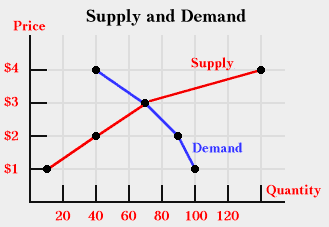
What is the Equilibrium Price?
1
2
3
4

When there is a shortage the price will usually?
rise
fall
remain the same
equilibrium
When the price of Nike brand shoes increases, we will probably go purchase a brand like Adidas or Pumas instead. Which of the following best explains this behavior?
Substitution Effect
Income Effect
Complement Goods
Consumer expectations
This part of the market determines DEMAND
buyers
sellers
suppliers
store owners
This part of the market determines SUPPLY
buyers
sellers
consumers
us
For the law of demand, as price rises, what happens to quantity demanded?
it goes up
it goes down
it stays the same
it is not effected
For the law of supply, as price rises, what happens to quantity supplied?
it goes up
it goes down
it stays the same
it is not effected
If a price is below the equilibrium price it creates a...
shortage
surplus
market price
supply
If a price is above equilibrium price, it creates a...
shortage
surplus
market price
demand

The response of buyers as price changes for goods and services
Elasticity of Demand
Diminishing Marginal Returns
Variable Cost
Operating Cost
The output produced multiplied by the price of the good
Total Revenue
Marginal Cost
Marginal Revenue
Excise Tax
Economics is the study of how people make choices about ways to use _______________ resources to fulfill their unlimited wants and needs.
Limited
Unlimited
Natural
Man-made
The central problem in economics is:
Government
Busineseses
Scarcity
Opportunity Cost
The factor of production that includes natural resources is known as:
Land
Labor
Capital
Entrepreneurship
What are the factors of production?
Land, Technology, Dirt, Resources
Land, Labor, Capital, Entrepreneurship
Land, Labor, Entrepreneurship
Resources used in the production of only services
A student must decide between going to the movies with friends or staying home and studying for a final exam. She chooses to stay home and study. Which economic concept describes going to the movies in this scenario?
Comparative Advantage
Equilibrium Point
Income Effect
Opportunity Cost
What would be an example of a capital resource
water
trees
business owner
school building
The economic factor of production that is comprised of the human efforts expended by those not in leadership is...
Land
Labor
Capital
Entrepreneur
A gap between unlimited wants and limited resources creates
Economics
Resources
Scarcity
Wants
You see that a band’s album is available today.
Form Utility
Time Utility
Place Utility
Possession Utility
This economic system is based on individual freedom.
Traditional
Command (Communism)
Free Market
Today, most economies are:
Free Market
Traditional
Mixed
Command (Communism)
Socialism is the economic system where
individuals own all resources and use them for the good of the society.
the government regulates private property so that some social justice can be achieved.
resources are shared between the individuals and the government so critical goods and services like health care, police protection, education, and food can be equally distributed.
society meets and votes on how resources will used.
People who are responsible for setting goals and planning for the future. They have titles like president, vice president, chief executive officer (CEO). Top-level managers usually consist of a small group of people or even one person.
Top-level (Upper) Management
Middle-level Management
First-line (Supervisory) Manager
One who carries out the decisions of top-level management. They include plant managers, regional managers, and department heads. They are responsible for planning and controlling an operation.
Top-level (Upper) Management
Middle-level Management
First-level Management
Sometimes referred to as supervisory managers. They may also be called team leaders, coaches, supervisors, office managers, crew leaders, or unit coordinators.
Top-level (Upper) Management
Middle-level Management
First-line (Supervisory) Manager
Includes giving orders. Good leaders must create a vision for the company, set standards, communicate with employees, provide guidance, and resolve conflict among workers.
Planning/Staffing
Controlling
Leading
Organizing
Setting company goals. Top-level managers must decide what must be done, who will do it, how will the work be grouped, and hiring staff.
Planning/Staffing
Controlling
Leading
Organizing
Deciding how you will get the work done to accomplish the goals.
Planning/Staffing
Controlling
Leading
Organizing
Brent frequently walks through the office to be sure that all the employees in his section are on target to complete the company objectives. This is an example of which business management function?
Planning
Organizing
Leading
Controlling
It is the Process of obtaining and maintaining capable and competent candidates to fill all job position.
Controlling
Directing
Staffing
Planning
Leading and motivating the employees in achieving the goals of the business.
Controlling
Directing
Staffing
Planning
Distinguish between leadership and management
Management is all about managers and leadership is for critical thinkers .
Management controls and directs people and resources accordingly to achieve objectives whereas leadership ,motivates ,guides and communicate .
Management is the most effective leadership style
Which definition is Autocratic leadership style?
leader encourages group input
leader makes all decisions
there is no defined leader
everyone has input and leads themselves

Holden's group gets a low grade on a project because he didn't complete his share of the work. He owns up to his mistake and apologizes. Holden is demonstrating...
trust.
rule of law.
viability.
accountability.
You make sure everyone working on your group project has an equal share of the work because you care about the ethical principle of...
rule of law.
fairness.
accountability.
transparency.
Ava doesn't agree with her classmate's opinion, but she listens carefully instead of starting an argument or insulting her. Which ethical principle is Ava illustrating?
Integrity
Transparency
Respect
Trust
In the Leadership Secrets of Santa Claus, what does Santa say they should make the main thing?
Red Wagons
Cookies
Work
Mission Statement
When Santa said they had to Get Beyond the Red Wagons, he meant that they
needed to accept the reality of change.
change the style of the wagons.
work with different Reindeer.
listen to the elves.
When we promote an employee based on the fact that they have worked there the longest, we are promoting people based on
skills.
seniority.
characteristics.
good deeds.
When you plan your work, you should ask the following questions EXCEPT
What needs to be accomplished?
Why does it need to be done?
Who will be involved?
How much will it cost?
In the chapter Make a List and Check it Twice, Santa says that we should make the most of all of the following EXCEPT...
Time
Food
Money
Materials
What are the advantages of autocratic leadership?
It is an innovative style of leadership
Decisions are made quickly and by the most experienced members of staff
Employees ideas and creativity are not usually considered
What is an advantage of laissez-faire style of leadership?
It leaves room for decision making to more innovative
Roles of responsibility are clearer
It makes employees feel more supported
Which type of leadership relies heavily on the use of policies, procedures, and regulations?
Autocratic
Democratic
Participative
Laissez Faire
Which function of management is involved in determining organizational goals or objectives?
Planning
Organizing
Leading
Controlling
Which task in the staffing process ensures that employees are knowledgeable and productive?
Recruiting
Determining need
Developing compensation plans
Training and developing

