
 Worksheets
AP Chem Unit 5
Total questions: 43
Worksheet time: 53mins

Which of the following will most likely increase the rate of the reaction represented above?
Decreasing the temperature of the reaction system
Adding a heterogeneous catalyst to the reaction system
Increasing the volume of the reaction vessel using a piston
Removing some H2(g) from the reaction system
Two solid reactants of varying particle size are combined in a vessel. Assuming that the same mass of each reactant is used in each case, which of the following represents the conditions that will result in the fastest reaction rate?


Cu(s) + 4 HNO3(aq) → Cu(NO3)2(aq) + 2 NO2(g) + 2 H2O(l)
Each student in a class placed a 2.00 g sample of a mixture of Cu and Al in a beaker and placed the beaker in a fume hood. The students slowly poured 15.0 mL of 15.8 M HNO3(aq) into their beakers. The reaction between the copper in the mixture and the HNO3(aq) is represented by the equation above. The students observed that a brown gas was released from the beakers and that the solutions turned blue, indicating the formation of Cu2+(aq). The solutions were then diluted with distilled water to known volumes.
In one student’s experiment the reaction proceeded at a much slower rate than it did in the other students’ experiments. Which of the following could explain the slower reaction rate?
In the student’s sample the metal pieces were much smaller than those in the other students’ samples.
The student heated the reaction mixture as the HNO3(aq) was added.
The student used a 1.5 M solution of HNO3(aq) instead of a 15.8 M solution of HNO3(aq).
The student used a 3.00 g sample of the mixture instead of the 2.00 g sample that was used by the other students.
A 0.50g sample of Mg(s) was placed in a solution of HCl(aq), where it reacted completely.
In a third experiment, 0.10g samples of Mg(s) are placed in excess HCl(aq) of various concentrations: 0.050M, 0.10M, 0.25M, and 0.50M. The reactions are run in successive order from 0.050M to 0.50M, and the time required for each reaction to go to completion is recorded. As the concentration of HCl(aq) increases from 0.050M to 0.50M, which of the following is the expected result?
The reaction time increases, and the rate of the reaction decreases.
The reaction time decreases, and the rate of the reaction increases.
Both the reaction time and the rate of the reaction increase.
Both the reaction time and the rate of the reaction decrease.
H3AsO4 + 3 I– + 2 H3O+ → H3AsO3 + I3– + H2O
The oxidation of iodide ions by arsenic acid in acidic aqueous solution occurs according to the stoichiometry shown above. The experimental rate law of the reaction is:
Rate = k[H3AsO4] [I–] [H3O+]
According to the rate law for the reaction, an increase in the concentration of hydronium ion has what effect on this reaction?
The rate of reaction increases.
The rate of reaction decreases.
The value of the equilibrium constant increases.
The value of the equilibrium constant decreases.
Neither the rate nor the value of the equilibrium constant is changed.

The initial-rate data in the table above were obtained for the reaction represented below. What is the experimental rate law for the reaction?
2 NO(g) + O2(g) → NO2(g)
Rate = k[NO][O2]
Rate = k[NO][O2]2
Rate = k[NO]2[O2]
Rate = k[NO]2[O2]2
Rate = k[NO] / [O2]

The table above shows the results from a rate study of the reaction X + Y → Z. Starting with known concentrations of X and Y in experiment 1, the rate of formation of Z was measured. If the reaction was first order with respect to X and second order with respect to Y, the initial rate of formation of Z in experiment 2 would be
R/4
R/2
R
2R
4R
An experiment was conducted to determine the rate law for the reaction A2(g) + B(g) → A2B(g). The table above shows the data collected. Based on the data in the table, which statement is correct?
Since the rate law can be expressed as rate=k[A2]2, tripling the concentration of A2 will cause a 9-fold increase in the rate of the reaction.
Since the rate law can be expressed as rate=k[A2][B], doubling the concentrations of A2 and B will quadruple the rate of the reaction.
Since the rate law can be expressed as rate=k[A2]2[B], tripling the concentration of A2 while keeping the concentration of B constant will triple the rate of the reaction.
Since the rate law can be expressed as rate=k[A2][B]2, doubling the concentration of B while keeping the concentration of A2 constant will double the rate of the reaction.
S2O82−(aq) + 3 I−(aq) → 2 SO42−(aq) + I3−(aq)
In aqueous solution, the reaction represented by the balanced equation shown above has the experimentally determined rate law:
rate=k[S2O82−][I−]
If the concentration of [S2O82−] is doubled while keeping [I−] constant, which of the following experimental results is predicted based on the rate law, and why?
The rate of reaction will remain the same, because k will decrease by half.
The rate of reaction will double, because the rate is directly proportional to [S2O82−].
The rate of reaction will increase by a factor of four, because two moles of SO42− are produced for each mole of S2O82−− consumed.
The rate of reaction will increase by a factor of four, because the reaction is second order overall.
The rate law for the reaction of nitrogen dioxide and chlorine is found to be rate = k [NO2]2[Cl2]. By what factor does the rate of the reaction change when the concentrations of both NO2 and Cl2 are doubled?
2
3
4
6
8

The data in the table above were obtained for the reaction X + Y → Z. Which of the following is the rate law for the reaction?
Rate = k[X]2
Rate = k[Y]2
Rate = k[X][Y]
Rate = k[X]2[Y]
Rate = k[X][Y]2
X → products
Pure substance X decomposes according to the equation above. Which of the following graphs indicates that the rate of decomposition is second order in X ?


2 HO2(g) → H2O2(g) + O2(g)
The reaction represented by the chemical equation shown above occurs in Earth’s atmosphere. In an experiment, [HO2] was monitored over time and the data was plotted as shown in the following graph.
Based on the information, which of the following is the rate law expression for the reaction?
Rate = k
Rate = k[HO2]
Rate = k[HO2]2
Rate = k[HO2][O2]
After a certain pesticide compound is applied to crops, its decomposition is a first-order reaction with a half-life of 56 days. What is the rate constant, k, for the decomposition reaction?
0.012 day-1
0.018 day-1
56 day-1
81 day-1
After a certain pesticide compound is applied to crops, its decomposition is a first-order reaction with a half-life of 32.5 days. What is the rate constant, k, for the decomposition reaction?
0.0213 day-1
0.0308 day-1
32.5 day-1
46.9 day-1
If the oxygen isotope 20O has a half-life of 15 seconds, what fraction of a sample of pure 20O remains after 1.0 minute?
1/2
1/4
7/30
1/8
1/16
The isomerization of cyclopropane to propylene is a first-order process with a half-life of 19 minutes at 500oC. The time it takes for the partial pressure of cyclopropane to decrease from 1.0 atmosphere to 0.125 atmosphere at 500oC is closest to
38 minutes
57 minutes
76 minutes
152 minutes
190 minutes
Step 1: H2(g) + ICl(g) → HI(g) + HCl(g) (slow)
Step 2: HI(g) + ICl(b) → HCl(g) + I2(g) (fast)
Which of the following represents the overall chemical equation for the reaction and the rate law for elementary step 2?
The overall reaction is H2 + 2 ICl → HCl + I2
the rate law for step 2 is rate=k[H2][HI][ICl].
The overall reaction is H2 + 2 ICl → 2 HCl + I2
the rate law for step 2 is rate=k[H2][ICl]2.
The overall reaction is H2 + ICl → HCl + I2
the rate law for step 2 is rate=k[H2][ICl].
The overall reaction is H2 + 2 ICl → 2 HCl + I2
the rate law for step 2 is rate=k[HI][ICl].
Step 1: ? (slow)
Step 2: NO3(g) + CO(g) → NO2(g) + CO2(g) (fast)
Overall: NO2(g) + CO(g) → NO(g) + CO2(g)
A two-step reaction mechanism is proposed for a gas-phase reaction, as represented above. Which of the following correctly identifies both the chemical equation for step 1 and the rate law for the overall reaction?
The chemical equation for step 1 is
2 NO2 → NO + NO3,
and the rate law is
rate=k[NO2]2
The chemical equation for step 1 is
NO2 + CO → NO + CO2,
and the rate law is
rate=k[NO2][CO]
The chemical equation for step 1 is
NO3 + 2CO→NO + 2CO2,
and the rate law is
rate=k[NO2][CO]
The chemical equation for step 1 is
NO3 + NO2 + 2CO →
NO + NO2 + 2CO2,
and the rate law is
rate=k[NO3][NO2][CO]2.
NO(g) and O2(�) react to form NO2(g). The rate law of the reaction is rate=k[NO]2[O2]. If the reaction occurs in a single elementary step that is a three-body molecular collision, then which of the following is the equation for the elementary step?
N + O + O → NO2
2 NO + O2 → NO2
N + O2 → NO2
N2 + 2 O2 → 2 NO2
2 NOBr(g) → 2 NO(g) + Br2(g)
The equation above represents an elementary step in a chemical reaction. Which of the following is the correct expression for the rate law of the elementary step?
Rate = k[NOBr]½
Rate = k[NOBr]
Rate = k[NOBr]2
Rate = k[NO]2 [Br2]
Cl−(aq) + ClO−(aq) + 2 H+(aq) → Cl2(g) + H2O(l)
What effect will increasing [H+] at constant temperature have on the reaction represented above?
The activation energy of the reaction will increase.
The activation energy of the reaction will decrease.
The frequency of collisions between H+(aq) ions and ClO−(aq) ions will increase.
The value of the rate constant will increase.
2 N2O(g) → 2 N2(g) + O2(g)
The rate law for the reaction represented above is experimentally determined to be rate=�[N2O]. Which of the following best explains why increasing the initial concentration of N2O(g) at a constant temperature increases the reaction rate?
Molecular collisions become more frequent.
There is a higher probability of effective molecular collisions.
The rate constant for the reaction increases.
The reaction mechanism changes to one that has a lower activation energy.
Which of the following best helps explain why an increase in temperature increases the rate of a chemical reaction?
At higher temperatures, reactions have a lower activation energy.
At higher temperatures, reactions have a higher activation energy.
At higher temperatures, every collision results in the formation of product.
At higher temperatures, high-energy collisions happen more frequently.

NO(g) + NO3(g) → 2 NO2(g)
The reaction between NO(g) and NO3(g) is represented by the equation above.
Which of the
following orientations of collision between NO(g) and NO3(g) is most likely to be effective?


4 FeS(s) + 7 O2(g) → 2 Fe2O3(s) + 4 SO2(g)
Due to the presence of FeS(s) as an impurity, the combustion of some types of coal results in the formation of SO2(g), as represented by the equation above. Also, SO2(g) can react with O3(g) to form SO3(g), as represented by the equation below.
SO2(g) + O3(g) ⇄ SO3(g) + O2(g)
∆H∘298 = −242kJ/molrxn
∆S∘298 = -25J/(K·molrxn)
Which of the following diagrams shows the correctly labeled activation energy, Ea, for the reaction between SO2(g) and O3(g)?


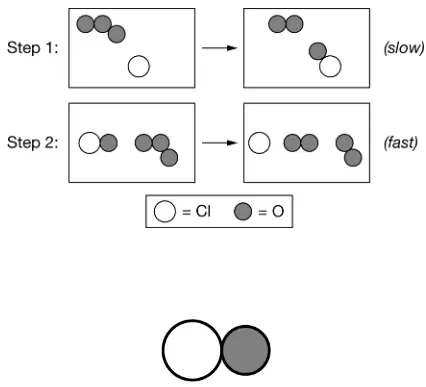
The particle models shown above represent a proposed two-step mechanism for the destruction of ozone (O3) in the upper atmosphere.
Based on the proposed mechanism, which of the following best describes the concentration of the species represented above as the reaction occurs?
The concentration is larger than that of reactant or product.
The concentration is very low for the duration of the reaction.
The concentration increases steadily as the reaction proceeds.
The concentration fluctuates between high and low during the reaction.
Step 1: NO(g) + O3(g) → NO2(g) + O2(g)
Step 2: NO2(g) + O(g) → NO(g) + O2(g)
A reaction mechanism for the destruction of ozone, O3(g), is represented above. In the overall reaction, NO(g) is best described as
an inhibitor
a catalyst
a reactant
an intermediate
a product

The particle models shown above represent a proposed two-step mechanism for the destruction of ozone (O3) in the upper atmosphere.
Based on the models, which of the following represents a species that acts as a catalyst for the reaction?


The particle models shown above represent a proposed two-step mechanism for the destruction of ozone (O3) in the upper atmosphere.
Based on the proposed mechanism, what is the balanced chemical equation for the overall reaction?
O3(g) + Cl(g) → O2(g) + ClO(g)
2 O3(g) + 2 Cl(g) → 2 O2(g) + 2 ClO(g)
O3(g) + Cl(g) + ClO(g) → 2 O2(g) + Cl2(g)
2 O3(g) → 3 O2(g)
Step 1: Ce4+ + Mn2+ → Ce3+ + Mn3+
Step 2: Ce4+ + Mn3+ → Ce3+ + Mn4+
Step 3: Mn4+ + Tl+ → Tl3+ + Mn2+
The proposed steps for a catalyzed reaction between Ce4+ and Tl+ are represented above. The products of the overall catalyzed reaction are
Ce4+ and Tl+
Ce3+ and Tl3+
Ce3+ and Mn3+
Ce3+ and Mn4+
Tl3+ and Mn2+

When free Cl(g) atoms encounter O3(g) molecules in the upper atmosphere, the following reaction mechanism is proposed to occur.
Which of the following rate laws for the overall reaction corresponds to the proposed mechanism?
Rate = k[O3]2
Rate = k[Cl][O3]
Rate = k[ClO][O3] 2
Rate = k[O2]3 / [ O3 ]2
2 A(g) + B(g) → 2 C(g)
When the concentration of substance B in the reaction above is doubled, all other factors being held constant, it is found that the rate of the reaction remains unchanged. The most probable explanation for this observation is that
the order of the reaction with respect to substance B is 1
substance B is not involved in any of the steps in the mechanism of the reaction
substance B is not involved in the rate–determined step of the mechanism, but is involved in subsequent steps
substance B is probably a catalyst, and as such, its effect on the rate of the reaction does not depend on its concentration
the reactant with the smallest coefficient in the balanced equation generally has little or no effect on the rate of the reaction

The rate law for the reaction represented by the equation above is rate = k[NO2][F2]. Which of the following could be the first elementary step of a two-step mechanism for the reaction if the first step is slow and the second step is fast?
F2(g) → 2 F(g)
NO2(g) + F2(g) → NO2F(g) + F(g)
NO2(g) + F(g) → NO2F(g)
2 NO2(g) + F2(g) → 2 NO2F(g)
NO2(g) + CO(g) → NO(g) + CO2(g)
The reaction between NO2(g) and CO(g) is represented above. The elementary steps of a proposed reaction mechanism are represented below.
Step 1: 2 NO2(g) → NO(g) + NO3(g) (slow)
Step 2: NO3(g) + CO(g) → NO2(g) + CO2(g) (fast)
Which of the following is the rate law for the overall reaction that is consistent with the proposed mechanism?
Rate = k [NO2][CO]
Rate = k [NO2]2
Rate = k [NO3][CO]
Rate = k [NO2][NO3][CO]
Br2(g) + 2 NO(g) → 2 NOBr(g)
The reaction represented by the equation above has the following proposed mechanism.
Step 1: NO(g) + Br2(g) ⇌ NOBr2(g) (fast equilibrium)
Step 2: NOBr2(g) + NO(g) → 2 NOBr(g) (slow)
Based on the information, which of the following is the initial rate law for the reaction?
Rate = k[Br2][NO]
Rate = k[Br2][NO]2
Rate = k[Br2]2[NO]
Rate = k[NOBr2][NO]
2 NO(g) + O2(g) → 2 NO2(g)
Consider the following mechanism for the reaction represented above.
Step 1: 2 NO ⇄ N2O2 (fast reversible)
Step 2: N2O2 + O2 → 2 NO2 (slow)
Which of the following statements is true?
Step 1 represents a unimolecular reaction.
Increasing the concentration of NO will decrease the overall rate of the reaction.
Raising the temperature will have no effect on the numerical value of the rate constant.
The rate law that is consistent with the mechanism is rate = k[NO]2[O2].
2 H2(g) + 2 NO(g) → N2(g) + 2 H2O(g)
The experimental rate law for the reaction represented above is rate=k[H2][NO]2. Which of the following proposed mechanisms is consistent with the rate law?


A proposed mechanism for the chemical reaction
2 NO2(g) + F2(g) → 2 NO2F(g)
is shown above. Which of the following rate laws is consistent with this mechanism?
Rate = k[NO2][F2]
Rate = k[NO2]2[F2]
Rate = k[NO2][F2]2
Rate = k[NO2]2[F2]2
Step 1. N2H2O2 ⇄ N2HO2– + H+ (fast equilibrium)
Step 2. N2HO2– → N2O + OH– (slow)
Step 3. H+ + OH– → H2O (fast)
Nitramide, N2H2O2, decomposes slowly in aqueous solution. This decomposition is believed to occur according to the reaction mechanism above. The rate law for the decomposition of nitramide that is consistent with this mechanism is given by which of the following?
Rate = k[N2H2O2]
Rate = k[N2H2O2] [H+]
Rate = k [H+][N2H2O2]
Rate = k [N2HO2][N2H2O2]
Rate = k[N2H2O2][OH]

When free Cl(g) atoms encounter O3(g) molecules in the upper atmosphere, the following reaction mechanism is proposed to occur.
Which of the following reaction energy profiles best corresponds to the proposed mechanism?
Responses


The energy diagram for the reaction X + Y → Z is shown above. The addition of a catalyst to this reaction would cause a change in which of the indicated energy differences?
I only
II only
III only
I and II only
I, II, and III
Step 1: O3(g) + Cl(g) → O2(g) + ClO(g)
Step2: ClO(g) + O(g) → O2(g) + Cl(g)
A proposed mechanism for the destruction of O3(g) in the upper atmosphere is represented above. Which of the following is the catalyst in the proposed mechanism?
O(g)
Cl(g)
ClO(g)
O2(g)

