
 Worksheets
US History Midterm Review
Total questions: 90
Worksheet time: 1hrs 9mins
What were some of the key reforms during the Progressive Era?
Prohibition of alcohol, reduced voting rights for women, and increased monopolies
Expansion of slavery, increased child labor, and decreased environmental regulations
Some key reforms during the Progressive Era included women's suffrage, labor rights, anti-trust legislation, and conservation efforts.
Elimination of labor unions, decreased government transparency, and increased pollution
What were the main causes of World War 1?
Militarism, alliances, imperialism, and nationalism
Religion, trade, and colonization
Economic depression, political instability, and technological advancements
Environmental factors, social inequality, and cultural differences
What characterized the Roaring Twenties in the US?
Technological regression, economic downturn, and cultural conservatism
Great Depression, political instability, and social stagnation
Military conflicts, economic recession, and cultural decline
Economic prosperity, technological advancements, and cultural dynamism
What were the main causes of the Great Depression and how did the New Deal attempt to address them?
The main causes of the Great Depression were overproduction and increased industrial output. The New Deal attempted to address them by reducing government intervention in the economy.
The main causes of the Great Depression were technological advancements and increased productivity. The New Deal attempted to address them by implementing tariffs on imported goods.
The main causes of the Great Depression were stock market crash, bank failures, reduction in consumer spending, and drought conditions. The New Deal attempted to address them by implementing various programs to provide relief, recovery, and reform, such as the creation of jobs, regulation of the stock market, and social security measures.
The main causes of the Great Depression were excessive government spending and high taxes. The New Deal attempted to address them by cutting social welfare programs.
What events led to US involvement in World War 2?
Attack on Pearl Harbor by Japan and the subsequent declaration of war by the United States
The US joining the Axis Powers
The invasion of Poland by Germany
The signing of the Treaty of Versailles
Who were some prominent figures in the Progressive Era and what were their contributions?
Susan B. Anthony, who was a famous chef and known for her culinary skills
Some prominent figures in the Progressive Era include Theodore Roosevelt, who was known for his trust-busting efforts and conservation policies, and Jane Addams, who was a social reformer and women's suffrage advocate.
Alexander Graham Bell, who was a prominent figure in the civil rights movement and known for his work in environmental conservation
Abraham Lincoln, who was known for his invention of the lightbulb and his contributions to the field of aviation
How did the Treaty of Versailles contribute to the outbreak of World War 1?
United Germany and its neighboring countries in a defensive alliance
Granted Germany control over all European colonies
Imposed heavy reparations and territorial losses on Germany
Provided economic aid to Germany to help rebuild its military
What were some popular cultural trends during the Roaring Twenties?
Jazz music, flapper fashion, and the Harlem Renaissance
Classical music, Victorian fashion, and the Industrial Revolution
Punk rock music, hippie fashion, and the Flower Power Movement
Disco music, cowboy fashion, and the Wild West Revival
What were the main components of the New Deal and how did they impact the US economy?
The main components of the New Deal included programs for relief, recovery, and reform, such as the creation of the Social Security system, the establishment of the Federal Deposit Insurance Corporation (FDIC), and the implementation of public works projects. These initiatives aimed to provide immediate relief to the unemployed, stimulate economic recovery, and regulate the financial system. Overall, the New Deal had a significant impact on the US economy by reducing unemployment, stabilizing the banking sector, and promoting economic growth.
The New Deal focused on reducing government spending, which resulted in a decrease in public services and infrastructure development.
One of the main components of the New Deal was the deregulation of the financial industry, leading to the Great Depression.
The main components of the New Deal were tax cuts for the wealthy, which led to increased income inequality and economic instability.
What were the major battles and turning points in World War 2 for the US?
Battle of Verdun, Battle of the Somme, Battle of Kursk
Battle of Pearl Harbor, Battle of Iwo Jima, Battle of Okinawa
Battle of Waterloo, Battle of Gettysburg, Battle of Normandy
Battle of Midway, D-Day invasion
What were the key events that led to the end of World War 2?
The signing of the Treaty of Versailles, the Battle of Waterloo, and the Battle of Gettysburg
The Battle of Midway, the D-Day invasion, and the dropping of atomic bombs on Hiroshima and Nagasaki
The Battle of Pearl Harbor, the Battle of Iwo Jima, and the Battle of Okinawa
The Battle of Verdun, the Battle of the Somme, and the Battle of Kursk
What were the significant social changes during the Roaring Twenties in the US?
Increased child labor, expansion of slavery, and decreased environmental regulations
Prohibition of alcohol, women's suffrage, and the rise of the Ku Klux Klan
Technological regression, economic downturn, and cultural conservatism
Great Depression, political instability, and social stagnation
What were the main objectives of the Progressive Era reforms?
To reduce government intervention in the economy, implement tariffs on imported goods, and increase industrial output
To eliminate labor unions, decrease government transparency, and increase pollution
To promote social welfare, political reform, and economic efficiency
To expand slavery, increase child labor, and decrease environmental regulations

What were the major impacts of the New Deal on American society?
Increased government intervention in the economy, implementation of social security measures, and creation of jobs
Decreased government transparency, elimination of labor unions, and increased pollution
Expansion of slavery, increased child labor, and decreased environmental regulations
Reduced government intervention in the economy, implementation of tariffs on imported goods, and increased industrial output


A social movement against the consumption of alcohol.
Reform
Abolition
Temprence
2nd Great Awakening
Which statement supports the idea that First Amendment rights were violated during the Red Scare?
Police made scores of arrests without search warrants.
Authorities deported 300 Russian immigrants to the Soviet Union.
Police broke into homes and offices of suspected radicals without search warrants.
Charles Schenck faced espionage charges for handing out flyers encouraging citizens to resist the military draft.
What was the Red Scare?
the fear that the ACLU would help Russia invade America
the fear that pollution would lead to toxic blooms of red algae
the fear that communism would take over the United States
the fear that the First Amendment would protect communists
Warren Harding ran for president in 1920, promising a return to 'normalcy'. Harding's 'normal' America can be best described as:
Giving all citizens a voice in their government.
Returning America to the way things were prior to World War I.
Bringing back the main ideas of the Democratic Party.
Allowing the production and selling of alcohol.
What description best supports the function of the Federal Reserve System?
State's central bank
Nation's central bank
Locality's central bank
City's central bank
Fill in the blank: The Federal Reserve regulates banks to ensure the soundness of the banking system and safety of ______________________.
Loans
Stocks
Deposits
Interest
What was the most controversial of the four Progressive amendments to the Constitution?
16th Amendment
17th Amendment
18th Amendment
19th Amendment
Which law did Congress pass in 1906 to require that food and drugs be labeled correctly?
The Pure Food and Drug Act
The Sherman Anti-Trust Act
The Interstate Commerce Act
The Pendleton Act
Which of the following best describes the assembly line manufacturing process?
Each product is fully manufactured one at a time
Products are made one step at a time as they pass down a line
Products are manufactured by robots
Products are made by people who stand in a line
Under what scandal did President Harding’s secretary of the interior, Albert B. Fall, secretly lease lands containing U.S. Navy oil reserves?
Watergate scandal
Palmer Raids
Forbes scandal
Teapot Dome scandal
What was the policy of protecting the interest of "Americans" against immigrants?
Isolationism
Socialism
Communism
Nativism
What event attempted to protect Americans but failed to turn up evidence of any conspiracy and trampled civil rights?
Red Scare
Palmer Raids
Teapot Dome Scandal
Boston Police Strike
Which of the following represents Nativism in the 1920s?
Sacco and Vanzetti case
Scopes Trial
Teapot Dome Scandal
Dawes Plan
Roads, skyscrapers, prisons, sewers, schools, railroads, etc, are all examples of what?
Infrastructure
Rural Expansion
Assimilation
Nativism

6) Which of these best explains why many immigrants came to the United States cities during the Gilded Age?
They were imported as forced labor for infrastructure projects
They were brought in to boost a declining population
They were drawn in by the offer of free land from the Homestead Act
They saw opportunity for a better life and factories needed workers
What contributions can be traced to the photographer Jacob Riis?
"How the Other Half Lives"
The Jungle
The exposure of the meat packing industry
The Gospel of Wealth
what is the name of the book that jacob riis wrote depicting the living conditions in tenement housing?
nativism
how the other half lives
parochial schools
contract labor act

What part of the country did political machines control?
Urban (city) governments
Rural (country) governments
The U.S. federal government

Many immigrants and poor families would be forced to live in dirty single room apartments called-
Poor houses
Brothels
Tenements
Debtor Jails

Why are political machines an example of corruption in the Gilded Age?
They made sure unions could not protect workers from management
They forced immigrants into the US from Latin America
They took control of city governments and stole millions of dollars from the cities
They prevented immigrants from being Americanized

The most famous political machine was Tammany Hall in New York lead by-
Bill the Butcher
Andrew Carnegie
William "Boss" Tweed
John D Rockefeller

During the Gilded Age cities were being controlled by groups of corrupt politicians known as-
Robber Barons
Political Machines
Political Cartels
Tenement Busters
After the central powers lost WW1, Germans were forced to take responsibility for all of the damages by signing what treaty?
The Treaty of Nanjing
The Treaty of WW1
The Treaty of Versailles
The treaty of Paris

What type of warfare contributed to the stalemate on the Western Front?
guerilla
nuclear
trench
submarine
What year did Woodrow Wilson ask Congress to join World War 1?
1914
1915
1916
1917
Woodrow Wilson's ____________________ Points was used to help create the Treaty of Versailles.
Thirteen
Seventeen
Fifteen
Fourteen
In the 1930s, Congress passed a set of laws called the ______________________________________ that limited America's involvement in world affairs because they did not want us being part of the second world war.
Peacekeeping Acts
Treaty of Versailles
Neutrality Acts
Zimmerman Acts
Writers that dig up the bad things going on in society
Suffragists
Muckrakers
Students
Chaffinators

Executive Order 9066
Affordable Care Act
1964 Civil Rights Act
The New Deal

World War I
World War II
Spanish American War
Vietnam War


To raise money to pay for the war, the government began selling
Comic books and board games
Radios and televisions
Shares in common stock
Victory Bonds and Liberty Bonds
President Teddy Roosevelt's foreign policy for relations with other countries.
Moral Diplomacy
Dollar Diplomacy
Big Stick Diplomacy
Panama Canal
One cause of U.S. imperialism was
Militarism
Alliances
Spanish Treachery
Desire to gain more land and natural resources
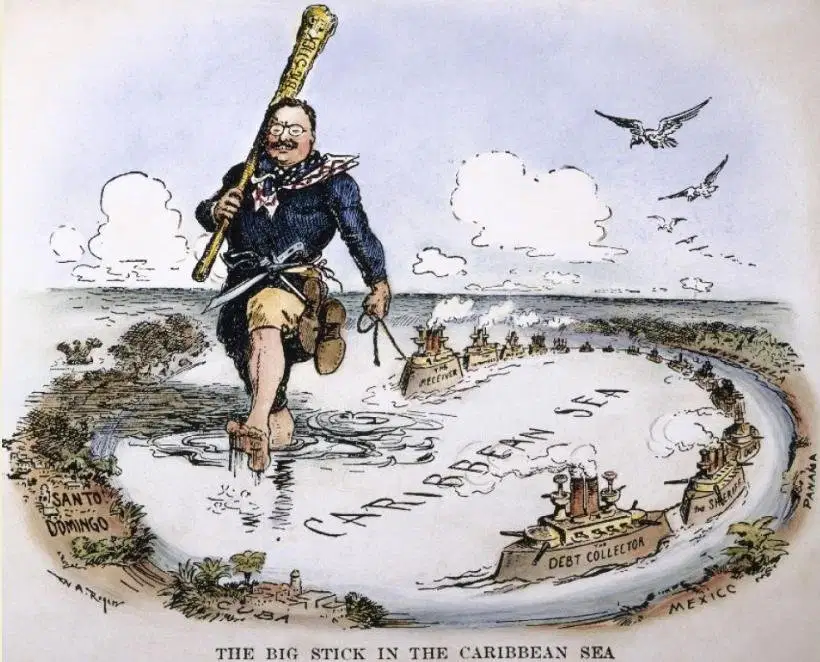
Roosevelt’s 1904 extension of the Monroe Doctrine, stating
that the United States has the right to protect its economic interests in South and
Central America by using military force
Truman Doctrine
Marshall Plan
Reagan Doctrine
Roosevelt
Corollary
The political party that advocated for farmers was known as the ______party.
Republican
Democrat
Populist
An organization of workers dedicated to protecting members' interests and improving wages, hours and working conditions for all.
Labor Union
Workers Rights
Worker Strikes
Collective Bargaining
What is the Harlem Renaissance?
A travelling basketball team
A rebirth of African American culture in art, music, and literature
A medieval game
Time period of around 1210 a.d. when the games of jousting and art became popular
True or False: Andrew Carnegie made his fortune in the oil business?
True
False
This Amendment granted African-American men the right to vote.
2nd Amendment
15th Amendment
6th Amendment
19th Amendment
Limited the number of terms that a president can serve to two.
21st Amendment
19th Amendment
22nd Amendment
18th Amendment
Which Amendment allows congress to collect an income tax?
10th Amendment
14th Amendment
15th Amendment
16th Amendment


What does the 21st Amendment to the United States Constitution do?
Establishes the right to free speech
Abolishes slavery
Repeals Prohibition
Guarantees the right to bear arms

The Great Plains were called the ______________ because strong winds lifted the dry soil and started dust storms.
Dust Bowl
Tumbleweed Trails
Lonesome Prairies
Windstorm States
These American Indians were recruited by the military to encode, transmit, and decode messages; the Navajo language was used to develop a code that was not broken by the enemy in WWII
Cherokee
Navajo
Apache
Sioux
Determined young men who enlisted to become America's first black military aviators at a time when the U.S. military still practiced racial segregation. They participated in over 15,000 sorties and earned over 100 Flying Crosses.
Tuskegee Airmen
Flying Tigers
Charles Lindbergh
Black Panthers
__________ ________ was an African American veteran of WWII that received the Medal of Honor
(a)
President Franklin D. Roosevelt proposed an increase in the number of Supreme Court justices because the Court ruled against -
the gold standard
some New Deal programs
internment camps
some rationing programs
1920's Republican Party views were
Globalization
Imperialism
Isolationism
Big Government

