
 Worksheets
Review Unit 2
Total questions: 13
Worksheet time: 7mins
Piece of unglazed white porcelain
● Iron pyrite ● Hematite ● Mica ● Talc ● Halite ● Magnetite
Which property of minerals will you be testing for?
Streak
hardness
density
cleavage
How are earthquakes related to the Earth’s moving plate tectonics?
Earthquakes occur in the lithosphere because this is where moving plate tectonics are located
The ocean ridges are the asthenosphere spreading centers, creating new oceanic crust and earthquakes.
The movement of the plate tectonics and magma pushing up through the cracks in the plates cause earthquakes.
The boundaries between the plates grind against each other, producing most earthquakes
Which is an example and explanation of how a convergent boundary is formed?
A geyser is formed by tectonic plates moving away from each other.
An undersea volcano is formed by the tectonic plates breaking apart and pushing one on top of the other.
A mountain range is formed by the impact of tectonic plates coming together.
An undersea canyon is formed by tectonic plates sliding past each other.
What is the primary classification trait used to explain how scientists divide rocks into the three classification groups?
Texture
Location
Formation
Composition
What evidence is used to support the argument that the surface and climate of the Earth is changing?
Erosion
Fossils
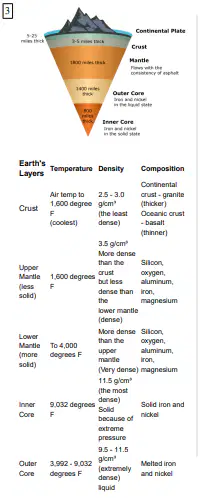
Which THREE statements are supported by the information on the layers of Earth?
The drawing shows the Mantle, Outer Core and Inner Core
As the pressure increases, the layers of the Earth become thicker.
The mantle contains the majority of Earth's metals.
Layers are compared through Order, Composition, Temperature and State of Matter.
Your science teacher gives you a glass jar filled with water, organic material, dirt, and small rocks. She asks you to shake the jar for one minute and allow it to rest overnight.
How does this experiment prove the composition of soil?
The particles will settle into layers with rocks on the top and organic material on the top.
All materials will remain mixed with the water in the glass jar.
The particles will settle into layers with organic material on the top and rocks on bottom.
The rocks will settle on the bottom and all other particles will remain mixed with the water
Mr. Hernandez's class is investigating this soil sample to determine the different layers of the soil.
Which methods will BEST investigate the presence of organic material and rock in the soil?
The student can remove the top layer of soil to investigate the middle layers of the soil.
The student can remove the roots from the topsoil because the roots will affect the soil sample.
The student can use a screen to sift the soil to determine the amount of rocks in the soil to determine the layers.
The student can remove the rock layer from the bottom of the soil sample to investigate soil without the bottom layer of rock.
Steps for Soil Investigation
1. Fill a clear jar with soil, leaving some room at the top.
2. Add water to the top of the jar.
3. Stir the soil.
4. Let the soil settle for an hour.
5. Examine the layers of soil.
Which observation made from the investigation supports the presence of decomposing organic matter in the soil?
Sand sinks to the bottom of the sample.
Soil separates into multiple layers after settling.
Partially decomposed organic material floats to the top of the sample.
Partially decomposed organic material sinks to the bottom of the sample.
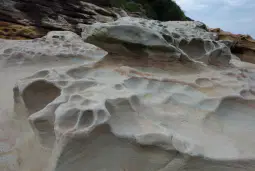
Sean's Science class had been studying rocks that are found in different areas and how they can be affected by physical weathering. Sean knows that physical weathering is caused by different weather conditions that will alter the rock.
Which question would be BEST for Sean to ask to determine what type of physical weathering has caused the depressions in the rocks?
A. Have these rocks been used by tourists to hike?
B.
C. Have chemicals been sprayed on the rocks in the past?
D. Is there a water source that flows through the rock formation?
Is there a water source that flows through the rock formation?
Have chemicals been sprayed on the rocks in the past?
Are the depressions in the rocks caused by animals?
Have these rocks been used by tourists to hike?
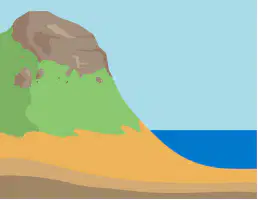
Leann made this model of weathering to show how the rock has been broken down over time.
How could Leann adjust her model to BEST show what causes the weathering and erosion?
She should remove the original piece of rock and add a water stream flowing to the larger source of water that would show the water moving the pieces of rock.
She should remove the grass from the model because the grass has no effect on the erosion and moving the rock downhill.
She should show rain falling into the body of water that would increase the water level and move the rock pieces downhill.
She should add a stream traveling down the rock to the water to move the rock pieces it has broken apart downhill.
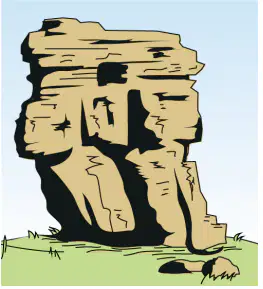
If a rock formation consists of alternating hard and soft layers, differential erosion occurs.
How will this rock formation MOST LIKELY be affected by wind-blown sand over time if the lower layers are composed of sandstone?
Over a period of time, the rock formation will develop a flat, smooth face on the side experiencing the blowing wind.
The rock formation will form deep hollows or craters, eventually weakening the formation until it crumbles into smaller rocks.
As the wind blows over the rock formation, it will smooth out into a flat table shape or mesa.
The base of the rock formation will experience the greatest amount of erosion, slowly creating a mushroom shape.
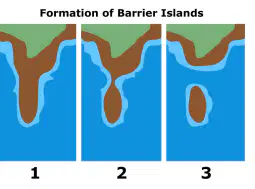
What process is responsible for the creation of the barrier islands in the diagram and why?
Deposition of the sand and rock from the force of the wind on the original coastline has caused a new island to form.
Erosion has created the new island because of the wind breaking down the rock.
Deposition of the sand and rock from the force of the waves on the original coastline has caused a new island to form.
Erosion has created the new island because of the waves breaking down the rock.

