
NEW
Font size
 Worksheets
Thermodynamics Quiz
Total questions: 15
Worksheet time: 19mins
Heat is the transfer of energy from one place to another. It naturally occurs by of three methods. Which of the following is not a natural heat transfer method?
Conduction
Convection
Radiation
Refrigeration
Radiation is the chief method of energy transfer from......
from the sun an earth satellite
from a gas flame to the top layer of water in teakettle
from a soldering iron to metals being soldered
from the bottom of a glass of water to an ice cube floating in it
Of the process below, the one in which practically all the heat transfer by conduction is________
from the sun to an earth satellite
from a gas flame to the top layer of water in a teakettle
from a stove top to a pot of water above it
None
Plastic handles are often used for kitchen utensils because...
the plastic is a good radiator
the plastic is a good insulator
the plastic is a good conductor
the plastic softens gradually with excessive heat
The law stating the heat energy always goes towards entropy, or moves from hot to cold and from order to disorder, is known as...
1st law of thermodynamics
2nd law of thermodynamics
Newton's 1st law
Newton's 2nd law
Which of the following methods of heat transfer explains why air near the ceiling is warmer than the air near the floor in an enclosed room?
convection
conduction
radiation
R-value
Energy in motion is called...
mechanical energy
kinetic energy
potential energy
static energy
To increase the insulating qualities of a house, a homeowner should...
increase the R-value
increase the U-value
increase radiation
increase conduction
Which answer below describe the definition of thermodynamics
The effects of work, thermal energy and energy on a system
The effects of kinetic energy, and thermal energy on a system
The average kinetic effects on thermal flow and thermal energy
none of the above is correct
What is entropy?
The measure of how evenly distributed heat is in a system
The transfer of thermal energy by the movement of fluid
the flowing of thermal energy from hot to cold
the average kinetic energy of particles in an object
Name three examples of thermodynamic systems?
nuclear power, electronics heat sink, rocket launch
electronics heat sink, boiler system, heat through a wall
boiler system, thermal flow through a heating pipe
none of the above
List two examples of convection.
weather, boiler system
heat travelling through a wall, water boiling at 100C
heat travelling through a spoon, flowing from hot to cold
none of the above
Define specific heat capacity (c)
The amount of energy it takes to raise one gram of a substance by one degree Celsius
The internal energy of an object
The measure of the kinetic energy of an object's molecules
None
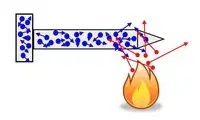
When thermal energy is added to a substance, the substance's particles move:
More rapidly at an increased diestance from each other.
More rapidly with less distance between each other.
More slowly with a greater distance between each other.
More slowly with a reduced distance between each other.

Calculate the energy transferred when a
block of aluminum at 90.0 °C is placed in
2.00 liter (2 kg) of water at 20.0 °C if the
final temperature becomes 40.0 °C. Also, calcuate the mass of the Aluminium block? The specific heat capacity of water is 4184 J/KgoC and Al is 900 J/KgoC. The thermal energy equation is Q = m.c.ΔT
(Q = 167360 Joules)
&
(Alm = 3.719 kg)
(Q = 67360 Joules)
&
(Alm = 1.719 kg)
(Q = 267360 Joules)
&
(Alm = 0.719 kg)
Zero

