
 Worksheets
2025 Environmental Science Fall Exam
Total questions: 42
Worksheet time: 24mins
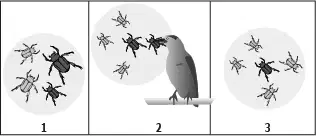
The image shows an example of natural selection.
Why is the population of beetles in image 3 mostly light-colored ones?
The light colored beetles are avoided by predators because they are bigger.
The dark-colored beetles change their coat colors to black to avoid predators.
The light-colored beetles are preyed upon more frequently as they are easily visible to predators.
The dark-colored beetles are preyed upon more frequently as they are easily visible to predators.
Different members of the same species are geographically isolated for many generations. What will
likely happen to the populations?
Each population will evolve different traits influenced by their specific environments.
Random recombination will ensure that the two populations evolve in a similar manner.
The two populations will evolve the same future traits because they are starting with similar genetic material.
One of the populations will fail to evolve because it was removed from its natural environment.
Several thousand acres of forested land have been destroyed in a volcanic eruption. After the eruption,
which plant species would be expected to grow in the area first?
Coniferous trees
Deciduous trees
lichens/grass
shurbs
The Galapagos Islands contain 15 species of finches that mainly have different beak types and sizes.
These finches evolved from a common ancestor that moved to these islands and occupied different parts
of it.
What was the most likely reason these finches evolved into different species?
They interbred with other bird species.
They adapted to different food sources.
The beaks provided a variation for survival in extreme climates.
The beaks prevented them from being seen by predators.

The diagram shows the limbs of four different species of organisms.
What can be inferred about the evolution of these organisms based upon the anatomical structure of
each species?
They shared a common ancestor.
They used their limbs for similar functions.
They adapted to the same environmental conditions.
They competed for the same sources of food.
Which event would lead to primary succession of a forest?
a volcanic eruption
a forest fire
an abandoned field
a tornado
Ecological succession is a series of progressive changes in an ecosystem where one community
slowly progresses into a new community. There are two types of succession, primary and
secondary.
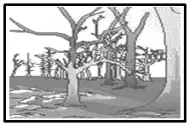
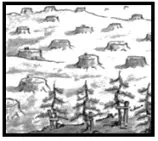
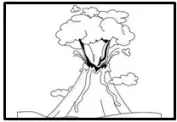
Which location is an example of where primary succession could occur?

Similarities are found between embryos of fish, dogs, and humans. What does this observation suggest?
They all have similar components in their blood.
They all maintain similar number of chromosomes.
They have similar habitat requirements.
They share a common genetic heritage.
A large percentage of the panda bear’s daily food intake consists of the leaves, stems, and shoots of
bamboo plants. What would happen to the panda bear if the area where bamboo grows is cleared for
human agricultural purposes?
The panda bear would easily move elsewhere.
The panda bear would have an abundance of food.
The panda bear would not be affected.
The panda bear would not have enough to eat.
An earthquake creates a canyon that divides a population of tree snakes in half. The left side of the
canyon has a river flowing through it while the right side is relatively dry.
How will natural selection impact the population of tree snakes over a long period of time?
The snakes on both sides of the canyon will migrate away from the area.
The snakes on both sides of the canyon will remain the same species.
The snakes on each side of the canyon will develop into two different species.
The snakes on the dry side of the canyon will find ways to move to the other side.
Certain structural adaptations among the members of a population are passed on to future generations
while others are not. What is the most likely explanation?
The adaptations passed on are environmental changes and are favorable for the species.
The adaptations passed on are genetic changes and are favorable for the species.
The adaptations passed on are environmental changes and are unfavorable for the species.
The adaptations passed on are genetic changes and are unfavorable for the species.

The diagrams represent a community in various stages of succession.
Which diagram represents the climax community?
W
X
Y
Z
Genetic changes can occur frequently in individuals in a population, but not all of the changes get
passed along to offspring because these changes are not always good. In order to be beneficial and
increase the likelihood that a trait will be passed on to its offspring, any genetic change would have to
increase what attribute of the individual?
appendages
fitness
size
speed
Nearly all African elephants have tusks. In 1930, only 1% of the elephant population in Uganda lacked
tusks because of a rare genetic mutation. Food was fairly plentiful, and by 1963, there were 3,500
elephants. In the 1970s, civil war in Uganda resulted in wildlife being killed for food, and poachers
killed elephants for their ivory tusks. By 1992, the elephant population had dropped to about 200. But
by 1998, the population had increased to 1,200. A survey in 1998 revealed that as many as 30% of the
adult elephants lacked tusks. There was also a decline in poaching. One part of the Theory of Natural
Selection states that variations exist within inherited traits.
Which statement is an example of genetic variation?
All African elephants have tusks.
Poachers killed elephants for their ivory tusks.
In 1930, only 1% of the elephant population did not have tusks.
By 1998, the African elephant population had increased to 1,200.
Every year thousands of acres of forest are cut down for humans to build houses, shopping malls, and
other essential components of modern society. How does the cutting down of forests affect the genetic
diversity of the species found within them?
Genetic diversity increases because the species are closer to one another and can exchange
genes more easily.
Genetic diversity decreases because without the habitat many individuals die, and their genes are
lost forever.
Genetic diversity does not change because while some individuals die, the remaining organisms
still contain those genes.
Genetic diversity is not affected by cutting down forests because forests do not have genes to
pass to the next generation.
Fiona read in her textbook that in ecological succession, pioneer species appear first. They are followed
gradually by more complex species until the ecosystem becomes stable with a climax community.
If grass is one of the pioneer species of a forest, then what would be one of the climax species?
Lichen
Maple tree
Moss
Tulip
Which event would be followed by primary succession?
A farmer tills under his last crop of corn and allows the field to go fallow.
A hurricane deposits enough displaced sand to create a new, low dune system.
A large EF-5 tornado destroys fields and forests in a rural community.
A logging company clear-cuts a pine forest, opening up the canopy to new plant species.
A NC town builds a hydroelectric dam, separating a population of fish. Years later the dam is
demolished, allowing the fish to interact, but they can no longer mate together. What has occurred?
behavioral isolation
geographic isolation
morphological isolation
temporal isolation
Most amphibians produce many offspring but give them little care. Mammals, on the other hand,
produce few young and care for them for varying periods of time. What competitive advantage does
caring for offspring provide?
It makes it easier for the young to disperse and grow rapidly.
It makes it easier to provide food and shelter for the young.
It provides a social structure which ensures safety later in life.
It helps the young survive in crowded, competitive environments.
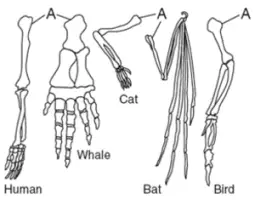
These five species have similar bone structures.
What can be inferred about these animals?
They share a common ancestor.
They share a common habitat.
They share the same niche.
They share the same type of locomotion.
Which human action has had the most positive ecological impact on the environment?
overhunting predators to reduce the death of their prey
reforestation to reduce the amount of carbon dioxide in the atmosphere
introduction of non-native species such as kudzu into the U.S. to reduce erosion
use of pesticides to reduce crop damage by insects
In the late 1940s, the World Health Organization started programs to wipe out malaria with the use of
DDT, which was used to kill the mosquito that was a vector for malaria. During its early years, the
program ran successfully. Within a few decades, DDT lost its effectiveness against the mosquito.
Which explanation describes why mosquitoes continue to be a vector for malaria?
The mosquito populations evolved mechanisms that make DDT ineffective when it enters into their
body systems.
The mosquito populations learned to protect themselves from destruction by hiding in areas where
DDT was not sprayed.
The current mosquito populations developed from eggs laid before the DDT program was
implemented, so the mosquitoes survive and reproduce.
The original mosquito populations were made of diverse forms, some that were resistant to DDT,
and those forms survived and reproduced.
The Shearon Harris nuclear power plant, which is located 20 miles southwest of Raleigh, NC, provides
efficient, inexpensive energy. What is a negative impact of the power plant?
It reduces dependence on fossil fuels.
It decreases use of coal-fired power stations.
It produces radioactive wastes.
It increases local biodiversity.
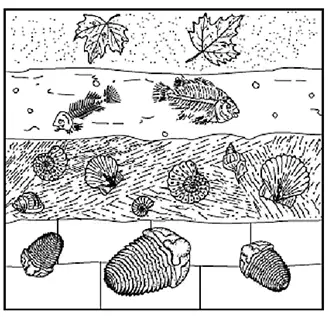
The diagram shows undisturbed layers of rock containing a variety of fossils.
What can most likely be inferred about the evolutionary history of this area?
The area was once a saltwater sea and was later replaced by a forest.
The area was once a forest and was later replaced by a freshwater lake.
The area was once a freshwater lake and was later replaced by a desert.
The area was once a saltwater sea and was later replaced by a desert.
What is an essential characteristic of members of a given species?
the ability to produce eggs or live offspring without sexual reproduction
the ability to reproduce with members of another species
the ability to reproduce with one another and have fertile offspring
the ability to reproduce with organisms outside of their local gene pool
Toothed whales, like sperm whales, have complete sets of teeth throughout their lives. Baleen whales
have baleen plates, fibrous structures that filter food from water. Fetuses of baleen whales develop tooth
buds that are reabsorbed before birth.
What does the evidence suggest about the evolution of whales?
Both the whales have common ancestors.
Both the whales evolved at the same time.
Toothed whales evolved from baleen whales.
Toothed whales had ancestors that had baleen plates.
Which process will directly result in organic matter being added to the soil?
water freezing in cracks of rocks
glaciers carving out a valley
river water eroding the banks of a stream
bacteria breaking down dead matter
Significant destruction of a forest habitat will increase which gas in the atmosphere?
CO2
NO2
O2
N2
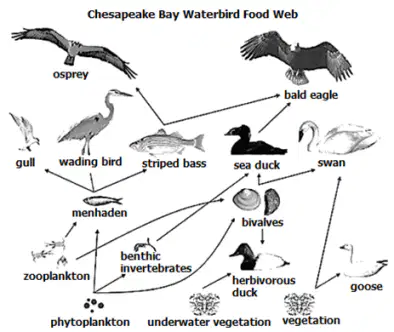
The food web shows organisms living in Chesapeake Bay, Maryland.What organism would be considered a producer in this ecosystem?
Bivalves
Herbivorous Duck
Menhadden
Phytoplankton
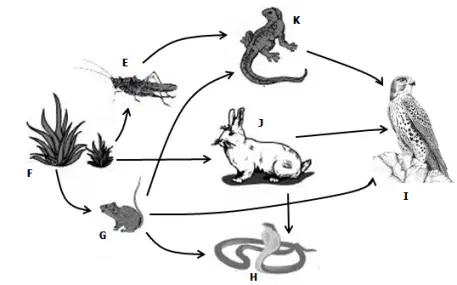
Food webs show feeding and energy relationships in nature. Examine the diagram of a grassland food
web. What type of consumer is organism H?
Carnivore
Decomposer
Herbivore
Omnivore
Why is a pyramid a good way to show the flow of energy from one trophic level to the next in an
ecosystem?
Energy is transferred from the bottom, making more energy available at the top.
Energy is transferred from the bottom, making less energy available at the top.
Energy is transferred from the top, making less energy available at the bottom.
Energy is transferred from the top, making more energy available at the bottom.

Examine the diagram showing a typical food chain found in a forest What decrease is represented by the pyramid shape?
Food Consumption
Organism Size
Energy Availability
Habitat Availability
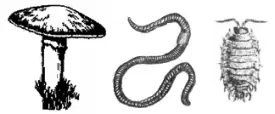
The organisms in the diagram are found in many different ecosystems and play an important role.
In which trophic level do the organisms belong?
Carnivores
Decomposers
Herbivores
Omnivores
Which biotic limiting factor could be responsible for a decrease in a population of rabbits in an area?
an increase in vegetation
a decrease in rainfall
an increase in the coyote population
a decrease in the pH of their water

Study the relationships shown in the food web.
Which food chain shows one of the ways energy flows in this ecosystem?
hawk → bird → caterpillar → leaves
berries → earthworm → bird→ hawk
copperhead → opossum → earthworm → leaves
berries → rabbit → opossum → hawk
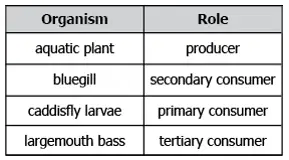
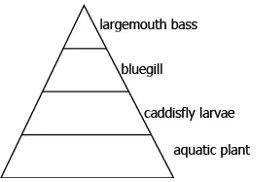
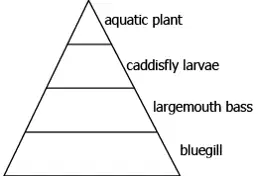
The table lists the roles of different organisms in an aquatic food chain. Which pyramid would be the best representation of the information in the table?.


Which example represents a density-independent abiotic factor that might affect a population of
rabbits?
a hurricane
a viral infection
competition
predation

The graph shows the growth of the world’s human population related to the availability of
nonrenewable resources and to the resulting pollution created.
What can be inferred from the graph?
The human population has reached its carrying capacity.
Increased pollution is limiting the growth of the human population.
The increase in the human population is depleting nonrenewable resources.
Increased nonrenewable resources are sustaining the growth of population.
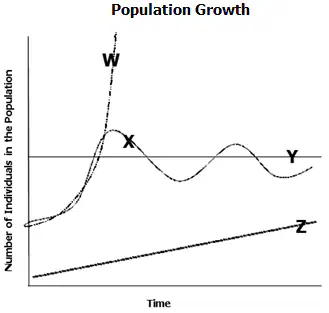
Examine the graph.
Which line on the graph shows the growth of the human population in the last 500 years?
W
X
Y
Z
On Earth, the plants and the oceans store carbon dioxide from the atmosphere. What results when a
factor, such as the clear-cutting of large stands of forest, disrupts this process?
global warming
overpopulation
ozone depletion
soil erosion
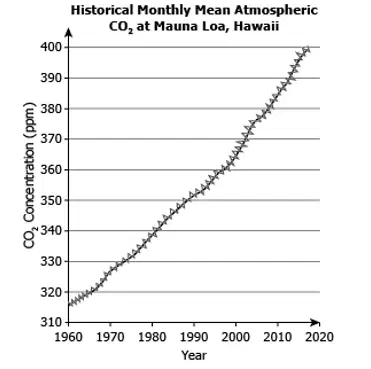
The graph shows the concentration of CO in the atmosphere from 1960 to 2015.
Which global change shows a similar trend?
increase in temperature on Earth
increase in wind flow along coastal areas on Earth
increase in Earth’s atmospheric moisture
increase in Earth’s groundwater levels
The first organism to occupy an area after a prairie fire are known as ________ species.
Keystone
Pioneer
Competition
Prey

