wayground logo

Free Printable Worksheets

Font size

S
M
L
XL
Worksheets

Fall Review Quizziz

Total questions: 182

Worksheet time: 4hrs 39mins

Name
Class
Date
1.
Momentum is a ____________________ quantity
a)
science
b)
scalar
c)
vector
d)
energy
2.
The equation to calculate momentum is
a)
p=mv
b)
p=1/2mv2
c)
p=mgh
d)
p=mg
3.
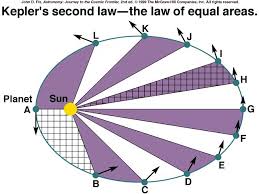
The momentum of an object depends upon the object's ___________&_____________.  
a)
size and shape
b)
mass and speed
c)
mass and veloctiy
d)
mass and energy
4.
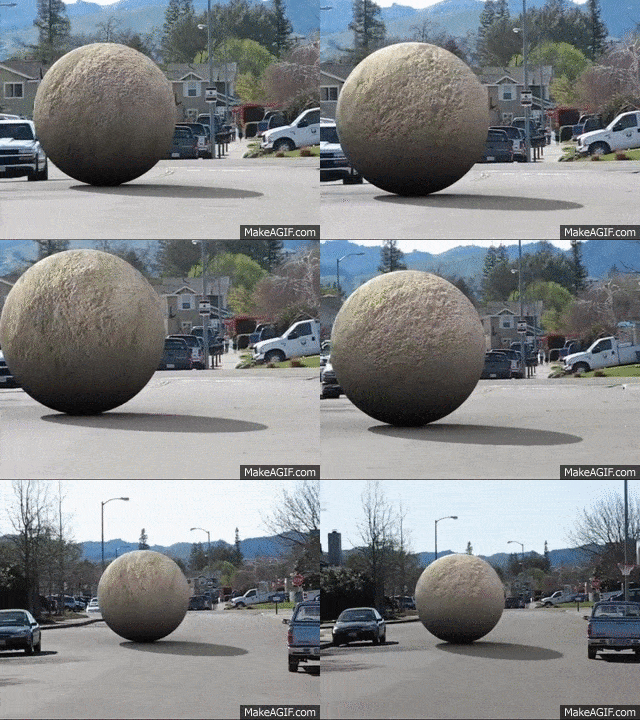
What is the momentum of a charging rhino?
a)
2 × 10² kg⋅m/s
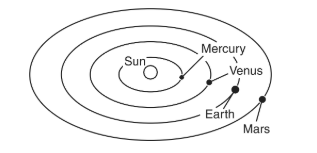
b)
3 × 10² kg⋅m/s
c)
2 × 10⁴ kg⋅m/s
d)
3 × 10⁴ kg⋅m/s
5.

Find the momentum of a 3.0 kg mass when it is stopped.

a)

0 kg*m/s

b)

need to know the velocity

c)

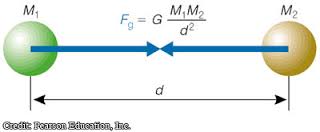
3.0 kg*m/s

d)

9.8 kg * m/s

6.
Which of the following correctly explains why less force is required to stop a person using an airbag?
a)
hitting the airbag decreases the person's momentum
b)
the airbag changes the person's momentum over a longer time interval
c)
the airbag is very soft, like a pillow
d)
decreasing the time of the impact decreases the force of the impact
7.

a bat strikes a 0.05 kg baseball so that its velocity changes by +30 m/s in 0.1 s. With what average force was the ball struck?

a)

+15 N

b)

-15 N

c)

+300 N

d)

-300 N

e)

+150 N

8.
The impulse is ______ the change in momentum
a)
greater than
b)
equal to
c)
less than
d)
always double
9.

At what speed do the two blocks move after the collision?

a)

2 m/s

b)

5 m/s

c)

10 m/s

10.
When two objects collide, the Momentumbefore is ____________ the Momentumafter.
a)
more than 
b)
less than 
c)
equal to
d)
unrelated to
11.

What is the unit for momentum?

a)

m/sec

b)

kg/sec

c)

kg/m

d)

kg x m/sec

12.
A 50 kg ball rolls down the street at 5 m/s. Calculate the momentum of the ball. 
a)
55 kg*m/s
b)
100 kg*m/s
c)
250 kg*m/s
d)
500 kg*m/s
13.

Which of the following has the MOST momentum? (they are all rolling at the same velocity)

a)

rolling ping-pong ball

b)

rolling bowling ball

c)

rolling soccer ball

d)

rolling basketball

14.
A 9 kg blob moving at 5 m/s collides and sticks to a second blob with a mass of 5 kg. If the two bobs stick together, what will the velocity of the two blobs move at?
a)
3.57 m/s
b)
3.2 m/s
c)
10.0  m/s
d)
9.0  m/s
15.
A runner has a momentum of 720 kg m/s and is traveling at a velocity of 5 m/s. What is his mass?
a)
14.4 kg
b)
1400 kg
c)
144 kg
d)
360 kg
16.

A 9300 kg railroad car traveling at a velocity of 5 m/s strikes a second boxcar that weighs 5000 kg at rest. The first railroad car stops completely after the collisions. At what speed will the second boxcar move due to the collission?

a)
18.6 m/s
b)
9.3 m/s
c)
7.5 m/s
d)
1.86 m/s
17.
When the speed of an object is doubled, its momentum
a)
remains unchanged in accord with the conservation of momentum.
b)
doubles
c)
quadruples
d)
decreases
18.
Two football players with mass 75 kg and 100 kg run directly toward each other with speeds of 6 m/s and 8 m/s respectively. If they grab each other as they collide, the combined speed of the two players just after the collision would be:
a)
2 m/s 
b)
3.4 m/s 
c)
4.6 m/s 
d)
7.1 m/s
19.
An open cart on a level surface is rolling without frictional loss through a vertical downpour of rain. As the cart rolls, an appreciable amount of rainwater accumulates in the cart. The speed of the cart will
a)
increase because of conservation of mechanical energy
b)
decrease because of conservation of momentum
c)
decrease because of conservation of mechanical energy
d)
remain the same because the raindrops are falling perpendicular to the direction of the cart's motion
20.
Which of the following has more momentum? 
a)
a moving SUV
b)
a moving semi-truck
c)
more information is needed
21.

Which of the following has the greatest momentum?

a)

a scurrying cockroach

b)

a parked semi-truck

c)

more information is needed

22.
Most modern vehicles have padded dashboards. This reduces collision injuries by...
a)
reducing the driver's change in momentum
b)
increasing the driver's change in momentum
c)
increasing the force of impact
d)
increasing the time of impact
23.
A block sliding on a frictionless surface runs into a second block of equal mass at rest. After the two collide, they stick together and travel with a velocity...
a)
that is twice the magnitude of the original velocity
b)
that is half the magnitude of the original velocity
c)
more information is needed
24.
Parkour Peter bends his knees upon landing in order to ____
a)
reduce his change in momentum
b)
increase his change in momentum
c)
increasing his landing time
d)
increasing his landing force
25.
Both students experience the same ____
a)
force of impact
b)
time of impact
c)
change in momentum
d)
all of the above
26.
This picture is an example of ____________
a)
Elastic Collision
b)
Inelastic collision
27.

Why does a semi truck have more momentum than a car if they are both traveling at 60kph?

a)

Truck is more massive

b)

Truck is less massive

c)

Car is moving faster

d)

Car is more massive

28.

Which would have more momentum between a train moving at 0 kph and a bug flying at 0.5 kph?

a)

Bug

b)

Train

c)

They are the same

29.
T/F:  A big truck will always have more momentum than a small car.
a)
True
b)
False
30.
The impulse acting on an object is always equal to its change in _____.
a)
Momentum
b)
Energy
c)
Position
d)
Velocity
31.
As you are walking along the sidewalk you step on a piece of gum that sticks to your shoe.  This is an example of an _____ collision.
a)
Elastic
b)
Inelastic
32.
Due to friction, a purely _____ collision is impossible outside of a laboratory setting.
a)
Elastic
b)
Inelastic
33.
Planets orbit the Sun in a shape called a(n)
a)
circle
b)
ellipse
c)
focus
d)
perihelion
34.
An ellipse is drawn around two points called
a)
aphelion
b)
perihelion
c)
foci
d)
axis
35.
Where is the planet moving faster
a)
Position A to B
b)
Position B to C
c)
Position H to I
d)
Position I to J
36.
What is true about the area between points A, B and the Sun, and the area between points H, I and the Sun?
a)
The area between A, B and the Sun is the largest.
b)
The area between H, I and the Sun is the largest
c)
Both areas are equal in size
d)
There is not enough information to determine the areas
37.
What has an eccentricity of zero
a)
a straight line
b)
a large ellipse
c)
a circle
d)
a small ellipse
38.
Kepler's 2nd Law deals with 
a)
the shape of the planets' orbits
b)
the speed/area the planet travels 
c)
the length of time it takes the planet to orbit the sun
39.
A planet moves __________ when it is farthest from the sun.
a)
faster
b)
slower
40.
Kepler's first law states that the orbits of the planets are oval in shape or 
a)
ellipses
b)
perfect circles
41.
What are the two factors that influence gravity the most?
a)
Mass and weight
b)
Weight and gravity
c)
Mass and distance
d)
Weight and distance
42.
When a planet orbits the Sun, one of the foci of the elliptical orbit is 
a)
the axis
b)
the perihelion
c)
the center
d)
the Sun
43.
An ellipse is drawn around two points called
a)
aphelion
b)
perihelion
c)
foci
d)
axis
44.

The diagram below shows a moon revolving around a planet in an elliptical orbit. At which position is the moon traveling fastest?

a)

location 1

b)

location 2

c)

location 3

d)

location 4

45.

The diagram below shows a moon revolving around a planet in an elliptical orbit. At which position is the moon traveling slowest?

a)

location 1

b)

location 2

c)

location 3

d)

location 4

46.

A year on Jupiter is 4,344 days long. This tells you how long it takes

a)

Jupiter to orbit the sun.

b)

Jupiter to rotate one time on its axis.

c)

the sun to orbit Jupiter.

d)

Earth to orbit Jupiter.

47.

What causes Earth’s year to be shorter than Jupiter’s year?

a)

the gravitational pull of Jupiter’s moons

b)

the shape of Earth’s orbit around the Sun

c)

the distance between Earth and the Sun

d)

the mass and density of Jupiter

48.

Which planet will take the least amount of time to revolve around the Sun?

a)

Mercury

b)

Venus

c)

Earth

d)

Mars

49.

Which planet will take the most amount of time to revolve around the Sun?

a)

Mercury

b)

Venus

c)

Earth

d)

Mars

50.

Which statement best describes Kepler’s 2nd Law of Planetary Motion?​

a)

Planets revolve around the sun over equal areas in equal time intervals.

b)

Planetary orbits are in the shape of an ellipse.

c)

A planet’s orbital period is proportionate to its distance from the sun.

51.

Kepler's 3rd law tell us that __ would be dependent on __.

a)

orbital period ; distance

b)

distance ; orbital period

52.

When a planet or moon travels once fully in its orbit around a largest celestial body, it is a(n):

a)

Rotation

b)

Revolution

53.
What has an eccentricity of zero
a)
a straight line
b)
a large ellipse
c)
a circle
d)
a small ellipse
54.
Which is NOT one of Kepler's laws?
a)
Planets travel in an ellipse
b)
Planets closest to the sun travel faster
c)
The farther a planet is from the sun, the longer it takes to orbit
d)
Planets revolve around the Earth
55.

A way of measuring distances in space. Equivalent to the distance from Earth to the Sun.

a)

Elipse

b)

Eccentricity

c)

Astronomical Unit

d)

Period

56.

A measure of how round an orbit is.

a)

Period

b)

Eccentricity

c)

Astronomical Unit

d)

Vector

57.

Planets travel faster when they are closer to the sun.

a)

Kepler's 1st Law

b)

Kepler's 2nd Law

c)

Kepler's 3rd Law

58.

The time it takes one object in space to fully orbit another.

a)

Astronomical Unit

b)

Vector

c)

Orbital Period

d)

Orbital Radius

59.

The diagram explain about....

a)

Kepler's First Law

b)

Kepler's Second Law

c)

Kepler's Third Law

60.

The diagram is about....

a)

Kepler's First Law

b)

Kepler's Second Law

c)

Kepler's Third Law

61.

This formula is about

a)

Kepler's First Law

b)

Kepler's Second Law

c)

Kepler's Third Law

62.

Earth takes 1 year to make 1 complete orbit while Saturn takes 29.5 years.

a)

True

b)

False

63.
Two asteroids exert a gravitational force, F, on each other. Some time later, the asteroids are now three times as far from each other as before. Which of the following represents the gravitational force at this distance? 
a)
F/3
b)
F/2
c)
F/6
d)
F/9
64.
If Earth's mass was cut in half, what would happen to your mass?
a)
increase because gravitational force increases
b)
decrease because gravitational force decreases
c)
decrease because gravitational force increases
d)
nothing, mass is not affected by gravitational force
65.

Calculate the gravitational force between two objects when they are 0.750m apart. Each object has a mass of 5.00kg.

a)

2.96x10⁻⁷N

b)

3.00x10⁻⁶N

c)

2.22x10⁻⁹N

d)

2.23x10⁻⁸N

66.
Two objects are attracted to each other with 36 N of gravitational force.
What would the force between them be if the distance between them were doubled?
a)
9
b)
18
c)
72
d)
144
67.
What is the Universal law of gravitation equation? 
a)
G=F ⋅ m⋅m2/r2
b)
F=G ⋅ m⋅m2/(r)2
c)
F=G ⋅ r2/m⋅m2
d)
G=F ⋅ r2/m⋅m2
68.
Two factors effecting the magnitude of the force of gravity between 2 objects are...
a)
mass and distance 
b)
mass and matter
c)
distance and weight 
d)
weight and mass
69.
Gravity attracts all objects towards one another.
a)
False
b)
True
c)
It depends
70.

What is the gravitational force between two identical 50,000 kg asteroids whose centers of mass are separated by 1000 m?

a)

2500 N

b)

3.3 x 10⁻¹² N

c)

1.67 x 10⁻⁴ N

d)

1.67 x 10⁻⁷ N

71.

Two spherical objects have masses of 8000 kg and 1500 kg. Their centers are separated by a distance of 1.5 m. Find the gravitational attraction between them

a)

5.4 X 10⁻⁴ N

b)

1.2 X 10⁷ N

c)

3.6 X 10⁻⁴ N

d)

5.33 N

72.
Complete the following statement: The farther away two planets are the _______ the gravitational force between them.
a)
more
b)
same
c)
dosen't matter
d)
less
73.
Gravity is the force objects put on each other because of their ______.
a)
Mass
b)
Friendliness
c)
Acceleration
d)
Speed
74.

Which configuration will result in the greatest gravitational force?

a)

small masses far apart

b)

large masses far apart

c)

small masses close together

d)

large masses close together

75.
Force of gravity is directly proportional to
a)
Mass
b)
Weight
c)
Distance
d)
Time
76.
If I double the distance between two objects, what happens to their gravitational Force?
a)
4x bigger
b)
4x smaller
c)
2x bigger
d)
2x smaller
77.
If I double the mass of one object, but don't change anything else... WHat happens to the gravitational force between two objects?
a)
Doubles
b)
Quadruples
c)
Cut in Half
d)
4x Smaller
78.
What happens to Gravitational force if I double both of the masses but don't change their distance?
a)
doubles
b)
half as big
c)
4x bigger
d)
4x smaller
79.

Calculate the gravitational force between two objects when they are 0.750m apart. Each object has a mass of 5.00kg.

a)

2.96x10⁻⁷N

b)

3.00x10⁻⁶N

c)

2.22x10⁻⁹N

d)

2.23x10⁻⁸N

80.

If the distance between 2 masses is increased then the force of gravitation between them will...

a)

increase

b)

decrease

c)

stay the same

81.

If the mass of either m1 or m2 is increased then the force of gravitation between them will...

a)

increase

b)

decrease

c)

stay the same

82.
When distance increases, electrostatic force ____________; we call this relationship ____________ proportional
a)
decreases;directly
b)
decreases;inversely
c)
increases;inversely
d)
increases;directly
83.
What variable is a Coulomb the unit for?
a)
Charge
b)
Force
c)
Distance
d)
Mass
84.
What happens to the force between two charged objects when you double the distance between them?
a)
2X
b)
1/2X
c)
4X
d)
1/4X
85.
What happens to the force between two charged objects if you double the distance between them and double the magnitude of one charge?
a)
4X
b)
6X
c)
1/2X
d)
1/6X
86.
If each of the charges doubles, what happens to the force?
a)
Quadruples
b)
Doubles
c)
Stays the same
d)
Reduced by half
87.
If the distance doubles, what happens to the force?
a)
Reduced by half
b)
Reduced by 1/4
c)
Stays the same
d)
Quadruples
88.
Electrostatic force F is directly proportional to:
a)
r^2 (distance squared)
b)
q1
c)
q2
d)
both q1 and q2
89.
When distance increases, electrostatic force ____________; we call this relationship ____________ proportional
a)
decreases;directly
b)
decreases;inversely
c)
increases;inversely
d)
increases;directly
90.
What variable do Coulombs represent?
a)
Electrostatic Charge
b)
Force
c)
Distance
d)
Mass
91.

Recap:

Coulomb’s law states that the force between two charged objects will __________ when the magnitude of the object’s charge increases.

Coulomb’s law also states that the force between two charged objects will __________ when the distance between objects increases.

a)

increase; increase

b)

increase; decrease

c)

decrease; increase

d)

decrease; decrease

92.
The plastic covering is there to:
a)
Provide a conductor for electrical energy to flow.
b)
Provide an insulator so that electrical energy will not pass outside of the wires.
c)
Provide a conductor so that electrical energy can NOT flow.
d)
Provide an insulator so that electrical energy can flow.
93.
The difference between attract and repel is that to attract is to pull something closer and repel is to push something away.
a)
True
b)
False
94.
How do electrons differ from protons?
a)
They are the same thing
b)
Electrons hold a negative charge and protons hold a positive charge.
c)
Electrons are positively charged and protons are negatively charged.
d)
Protons are neutral 
95.

The image shows two charged particles with a force of 2.4 N. What would you predict the force of interaction would be when the magnitude of charge on q2 doubles?

a)

9.6 N

b)

4.8 N

c)

1.2 N

d)

.6 N

96.

The image shows two charged particles with a force of 2.4 N. What would you predict the force of interaction would be when the distance doubles?

a)

4.8 N

b)

1.2 N

c)

.6 N

d)

.3 N

97.
The Electric Force is strongest when charges are...
a)
close together
b)
far apart
c)
the electric force is constant everywhere
98.

What would a negative value for Fe mean?

a)

The particles are moving away from each other

b)

The particles have the same charge

c)

The particles have opposite charges

d)

The particles are moving towards each other

99.

Select all answer that apply:


What kinds of particles do Coulomb's Law apply to?

a)

electrons

b)

protons

c)

neutrons

d)

neutral atoms

100.

A repulsive force exists between which two particles?

a)

Two neutrons

b)

An electron and a neutron

c)

An electron and a proton

d)

Two protons

101.

The variable "r" in Coulomb's Law would have what units?

a)

Joules

b)

Coulombs

c)

Newtons

d)

Meters

102.

What does "r" measure?

a)

the distance between the two charged objects

b)

the amount of charge carried by the objects

c)

the amount of force between two charged objects

d)

the constant value for forces between the objects

103.

What does Fe stand for?

a)

the electrostatic force

b)

the symbol for iron

c)

the constant for the charges

d)

the charges of the particles

104.

What will be the units of F (or Fe)?

a)

Newtons

b)

Meters

c)

Coulombs

d)

Joules

105.

As the value of r increases, what happens to the value of F?

a)

F increases

b)

F decreases

c)

F never changes, q does

d)

Cannot know from the information

106.

What does q measure?

a)

the distance between the two charged objects

b)

the amount of charge carried by the object

c)

the amount of force between two charged objects

107.

Why are there two q's in the equation?

a)

because there are two charged objects

b)

because there are protons and electrons

c)

because the particles are moving away from each other

d)

because the particles are moving towards each other

108.

What can you do to increase the value of k?

a)

change the force

b)

change the distance

c)

change the charge

d)

nothing can be done to change the value of k; it is a constant

109.

An attractive force exists between which two particles?

a)

Two neutrons

b)

An electron and a neutron

c)

An electron and a proton

d)

Two electrons

110.

A 5 C and 8 C are 8 m apart. What is the force between them?

a)

5.625 x 10⁹

b)

5.625 x 10⁻⁹

c)

4.5 x 10¹⁰

d)

4.5 x 10⁻¹⁰

111.

A 5 C and 8 C charge give off a force of 2.5 x 10⁹ N. What is the distance between them?

a)

11 m

b)

12 m

c)

121 m

d)

144 m

112.

Two charges of equal magnitude give off a force of -441000 N when they are 1000 m away from each other. What are the charges magnitude?

a)

5

b)

7

c)

9

d)

11

113.

A charge of 3 C is 27 m away from another charge. They exert a force of -2.59 x 10⁸ N on each other. What is the 2nd charge?

a)

5 C

b)

-5 C

c)

7 C

d)

-7 C

114.
Calculate the force exerted between two charged objects separated by a distance of 0.6 m. One object has a charge of -5 C and the other has a charge of +2.0 C.
a)
-1.5E-11 N
b)
2.5E-11 N
c)
-2.5E11 N
d)
-7.5E-10 N
115.

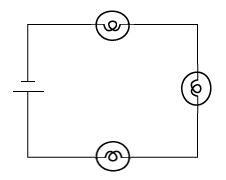
The picture shows an electrical circuit. This circuit is a series circuit because:

a)

It has 3 light bulbs.

b)

The same current flows through all three light bulbs.

c)

It uses a single battery.

d)

The electrical current has more than one path to flow through

116.

How many lightbulbs will work if there is a break in the circuit at POINT A?

a)

1

b)

2

c)

3

d)

NONE

117.
If the current through the battery was 10A in this diagram. What would the current through each bulb be?
a)
10A
b)
5A
c)
20A
d)
0A
118.

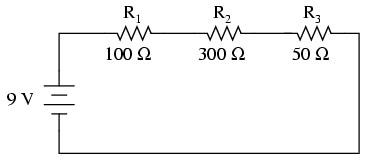
The equivalent resistance in this circuit is

a)

100 ohms

b)

450 ohms

c)

400 ohms

d)

30 ohms

119.
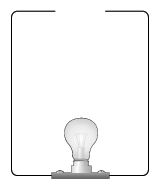
This circuit won't work. What essential part is missing from this circuit?
a)
resistance
b)
source of electric current
c)
conductor
d)
ammeter
120.

A 2.0-ohm resistor and a 4.0-ohm resistor are connected in series with a 12-volt battery. If the current through the 2.0-ohm resistor is 2.0 amperes, the current through the 4.0-ohm resistor is

a)

1.0 A

b)

2.0 A

c)

3.0 A

d)

4.0 A

121.

Where should an ammeter be located to correctly measure the total current and where should a voltmeter be located to correctly measure the total voltage?

a)

ammeter at 3 and voltmeter at 4

b)

ammeter at 1 and voltmeter at 4

c)

ammeter at 2 and voltmeter at 3

d)

ammeter at 1 and voltmeter at 2

122.

The total current through this circuit is

a)

0.02 amps

b)

0.09 amps

c)

50 amps

d)

9 amps

123.

The voltage dropped across the 300 ohm resistor is

a)

6 V

b)

9 V

c)

2 V

d)

30 V

124.
If you replace the paper clip with a plastic spoon, what happens?
a)
The bulb doesn't light
b)
The bulb is dimmer
c)
The wires get hot
d)
There is no change
125.
A series circuit has ____ path(s) that the electric current can take. 
a)
One
b)
Two 
c)
Three 
d)
Four
126.
In a parallel circuit, if one connection is broken, all of the connections stop working.
a)
True
b)
False
127.
Which of these objects is an insulator?
a)
Copper Wire
b)
Paper Clip
c)
Steel Pole
d)
Rubber Gloves
128.
An object through which electrons can easily flow is called a(n) ___________.
a)
Conductor
b)
Insulator
129.
Which one is a conductor? 
a)
wood 
b)
iron 
c)
plastic spoon 
d)
paper 
130.
Would would best complete this circuit?
a)
A wire
b)
A switch
c)
A battery
d)
A light bulb
131.
Electricity is the flow of _________.
a)
Protons
b)
Neutrons
c)
Electrons
132.
What kind of circuit is this?
a)
series
b)
parallel
133.
What kind of circuit is this?
a)
Series
b)
Consecutive
c)
Parallel
d)
Training
134.
As the resistance in a circuit increases, the electric current __________.
a)
increases
b)
decreases
c)
stays the same
135.

is the opposition to the flow of charges in a material.

a)

Resistance

b)

Voltage

c)

Time

d)

Current

136.

What would happen if in a circuit the voltage is increase?

a)

The time would increase

b)

The current would increase

c)

The current would decrease

d)

The current would stay the same

137.

What would happen if in a circuit, the resistance increases but the voltage stays the same?

a)

The current would decrease

b)

The current would increase

c)

The voltage would decrease

d)

The voltage would increase

138.

Why electrical wiring usually are covered with a layer of plastic?

a)

To make it look pretty

b)

To help electricity flow along the wire

c)

To make it safe

d)

To add more energy

139.

What needs to be done to this circuit so that the lamp lights up?

a)

Close the switch

b)

Add a source and close the switch

c)

Add another lamp

d)

Add another lamp and a switch

140.

If lamp 1 is unscrewed from its holder, what will happen to lamp 2?

a)

It will get brighter

b)

It will stay the same brightness

c)

It will go out

d)

Nothing will happen

141.
What is a switch's function in a circuit?
a)
to make the current hotter or colder
b)
turn on and off the flow of current
c)
the pathway that current flows
d)
to add more power to the circuit
142.
This instrument can be used to see if materials conduct electricity.  Which of these groups contains items that could all conduct electricity to complete the circuit?
a)
rubber ball, plastic comb, nail
b)
paper clip, penny, screw
c)
cork, dollar bill, tweezers
d)
pencil, eraser, spoon
143.
What will happen if one light bulb is removed from this circuit?
a)
the other bulbs will go out
b)
the other bulbs will get dimmer
c)
the other bulbs will get brighter
d)
the battery will become stronger
144.
Which light will be brighter and why?
a)
Bulb A because its circuit is closed
b)
Bulb B because its circuit is closed
c)
Bulb B because it has more volts
d)
Bulb A because it has less volts
145.
Voltage is measured in __.
a)
volts.
b)
watts.
c)
coulombs. 
146.
Current has units: 
a)
kilowatt·hour 
b)
ampere 
c)
coulomb 
d)
volt 
147.
In a parallel circuit which of the following is the same value throughout the circuit?
a)
Voltage
b)
Current
c)
Resistance
d)
Charge
148.
Which of the two circuits would have the brightest bulbs? 
a)
A
b)
B
149.

What is voltage?

a)

the power in a machine

b)

the difference in electric potential energy per charge.

c)

how much electricity is in an object

d)

the electric current

150.

Solve for the total resistance of the circuit shown

a)

50 V

b)

1970 ohms

c)

705 K ohms

d)

20 Amps

151.

Solve for the voltage drop at resistor 1

a)

38 volts

b)

60 Kvolts

c)

50 volts

d)

25 volts

152.

Voltage drop stands for what?

a)

the voltage applied to a circuit

b)

the voltage flowing through a resistor

c)

the voltage used by a load

153.

With three 10 resistors connected in series with a 30 volt power supply, the total circuit current will equal ____.

a)

300 amps

b)

1 amp

c)

150 amps

d)

1 millamp

154.

The voltage drop across R1 is ______________________________ V.

a)

20

b)

30

c)

40

d)

50

155.

When a resistor in a series circuit is replaced by another resistor with an increased resistance value, the total circuit current will __________.

a)

stay the same

b)

decrease

c)

increase

d)

double in value

156.

This circuit has only one path for current to flow

a)

series

b)

parallel

c)

combination

d)

split

157.

__________ remains the same in a series circuit.

a)

Resistance

b)

Voltage

c)

Current

d)

Power

158.

What happens to total current in a series circuit when the total voltage stays the same, circuit resistance decreases, current will ____________.

a)

increase

b)

Stay the same

c)

Decrease

159.

What is the total circuit resistance of two 25 ohm resistors and three 75 ohm resistors connected in series?

a)

100 ohms

b)

200 ohms

c)

275 ohm

d)

175 ohms

160.
Velocity
a)
Vector
b)
Scalar
161.
Force
a)
Vector
b)
Scalar
162.
Which of the following quantities are vectors?
a)
speed, velocity, acceleration
b)
velocity, acceleration, force
c)
force, acceleration, mass
d)
length, mass, time
163.
An object's velocity can be changed by changing its speed, its direction, or both.
a)
True
b)
False
164.
A change in velocity over time is called ___________.
a)
speed
b)
force
c)
acceleration
d)
direction
165.
One kg multiplied by m/scan also be expressed as 1 __________.
a)
direction
b)
mass
c)
kilogram2
d)
newton
166.
Newton's second law of motion describes acceleration as force divided by __________.
a)
mass
b)
inertia
c)
speed
d)
direction
167.
If a net force acts on a moving object in the direction that the object is moving, the object will slow down.
a)
True
b)
False
168.

If an object isn't moving, it's net force must be zero.

a)

True

b)

False

169.

What is the unit for force?

a)

Newton

b)

Grams

c)

m/s^2

d)

Push

170.

What is the unit for acceleration?

a)

m/s^2

b)

m/s

c)

Newtons

d)

grams

171.

Weight and Mass are the same thing

a)

True

b)

False

172.

Vectors should include...

a)

direction and time

b)

direction and distance

c)

direction and magnitude

d)

time and magnitude

173.

I'm pushing really hard on a box on the floor, it's hard to move because of...

a)

tension

b)

frictional force

c)

normal force

d)

none of the above

174.

Tension is...

a)

A push by a surface

b)

the sum of all forces on an object

c)

a pull by a rope

d)

a pull towards Earth

175.

Acceleration and Force are...

a)

Inversely proportional

b)

Directly proportional

c)

The exact same thing

d)

Not at all related

176.

Acceleration and Mass are...

a)

Inversely proportional

b)

Directly proportional

c)

The exact same thing

d)

Not at all related

177.

What is the force on 400g object that's accelerating at 2m/s^2

a)

200N

b)

200

c)

800N

d)

800

178.

A net force of 100 N acts on a block with 20 kg. What is the acceleration?

a)

200 m/s^2

b)

20 m/s^2

c)

5 m/s^2

d)

0.5 m/s^2

179.

An object with unknown mass has a net force of 150 N acting on it and accelerates at 10 m/s 2 .

What is its mass?

a)

15 kg

b)

1500 kg

c)

1.5 kg

d)

0.15 kg

180.

A 30 kg object is accelerating at 5 m/s 2 . What is the net force?

a)

6 N

b)

15 N

c)

150 N

d)

60 N

181.

Which direction will this object move in?

a)

Up

b)

Down

c)

Left

d)

Right

182.

What is the net force on this object

a)

20 N right

b)

23 N right

c)

17 N right

d)

6 N right