
Font size
 Worksheets
SS8H4
Total questions: 63
Worksheet time: 35mins
Under the _______ white men could receive up to 1,000 acres of land based on the size of their families and how many slaves they owned.
Headright System
Yazoo Land Act
Land Lottery
Homestead Act
The controversial law in which Georgia sold land in what is now Alabama and Mississippi to four land companies.
Headright System
Yazoo Land Act
Land Lottery
Homestead Act
In the ___________ white males could pay for a ticket and have the opportunity to win land.
Headright System
Yazoo Land Act
Land Lottery
Homestead Act
Which methods did Georgia use to distribute land in the late 1700s and early 1800s?
collective bargaining and issuing bonds
speculation and sharecropping
the headright system and the land lottery
the land−use plan and the embargo system
Events in which Georgians had the chance to win the right to buy land from the state were known as __________________.
headright systems
land lotteries
circuit riders
Yazoo deals
How many acres of land could the head of the family receive under the headright system?
1,000
500
200
2000
With which topic was the Yazoo fraud concerned?
Indian lands in north Georgia
sale of land in western Georgia territory
ratification of the Constitution in Georgia
creation of a national park on state property
The Yazoo land fraud occurred because land companies ______.
claimed land that had been acquired illegally
took land from the Native Americans by force
made illegal treaties with the Native Americans
bribed legislators so they could buy land cheaply
The process first used to distribute lands in Georgia, in which a head of household received land for himself and his family was called the:
headright system
land lottery
cession
allocation by price
Which fact provides the BEST evidence to support the conclusion that the Yazoo Land Fraud was one of the most influential factors in the establishment of Georgia's borders?
As a result of the Yazoo Land Fraud, Georgia's capital was moved from Louisville to Milledgeville.
The controversy surrounding the Yazoo Land Fraud took years to resolve and eventually involved the U.S. Supreme Court.
The Dahlonega gold rush of 1829 drew thousands of white settlers into north Georgia and resulted in the loss of Cherokee territory.
As a result of the Yazoo Land Fraud, the western boundary of Georgia was moved from the Mississippi River to the Chattahoochee River.
The "Headright" system and the Land Lottery of 1805 were similar in that each
was a major cause of the Battle of Horseshoe Bend and the War of 1812.
contained provisions to preserve Creek and Cherokee ownership of the land.
was a method used by the state government to distribute public land to settlers.
required males between the ages of 16 and 60 to work on local roads at least 12 days a year.

Why was the University of Georgia founded?
to provide a higher education to the average person, not just the wealthy
to provide a higher education to wealthy, privileged landowners
to provide a higher education to all students, regardless of gender, race, or background.
to provide a higher education to women.

Who wrote the University of Georgia's original charter and its the first president?
Abraham Baldwin
Lyman Hall
Button Gwinnett
George Walton

What event caused the capital to move from Savannah to Augusta?
The advancement of the British Army during the American Revolution
Georgia took land from the Cherokee Indians
Gold was discovered in Augusta and settlers rushed into the area
Union General William Sherman was advancing on Savannah

Why did the Georgia capital move from Augusta to Louisville?
Louisville was in the center of Georgia's population
Leaders hoped that Louisville would be a center of trade because it was on the Ogeechee River
Augusta's capital building was outdated
Augusta had a severe breakout of malaria

What was the end result of the Yazoo Land Fraud?
Georgia ceded (gave up) what is now Alabama and Mississippi to the U.S. government
The Georgia Legislature burned the Act and pretended like it never happend
Georgia was forced to cede (give up) what is now Alabama and Mississippi to the Native American tribes that lived there
The Georgia Legislature gave citizens that bought land from the land companies a full refund.

In the ___________ white males could pay for a ticket and have the opportunity to win land.
Land Lottery
Headright System
Oklahoma land race
Homestead Act
Land distribution policies were designed to quickly give land away that was taken from
Native Americans
the Spanish
the British
the French
What is the correct chronological order of Georgia's Capitals?
Savannah, August, Louisville, Milledgeville, Atlanta
Savannah, Atlanta, Louisville, Milledgeville, Atlanta
Snellville, Athens, Lithonia, Macon, Atlanta
Savannah, Athens, Macon, Atlanta
What were the two largest Native American tribes affected by land distribution in Georgia?
Choctaw and Cherokee
Creek and Cherokee
Chickasaw and Cherokee
Cherokee and Seminole
In what year was the University of Georgia chartered (founded)?
1785
1765
1775
1755
The University of Georgia was the first ________________________sponsored university in the USA.
agriculture
private
group
state
Why did the capital of Georgia continue to be moved westward during the early 1800s?
State officials wanted the capital to be in their hometown.
Those were the largest cities in the state
It was moved to the governor's hometown
to be closer the population of people
Which statement best describes a "land grant university," such as the University of Georgia?
The land for the college was donated by the government.
The college was established as an agricultural college.
First college to allow women
Could never be used for any purpose other than a college
What was the purpose of the headright system?
It established a method of counting population.
It provided an organized system of collecting taxes.
It distributed land to new settlers to increase the states population
It administered voting and election districts.
Why did Georgia give up land claims in what is now Mississippi and Alabama?
The federal gov’t wanted to set that land aside for the Indian population.
The state did not have the millions of dollars needed to buy the land from Spain.
The state could not claim the land because the General Assembly illegally sold it to private companies.
The federal gov’t paid millions to settle the land fraud and agreed to remove the Creeks from the state.
The process first used to distribute lands in Georgia, in which a head of household received land for himself and his family was called the:
headright system
land lottery
cession
allocation by price

This map shows the cities that have been capitals of Georgia. What trend can be seen when studying the map?
The location of capitals have shifted westward over time.
The capitals were moved to be further from invading armies.
The location of capitals have been located next to major bodies of water.
The capitals have been located in cities with the largest trading centers.
As the capital of Georgia changed, it shifted west. What was the reason for the westward shift?
As more Indian lands were being taken, Georgia’s population moved in that direction.
Georgia citizens were trying to get away from the constant British attacks after the Revolutionary War.
Georgia citizens did not like being near the ocean.
The spread of disease continuously moved Georgia citizens away from their original capital city.
From 1796 to 1807, the capital of Georgia was "Louisville." Why was the city was named "Louisville"?
The city was founded by settlers who immigrated from France.
The area was settled by a large number of people who moved to Georgia from Kentucky.
It was named in honor of the the King of France who supported the Americans in the Revolution.
It was named in honor of the immigrant soldiers who helped defend the town during the American Revolution.

Which capital is depicted in the photo above
Atlanta
Louisville
Savannah
Macon
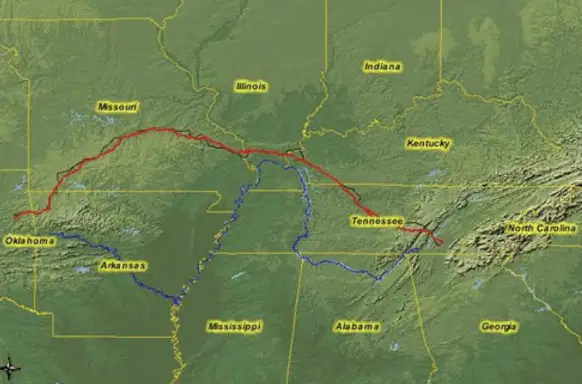
The red path on the map from Tennessee to Oklahoma is most likely showing what aspect of American history?
Erire Canal
Trail of Tears
Transcontinental Railroad
Sherman's March to the Sea
Which Supreme Court decision denied the right of states to take tribal lands but was ignored by President Andrew Jackson?
Brown v. Board
Plessy v. Ferguson
Tinker v. Des Moines
Worcester v. Georgia
John Marshall was a leader of which instrument of government? (SS8H4e)
The Senate
The Presidency
The Supreme Court
The House of Representatives
The Supreme Court case Worcester v. Georgia was a small victory for the Cherokee Nation in Georgia because it__________.
struck down laws created by the Georgia legislature to seize Cherokee lands.
ruled that the U.S. government's Indian Removal Act was unconstitutional.
established the Indian Territory east of the Mississippi in present-day Oklahoma.
declared that the U.S. government would honor the Cherokee Nation's constitution.
Which president is responsible for signing the Indian Removal Act of 1830?
Andrew Jackson
James Buchanan
Thomas Jefferson
John Quincy Adams
In what city was gold discovered in Georgia?
Atlanta
Savannah
Louisville
Dahlonega
What was the role of John Ross in the Antebellum South?
an abolitionist leader
general in the war of 1812
Chief of the Cherokee Nation
led the Nullification movement

Following the agreement that was reached in the Treaty of Indian Springs in 1825, Chief William McIntosh lost his life. Why did this happen?
He was betrayed by a rival American Indian who wanted the land he had received.
Creek leaders executed McIntosh because he agreed to sell the Creek's remaining land to the United States without their consent.
McIntosh died of Yellow Fever as a result of being forced to march on the Trail of Tears to Oklahoma.
The U.S. Government captured and executed him for violating the treaty just weeks after it was signed.
Which Supreme Court decision denied the right of states to take tribal lands but was ignored by President Andrew Jackson?
Fletcher v. Peck
Plessy v. Ferguson
Tinker v. Des Moines
Worcester v. Georgia

Who was the chief of the Cherokee who took a petition to Congress protesting the Cherokee removal from their land?
Sequoyah
John Ross
Alexander McGillivray
William McIntosh
Where were Creek Indians relocated after their removal?
Indian Territory/ Oklahoma
Alabama
Mississippi
New York
What did John Ross and William McIntosh have in common?
They were both Indian chiefs who played major roles in Indian Removal from Georgia
They were both Indian chiefs who resisted white expansion.
They both refused to give up Native American lands.
They both were Georgia legislators who wanted to take Native American territory.
The Dahlonega Gold Rush, Worcester v. Georgia, and the Trail of Tears all are related to
disputes over Georgia's boundaries.
scandalous land deals in the Yazoo Land Fraud
the removal of Native Americans from Georgia
the ending of slavery in Georgia.
Who was the Supreme Court Justice that made the decision the USA could not force its laws on Natives nor could the USA force them off their land?
John Marshall
Andrew Jackson
Abraham Lincoln
William McIntosh
What was the result of gold being discovered in Dahlonega, Georgia?
The revolution started in Georgia
UGA was founded
the capital of Georgia moved
Indians were forcibly removed from the area
Where were Native Americans relocated after their removal?
Indian Territory/ Oklahoma
Alabama
Mississippi
New York
What was the GA government's main reason behind the forced removal of Creek Indians?
Conflict with other tribes
Political disagreements
Desire for resources
Desire for land
Who is this?
Leader of the Creek Indians
Signed treaties with Georgia leaders that gave away Creek land
Killed by his own Tribe members
James Oglethorpe
Tomachichi
Mary Musgrove
William McIntosh
Why did the state capitals move Westward?
Population shifted
Following the Indian tribes
Just wanted to move to new area
Had better land
Why was the University of Georgia (UGA) established?
To help educate the rich African Americans
To Help educate The rich white americans
To give everyone a chance to go to college
and
was the first government funded school
John Ross order a new school to open so everyone would get an education
Which land distribution is described?
*Distributed by Georgia leaders
*Encouraged people to move to Georgia
*White males, Head of households got 200 acres, plus 50 acres for every family member and slave
*Up to 1,000 acres
Headright System
Indian removal Act
Yazoo Land fraud
Land Lottery
Which land distribution is being described?
Chattahoochee River became Georgia's Western boundary, land companies bribed the Georgia general assembly to sell land at a low cost.
Resulting in Georgia losing land
Land Lottery
Yazoo Land fraud
Headright System
Indian Removal Act
Cherokee were forced off their land in Georgia and out the Southeast
Moved to reservation in Oklahoma
Many Cherokee died during this time
Yazoo land fraud
Headright system
Trail of Tears
Land Lottery
Who does this describe?
*Chief of Cherokee Indians
*Fought for Cherokees rights
*Spoke in front of the Supreme Court on Behalf of the CHerokee Indians during the Worchester v. Georgia court case
James Oglethorpe
Mary Musgrove
John Ross
William McIntosh
Chief Justice of the US Supreme Court in the Worchester v. Georgia court case
This describes who?
Tomachichi
King George
John Ross
John Marshall
Savannah
Augusta
Louisville
Milledgeville
Atlanta
(S.A.L.M.A)
What does this list include?
Capitals in order
Name of cities to spell out Salma
Capitals by number of population, from high to low
Most famous cities in Georgia
What was the purpose of the Land Lottery in Georgia?
To distribute land to white males
To remove Native Americans from their land
To encourage settlement and development in Georgia
To generate revenue for the state
The first president of UGA
Abraham Baldwin
Lyman Hall
Henry Grady
George Washington

