
 Worksheets
PS 7 Changes in Species Review
Total questions: 14
Worksheet time: 11mins
Rohan, Abigail, and Luna are on a thrilling quest to uncover the secrets of evolution for their school project. They are time-traveling detectives, trying to piece together the puzzle of how species have transformed over the eons. What clues could they possibly look for on their exciting journey?
Fossils
Climate data
DNA
Embryology
Imagine Hannah, Michael, and Olivia are time-traveling scientists. They stumble upon a process where species change over time. What is this process called?
Evolution
Revolution
Mutation
Extinction
Henry, Harper, and Olivia are working on a school project about the theory of evolution. They are discussing what evidence has helped scientists develop this theory. What do they conclude?
Embryology data
Fossils
All of the above
DNA data
While studying about evolution, Hannah, Maya, and Lily stumbled upon a mysterious term. This term describes the fascinating process where different species evolve from a common species. Can you guess what this term is?
Convergent evolution
Adaptive radiation
Common ancestor
Divergent evolution
Imagine James, Mia, and David are on a quest to discover the mysteries of evolution. They come across a tricky question. Which of the following is NOT an example of evolution?
Over many generations, wild teosinte has become corn.
When the Grand Canyon formed, it geographically divided a squirrel population into two populations, which developed into distinct species.
A frog begins its life as a tadpole, but becomes an amphibian.
Finches in the Galapagos islands have diversified over time into many species each well-suited for eating a particular type of food.
Elijah, Liam, and Harper are on a quest to understand the mysteries of biology! They stumbled upon a term 'vestigial structure'. Can you help them understand what it is?
A structure that has origins in a common ancestor, but has evolved to perform the same functions
A structure that has origins in a common ancestor, but has evolved to perform different functions
A structure that makes an organism better suited to a habitat
A structure that has lost its function but is still part of the organism
Mia was studying the anatomy of different animals for her biology project. She noticed that the structure of the front flipper of a whale and the forearm of a wolf have similar bone structures. Avery, her classmate, suggested that these structures might have derived from a common ancestor. Emma, their biology teacher, confirmed this and said it is an example of __________.
analogous structures
homologous structures
vestigial structures
None of these
Imagine this, Nora, Maya, and Emma! You're on an exciting field trip to a museum filled with ancient fossils. You see fossils of all shapes and sizes. Now, how do you think these fossils support the idea of evolution?
The fossils provide evidence that organisms have changed over time.
Individual species disappear and reappear in the fossil record over time.
The fossils provide evidence that all organisms developed at the same time.
Organisms in the fossil record are identical to living organisms.

During a lively biology class, Evelyn, Isla, and Priya are examining the embryos of fascinating creatures like chickens, turtles, and even humans! They spot some striking similarities in their development stages and excitedly hypothesize that these organisms might have a common ancestor. Can you guess the intriguing biological concept they are delving into?
natural selection
embryology
speciation
evolution

During a thrilling game of 'Genetic Jeopardy', Scarlett and Kai stumble upon a challenging statement. They decide to seek help from their friend Hannah, who is known for her expertise in biology. The statement reads: 'Two species that are closely related would have'
a very similar DNA sequence
a completely different DNA sequence
no proteins in common
Sophia, Grace, and Rohan are having a lively debate in their biology class about evolution. They're trying to pinpoint which of the following isn't actually evidence for evolution. Can you jump in and help them out?
Sophia argues that many animals have homologous structures due to common ancestry
Grace is convinced that many animals have vestigial structures from an ancestor
Rohan is certain that we can observe changes in life forms by observing the fossil record
They all agree that all of these are evidence for evolution

Zoe, Olivia, and Arjun are having a debate about evolution. They are looking at a diagram and trying to identify the process it represents. Can you help them out? Which process of evolution is the diagram demonstrating?
Comparative anatomy
Homologous structures
Comparative embryology
Vestigial structures
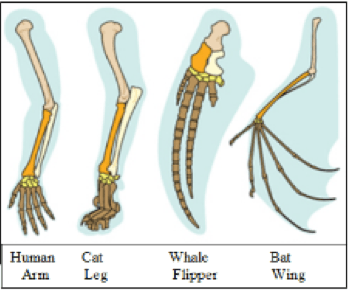
While on a thrilling adventure, Liam, Abigail, and Evelyn stumbled upon some mysterious bones. What could these bones possibly represent?
Evidence of a common ancestor
Evidence that animals can walk
Evidence that fossils are old
Evidence of nothing

Imagine Harper, Aiden, and David are on a thrilling adventure at a museum. They stumble upon a fascinating picture showcasing extinct species and modern horses. What secret does this picture whisper to them?
Horses magically appeared a million years ago, without any ancestors to speak of
Between 55 and 50 million years ago, the world was devoid of any creatures that could be considered horse relatives
The modern horse shares a family tree with some of these extinct species
The tiny hyracotherium and the modern horse are actually the same species

