
Font size
 Worksheets
ATA Geometry: Transformations & Triangle Properties
Total questions: 161
Worksheet time: 6hrs 26mins

Which of the following describes the sequence of transformations shown?
Reflection, then a rotation.
Rotation, then a translation.
Reflection across the x-axis, then a reflection across the y-axis.
Translation, then a rotation.

Which sequence of transformations will get you from triangle ABC to its image triangle A'B'C'?
Reflection, then a translation
Rotation, then a dilation
Reflection, then a rotation
Dilation, then a reflection

Which sequence of transformations will result from shape F to its image shape F''?
Reflection over both axes
Reflection, then a rotation
Translation, then a reflection
Rotation, then a translation

Which sequence of transformations will map trapezoid A to its image A'?
Reflection, then a translation
Rotation, then a translation
Reflection, then a rotation
Rotation, then a dilation

Which sequence of transformations occurred to pentagon QRSTU to form its image Q"R"S"T"U"?
Translation, then a reflection over the y-axis.
Reflection over the x-axis, then a translation.
Rotation, then a reflection over the y-axis.
Reflection over the y-axis, then a translation.

Which sequence of transformations maps the red parallelogram to the green parallelogram?
A translation, then a reflection.
A rotation, then a translation.
A reflection, then a translation.
A reflection, then a rotation.

Which sequence of transformations could map triangle ABC to triangle A"B"C"?
A dilation, then a rotation.
A translation, then a reflection.
A rotation, then a translation.
A reflection, then a rotation.

If the red triangle is rotated 180 degrees, then reflected over the line y=2, what is the resulting image?
Green Triangle
Blue Triangle
Orange Triangle
Red Triangle

Which sequence of transformations could map ∆ABC onto its image ∆A''B''C''?
A reflection, then a rotation
A reflection, then a translation
A translation, then a rotation
A translation, then a reflection

Which sequence of transformations will map PQRT to its image P'Q'R'T'?
A translation, then a reflection over the y-axis.
A reflection over the x-axis, then a translation.
A rotation 90o clockwise, then a reflection over the x-axis.
A rotation 180o clockwise, then a reflection over the y-axis.

Which sequence of transformations maps figure A to figure B?
A translation, then a reflection across the x-axis.
A reflection across the x-axis, then a reflection across the y-axis.
A reflection across the y-axis, then a translation.
A 90° counter-clockwise rotation, then a reflection across the y-axis.

Which sequence of transformations maps
Triangle ABC onto Triangle A"B"C"?
A 180° rotation, then a reflection across the y-axis.
A reflection across the y-axis, then a reflection across the x-axis and another reflection across the y-axis.
A translation, then a reflection across the y-axis.
A reflection across the x-axis, then a translation.

Which sequence of transformations maps
Quadrilateral WXYZ onto Quadrilateral W"X"Y"Z"?
A 90° counter-clockwise rotation, then a translation.
A reflection across the y-axis, then a reflection across the x-axis.
A translation, then a reflection across the y-axis.
A translation, then a reflection across the x-axis.

Which sequence of transformations does triangle ABC map onto triangle A''B''C''?
A reflection over x-axis, then a rotation.
A rotation, then a reflection over y-axis.
A reflection over y-axis, then a rotation.
A rotation, then a reflection over x-axis.

Which sequence of transformations maps ABC (green) onto A"B"C" (red)?
A translation, then a reflection over the x-axis.
A translation, then a reflection over the y-axis.
A reflection, then a translation.
A reflection, then a rotation.

Which sequence of transformations will get you from triangle BCD to its image, triangle B''C''D''?
A rotation, then a rotation
A rotation, then a dilation
A translation, then a reflection
A reflection, then a rotation

Which sequence of transformations maps the blue figure to the red figure to the brown figure?
A reflection, then a translation
A translation, then a reflection
A rotation, then a translation
A translation, then a rotation

Which sequence of transformations maps the green triangle to the red triangle to the blue triangle?
A rotation, then a translation.
A translation, then a rotation.
A translation, then a reflection.
A rotation, then a reflection.

Which sequence of transformations maps triangle ABC to its image triangle A''B''C''?
A reflection over the x-axis, then a rotation.
A reflection over the y-axis, then a rotation.
A 90° rotation, then a reflection over the x-axis.
A 180° rotation, then a reflection over the y-axis.

Which sequence of transformations maps ABC onto DEF?
A reflection over the x-axis, then a translation.
A reflection over the y-axis, then a translation.
A translation, then a reflection over the x-axis.
A rotation, then a reflection over the y-axis.
(x, y) --> _
(x, y) -->
(x, y) --> _
(x, y) --> _
(x,y)-->(y,-x)
Which rule describes the action of the coordinates when a figure is reflected over the x-axis?
(x, y)→(x, -y)
(x, y)→(-x, y)
(x, y)→(-x, -y)
(x, y)→(y, -x)
Which rule describes the action of the coordinates when a figure is rotated 90o counter-clockwise about the origin?
(x, y)→(-y, -x)
(x, y)→(-x, -y)
(x, y)→(-y, x)
(x, y)→(x, -y)
Which rule describes the action of the coordinates when a figure is reflected over the line y = x?
(x, y)→(-y, -x)
(x, y)→(-x, y)
(x, y)→(-x, -y)
(x, y)→(y, x)
Which rule describes the action of the coordinates when a figure is rotated 180o about the origin?
(x, y)→(y, x)
(x, y)→(-x, y)
(x, y)→(-x, -y)
(x, y)→(-y, -x)
Which rule describes the action of the coordinates when a figure is reflected over the y-axis?
(x, y)→(x, -y)
(x, y)→(-x, y)
(x, y)→(-x, -y)
(x, y)→(y, -x)
Which rule describes the action of the coordinates when a figure is rotated 270o counter-clockwise about the origin?
(x, y)→(-y, -x)
(x, y)→(-x, -y)
(x, y)→(-y, x)
(x, y)→(x, -y)
Which rule describes the action of the coordinates when a figure is dilated by a scale factor of 2?
(x, y)→(x+2, y+2)
(x, y)→(2x, 2y)
(x, y)→(x/2, y/2)
(x, y)→(x-2, y-2)
What rule represents a rotation 180 degree about the origin?
Flip & change sign on x-value.
Change sign on x-value and y-value.
Flip & change sign on y-value.
Flip x-value and y-value.
What rule represents a rotation of 90 degrees counterclockwise about the origin?
Flip & change sign on x-value.
Change sign on x-value.
Flip & change sign on y-value.
Change sign on both x-value and y-value.
During a translation, if the figure is moving right what do you need to do to the coordinates?
add to the x-value
add to the y-value
subtract from the x-value
subtract from the y-value
During a translation, if the figure is moving left what do you need to do to the coordinates?
add to the x-value
add to the y-value
subtract from the x-value
subtract from the y-value
(x,y)-->(y,-x)

What does congruent mean?
corresponding sides and angles are congruent
corresponding sides are proportional and corresponding angles are congruent
sames shape
neither sides or angles are congruent
Which of the following describes the sequence of transformations shown?
Reflect across the x-axis and then rotate -90 degrees around the origin
Rotate -90 degrees around the origin and then translate down.
Reflect across the x-axis and then reflect across the y-axis.
Translate up and then rotate 90 degrees about the origin.

What is the sequence of transformations for the image given?
Reflect over the x-axis, translate (x+8,y)
Reflect over the x-axis then translate (x+6, y)
Reflect over the y-axis then (x+1, y+1)
Translate down 4 (y-4) and to the right 5 (x+5)
Which transformations keep figures congruent?
translation, reflection, and dilation
reflection, rotation, and dilation
dilation, translation, reflection, and rotation
translation, reflection, and rotation

What are the coordinates of C(-6, 2) and B(-1, -1) if rotated 90 degrees counterclockwise?
C' (-6, 2), B' (-1, -1)
C' (6, 2), B' (1, -1)
C' (2, -6), B' (-1, -1)
C' (-2, -6), B' (1, -1)


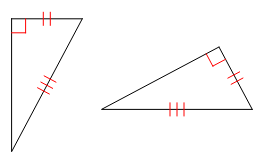
State if the two triangles are congruent. If they are, state which theorem you would use.
Yes, SAS
Yes, SSS
Yes, HL
Yes, SSA
Not Congruent

State if the two triangles are congruent. If they are, state which theorem you would use.
Yes, SAS
Yes, SSS
Yes, HL
Yes, ASA
Not Congruent


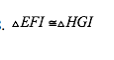
∠F = ___
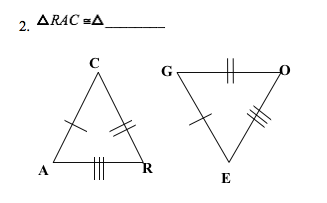
which is true?
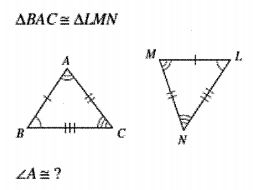
2
Which is true about any midsegment in a triangle?
(Select all that apply.)
The midsegment is parallel to its corresponding (opposite) side.
The midsegment is perpendicular to its corresponding (opposite) side.
The midsegment is half as long as its corresponding (opposite) side.
The midsegment connects the midpoints of two sides of a triangle.
The midsegment is twice as long as its corresponding (opposite) side.
A midsegment of a scalene triangle has a length of 12 in.
What is the length of its corresponding side?
6 inches
12 inches
24 inches
Cannot be determined without the coordinates.

If D and E are Midpoints, then
DE is _______________.an angle bisector
a perpendicular segment
a median
a midsegment

If AC = 42, find DF.
21
84
14
28

Name a segment that has the same length as segment BD.
BE
DE
AD
AC

Name a segment parallel to AC .
DE
AD
AC
BC

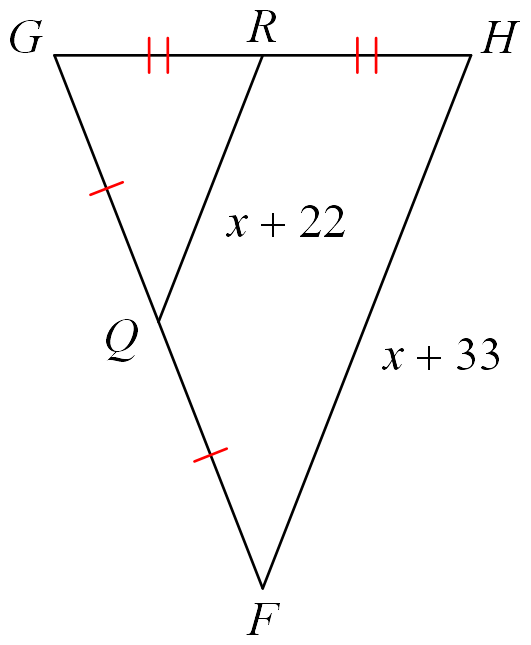
QR is a midsegment of ∆FGH. Solve for the value of x? Remember the formula... 2(midsegment) = opp. side
5.5
11
-5.5
-11

MP ∥ ______
Name the parallel segment.
(The symbol || means parallel.)
WY
YX
WX
PN
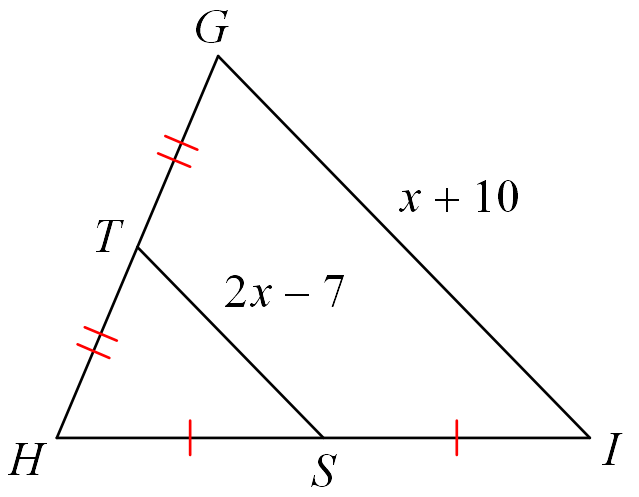
TS is a midsegment of ΔGHI .
Solve for the value of x.
Remember the formula... 2(midsegment) = opp. side
4
6
8
10

Name a segment that has twice the length of segment EC .
BC
BE
AC
BD
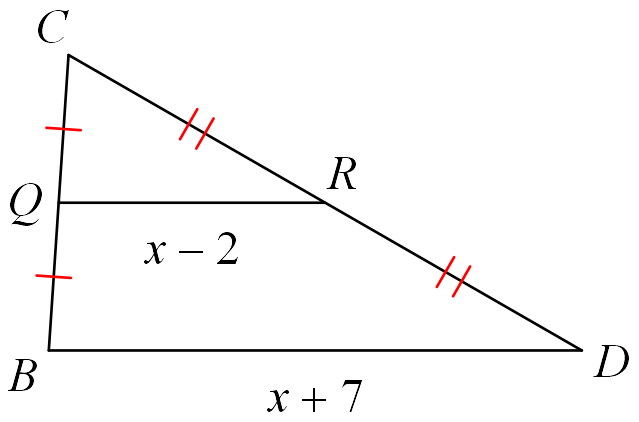
QR is a midsegment of ΔBCD .
Solve for the value of x.
Remember the formula... 2(midsegment) = opp. side
11
18
9
-7
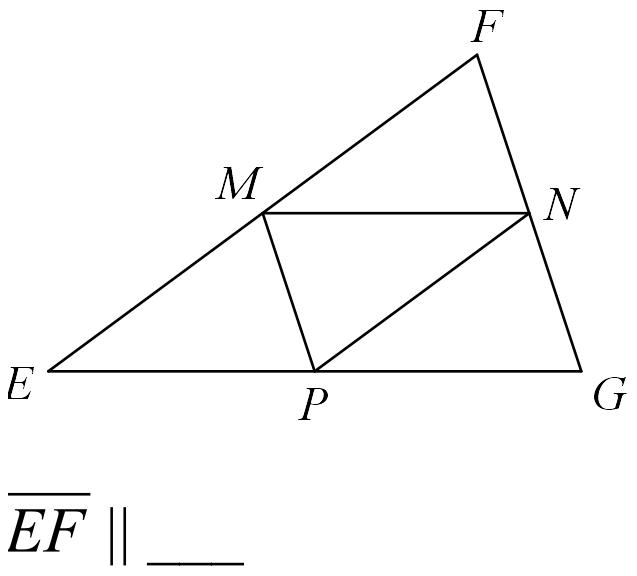

The midsegment of the triangle is 5x-1.
Find the value of x.
Remember the formula... 2(midsegment) = opp. side
x = 6
x = 7
x = 11.8
x = 12.4

What is the value of y?
3
-3
No Solution
5

What is the value of x?
10
No Solution
5
2

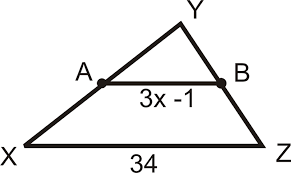
Find the length of AB.
Remember the formula... 2(midsegment) = opp. side
6
11
17
68


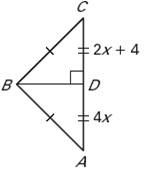


In the diagram MN is the perpendicular bisector of AB. What is the value of x?
-8
4
7
8

AB bisects ∠CAD bisects . Find x.
8
2
10
8/5

In the diagram MN is the perpendicular bisector of AB.
AM=?
AO
AB
BM
BO
State if the three numbers can be measures of the sides of a triangle.
8,10,20
Yes
No

In ΔPQR, find x if m<P=x - 12, m<Q=5x - 27 and m<R=2x+3
12
55
30
27

Find the indicated angle measure. (What is ?)
51°
37°
167°
41°

What is the measure of angle a?
36o
56o
63o
117o


A
B
C
D

Find the measure of angle A
A
B
C
D

Find the value of x
10
52
9
7

A
B
C
D

Classify each triangle by its angles and sides.
Acute, Isosceles
Obtuse, Isosceles
Right, Scalene
Equiangular, Equilateral,
Acute, Scalene

Classify each triangle by its angles and sides.
Acute, Isosceles
Obtuse, Isosceles
Right, Scalene
Equiangular, Equilateral,
Acute, Scalene

Classify each triangle by its angles and sides.
Acute, Isosceles
Obtuse, Isosceles
Right, Scalene
Equiangular, Equilateral,
Obtuse, Scalene

Classify each triangle by its angles and sides.
Acute, Isosceles
Obtuse, Isosceles
Right, Scalene
Equiangular, Equilateral,
Obtuse, Scalene

Find the value of x.
7
13
44
11

Find the value of x.
12
-12
9
7

Find the measure of each angle indicated.
51
62
67
129
180


What is the length of DF?
8
4
25
71

Solve for x, then find each angle measure.
x=13 m∠P = 126° m∠Q = 30° m∠R = 24°
x=34 m∠P = 336° m∠Q=114° m∠R=23°
x=5 m∠P=46° m∠Q=2° m∠R=16°

Solve for x, then find each angle measure.
x=5 m∠CAB=54° m∠ABC = 21° m∠ACB = 105° m∠DCB=75°
x=1 m∠CAB=2° m∠ABC=5° m∠ACB=177° m∠DCB=3°
Ryan was trying to measure angle A, but he isn't sure. Solve for x
28
12
10
2


Which one of these represent SAS?


Which one of these represent SSS?

Order the sides of the triangle from shortest to longest.
UV, UT, VT
UV, VT, UT
VT, UT, UV
VT, UV, UT

Order the sides of the triangle from longest to shortest.
KL, ML, KM
KL, KM, ML
KM, ML, KL
KM, KL, ML

Order the angles from smallest to largest.
∠D, ∠E, ∠C
∠D, ∠C, ∠E
∠C, ∠E, ∠D
∠C, ∠D, ∠E

Order the angles from largest to smallest
∠S, ∠R, ∠T
∠S, ∠T, ∠R
∠T, ∠R, ∠S
∠T, ∠S, ∠R


Can a triangle be formed with line segments that have lengths 2, 8 and 14 units?
No, because these line segments wouldn't satisfy the triangle inequality theorem
No, because there are only two sides to a triangle
Yes, because these line segments satisfy the triangle inequality theorem
Yes, because 8< 14
4 cm, 7 cm, 2 cm


Dilate the figure by a scale factor of 3. What are the coordinates of the image?
A(3,3) B(6,6) C(9,3)
A'(9,9) B'(18,18) C'(27,9)
A'(6,6) B'(9,9) C'(12,6)
A'(0,0) B'(3,3) C'(6,0)
A'(1,1) B'(2,2) C'(3,1)
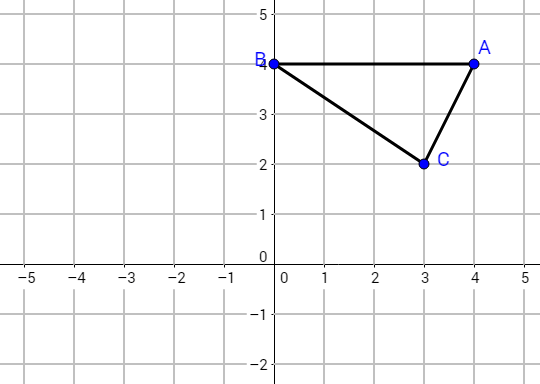


Trapezoid A’B’C’D’ is the dilation of trapezoid ABCD.
Which algebraic representation shows this dilation?
(x, y) --> (2x, 2y)
(x, y) --> (0.5x, 0.5y)
(2x, 2y) --> (x, y)
(x, y) --> (3x, 2y)


Determine if the figure has line, point, and/or rotational symmetry. Check all that apply.
Line
Point
Rotational
None

Determine if the figure has line, point, and/or rotational symmetry. Check all that apply.
Line
Point
Rotational
None

Determine if the figure has line, point, and/or rotational symmetry. Check all that apply.
Line
Point
Rotational
None

Determine if the figure has line, point, and/or rotational symmetry. Check all that apply.
Line
Point
Rotational
None

Determine if the figure has line, point, and/or rotational symmetry. Check all that apply.
Line
Point
Rotational
None

Determine if the figure has line, point, and/or rotational symmetry. Check all that apply.
Line
Point
Rotational
None

Determine if the figure has line, point, and/or rotational symmetry. Check all that apply.
Line
Point
Rotational
None

Determine if the figure has line, point, and/or rotational symmetry. Check all that apply.
Line
Point
Rotational
None

Determine if the figure has line, point, and/or rotational symmetry. Check all that apply.
Line
Point
Rotational
None

Determine if the figure has line, point, and/or rotational symmetry. Check all that apply.
Line
Point
Rotational
None

Determine if the figure has line, point, and/or rotational symmetry. Check all that apply.
Line
Point
Rotational
None

Determine if the figure has line, point, and/or rotational symmetry. Check all that apply.
Line
Point
Rotational
None


