
 Worksheets
Grade 8 T2
Total questions: 21
Worksheet time: 7mins
The product of multiplying frequency of 3 Hz with the periodic time equals...............................
1
One and half complete oscillation contains................................amplitudes.
6
..............................is a mechanical transverse wave.
Light
Water
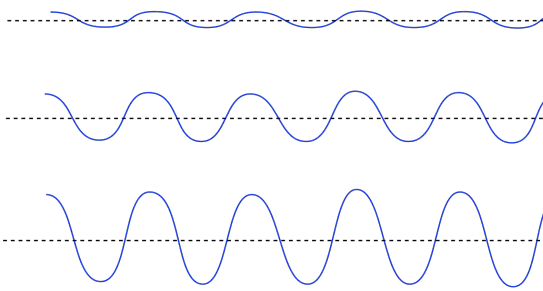
Which wave that has low amplitude>
First wave
Second wave
Third wave
No correct answer

From the previous graph, What is the periodic time?
0.04seconds
1 second
0.03 seconds
0.02 seconds
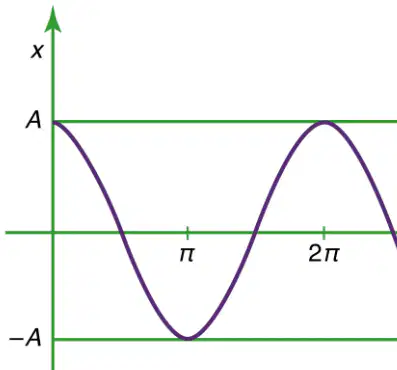
How many complete oscillations in this graph?
2.5
5
1.25
In sound wave, the medium particles vibrate.................................to the wave propagation.
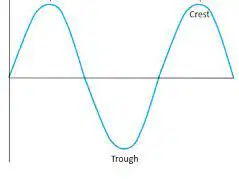
If the distance between successive crest and trough is 3 m then the wavelength is.............................................
3 meters
......................................is number of complete oscillations done in 1 sec.
Wave is a.............................that propagates and transfers energy.
If no. complete oscillations is 500 in 50 seconds, then the frequency is......................................

At which point the K.E is maximum?
B
A
C
D

What is the amplitude in this graph?
What is the speed of sound in water?
1500 m/s
340 m/s
300,000,000 m/s
0 m/s
Which type of wave requires a medium to propagate?
Light wave
Sound wave
X-ray wave
Radio wave
What is the unit of frequency?
Watt
Newton
Hertz
Joule
Periodic motion differs from translational motion that is.............................
circular motion
repeated in equal intervals of time
have end point and start point
move in straight line
Examples of oscillatory motion..............................................
pendulum, spring
spring, rotary bee
motion of car, spring
stretched spring, motion of train
The main difference between periodic motion and oscillatory motion is...............................................
frequency
rest position
periodic time
wave motion

If the time to move from B to A is 2 sec, what is the periodic time?
4 sec
2 sec
8 sec
6 sec
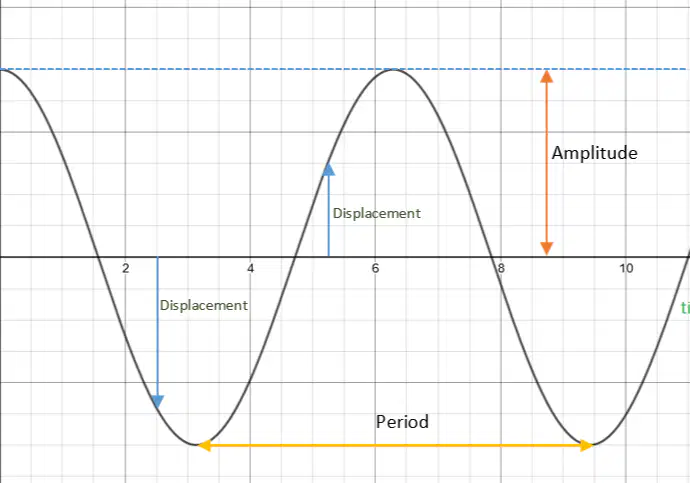
How many complete oscillations in this graph?
2 complete oscillations
1 and half complete oscillations
2 and 3/4 complete oscillations
1 and 3/4 complete oscillations

