
 Worksheets
Central Dogma & Protein Synthesis Unit Review
Total questions: 35
Worksheet time: 35mins
Which of the following statements is true?
DNA is single-stranded
RNA is single-stranded
DNA contains uracil
RNA contains deoxyribose
The Process of creating RNA from DNA is called...
Transcription
Translation
Replication
DNA contains the base T. What replaces T in RNA?
U
G
C
A
What combines together to make a protein?
Amino Acid
RNA
Ribosome
DNA
What organelle is the site of translation?
Nucleus
Ribosome
Mitochondria
Chloroplast
What is the order for Protein Synthesis?
Transcription -> Translation -> Protein
Translation - > Transcription -> Protein
Protein -> Transcription -> Translation
Translation -> Protein -> Transcription
Carries the amino acid used to make a protein
mRNA
rRNA
tRNA
Factory for making a protein
mRNA
rRNA
tRNA
Ribosome
What do we call the shape a DNA molecule takes?
double-stranded
double helix
sugar-phosphate backbone
pentagon
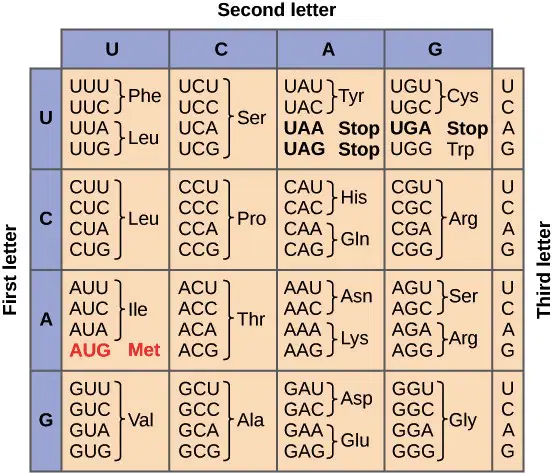
Which of the following tells the Ribosome to STOP?
UAC
UGG
UGA
UCA
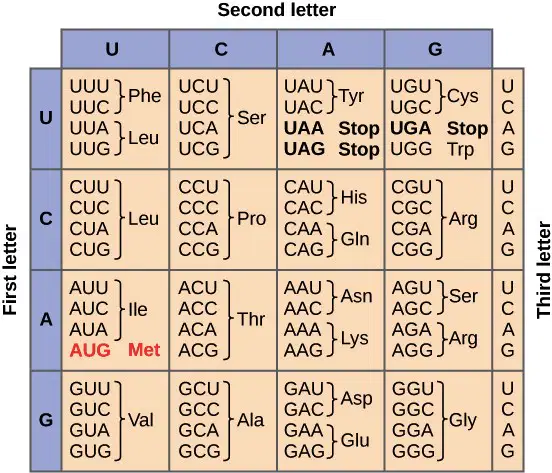
Which of the following tells the Ribosome to START?
AUG
UGG
UGA
UCA
What is the genetic code and how does it work?
The genetic code is the set of rules by which information encoded in genetic material is translated into proteins.
The genetic code is a type of password used to access DNA information
The genetic code is a system of symbols used to represent genetic information
The genetic code is a set of instructions for building DNA molecules
What are the components of a DNA molecule?
Amino acids
Nucleotides
Lipids
Carbohydrates
Explain the role of mRNA in protein synthesis.
mRNA is responsible for breaking down proteins in the cell
mRNA has no role in protein synthesis
mRNA carries the genetic information from DNA to the ribosomes, where it serves as a template for translation into a protein.
mRNA acts as a storage unit for excess genetic material
What is the relationship between the genetic code and the sequence of amino acids in a protein?
The sequence of amino acids in a protein is determined by random chance
The genetic code is not involved in determining the sequence of amino acids in a protein
The genetic code determines the sequence of amino acids in a protein through the process of transcription and translation.
The sequence of amino acids in a protein is determined by the environment
Describe the process of protein synthesis in a cell.
Protein synthesis is the process of converting lipids into energy in a cell.
Protein synthesis involves the production of DNA in a cell.
Protein synthesis is the process by which cells make proteins.
Protein synthesis is the process of making carbohydrates in a cell.
Which of these is the correct DNA base pairing rule
C pairs with A
A pairs with T
T pairs with G
G pairs with C
C pairs with G
G pairs with C
A codes for U
T pairs with A
T pairs with A
A pairs with T
C pairs with G
G pairs with C
C pairs with T
T pairs with C
C pairs with A
A pairs with C
A codes for U
T codes for A
C codes for G
G codes for C
Unit of both DNA and RNA, they consist of a sugar-phosphate backbone and a nitrogen-containing base
What are the building blocks of proteins?
Amino acids

Which of the following is the complementary mRNA sequence to this DNA strand: AAA TCG TTG CCC
AAA TCG TTG CCC
TTT AGC AAC GGG
UUU AGC AAC GGG
UUU TGC TTC GGG
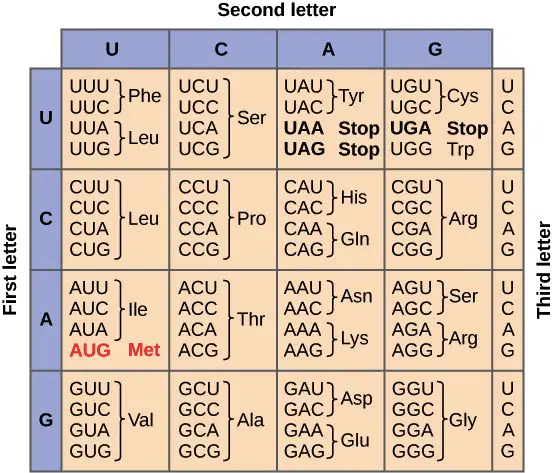
What amino acid is represented by the codon UUA?
Phe
Tyr
Leu
Stop codon
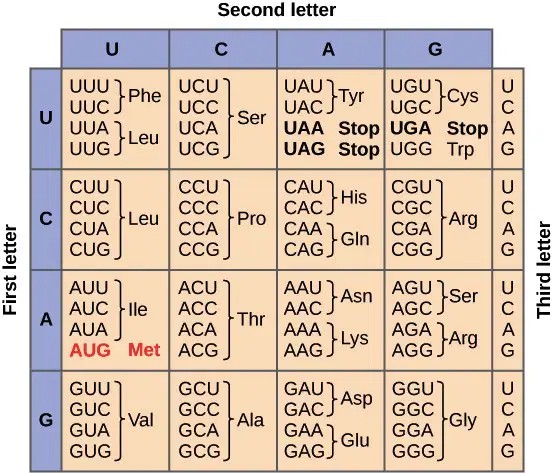
Which codon can code for Trp?
U G G
A G U
C A A
A U G

Units of 3 nucleotide bases in mRNA which code for a single
amino acid.
Mitosis
Base Pairing
Anti codon
Codon
What was the complementary mRNA sequence for this strand of DNA?
TGC ACG CAT
ACG TGC GTA
ACG UGC GUA
TGC ACG CAT
ACG TCG CUA
Which of these is true about RNA Polymerase?
It is a protein
all of these
It is an enzyme
It copies DNA into RNA

