
 Worksheets
2nd 9 Weeks District Assessment
Total questions: 70
Worksheet time: 5hrs 50mins
(a) was proposed by (b) and suggested that the (c) are in constant motion.
The earth's outer shell is divided into slabs of rock called ______ .
continental plates
crustal plates
trench plates
tectonic plates
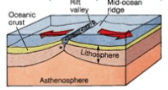
divergent
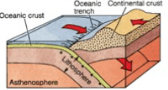
convergent
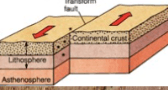
transform
At which plate boundary is new crust formed?
divergent
convergent
continental
transform
What type of crusts are involved with one plate subducting beneath another?
continental and continental
Oceanic and continental
oceanic and divergent
continental and convergent
What types of landforms are formed at convergent boundaries?
PICK TWO
volcanoes
new crust
Trenches
rift valley
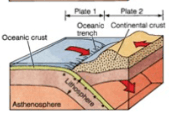
What is the WHOLE AREA called where the oceanic crust goes beneath the continental crust?
subtraction zone
section zone
secondary zone
subduction zone
At which boundary is crust neither consumed or created?
divergent
convergent
transform
oceanic
Select the reasons for plate movement.
Polar Bears
Convection Currents
Ridge Pasta
Slab Bacon


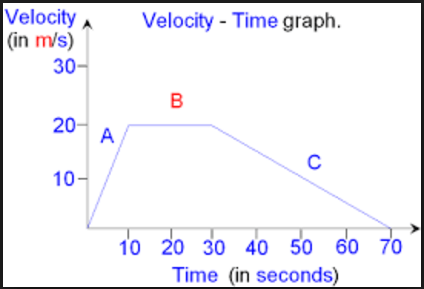
During which interval is the object speeding up?
A to B
B to C
D to E
E to F


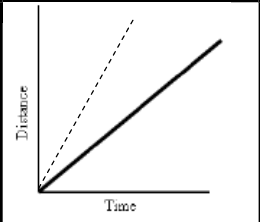
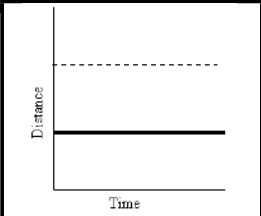
In which of the following graphs below are both runners moving at the same speed?


Object is...
(1) speeding up,
(2) constant speed,
(3) speeding up
(1) constant speed.
(2) stopped,
(3) constant speed

Object ...
accelerates... then goes constant speed... then accelerates again
goes constant speed... stops... goes constant speed
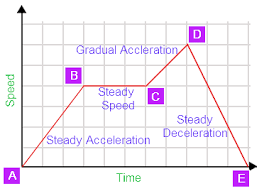
At what point is the speed the greatest?
C-D
B-C
A-B
D-E
What is weather?
The amount of moisture in the air
The number of clouds in the sky
The speed of the wind
The state of the atmosphere at any particular time.
What are the characteristics of a high-pressure system?
Wind and rain
Humidity and thunder
Extremely hot temperatures
Clear skies and sun
If the air is only holding one-third as much moisture as it can possibly hold, what is the relative humidity?
25 percent
50 percent
33 percent
67 percent
What will happen if the relative humidity is 100 percent, and the temperature begins falling?
It will start to rain
The air will be sticky and uncomfortable
The temperature will rise
The barometric pressure will rise
This tool measures the wind speed.
barometer
anemometer
thermometer
psychrometer
What kind of weather would you expect in a low pressure system?
Warm temperatures
Cool temperatures
Clear conditions
Cloudy/rainy conditions

Using a periodic table (you can use the one in the textbook) order the following elements by mass number, least to greatest.
Hydrogen
Boron
Gallium
Thallium
Radon
Using a periodic table (you can use the one in the textbook) order the following elements by # of valence electrons, least to greatest.
Potassium
Barium
Carbon
Oxygen
Neon

How many electron shells does the pictured atom have?
1
2
3
4

How many valence electrons does the pictured atom have?
20
3
2
4

A horizontal row of elements in the periodic table
Molecule
Period
Family
Atom

The smallest particle of an element.
Element
Molecule
Atom

A substance that cannot be broken down into other substances by chemical or physical means.
Covalent bond
Atom
Element
A combination of two or more atoms
Period
Molecule
Atom
Family
A physical model that depicts the atom as a small positively charged nucleus with electrons in orbit at different levels.
Covalent bond
Ionic bond
Bohr Model
Electron dot diagram
Elements in the same vertical column of the periodic table; also called group
Family
Atom
Element
Metals

What is one way Neutrons are different from electrons?
they both are negative
neutrons have no charge, while electrons have a negative charge
Both are in the nucleus( center of atom)
Electrons are inside nucleus and neutrons are outside the nucleus.

What is the atomic number?
35
18
17
52

How many protons and electrons does this element have?
35
18
17
52

How many neutrons does Chlorine have?
18
17
35
52

Which part of the diagram represents the proton?
a
b
c
d
Subatomic Particles
Atomic Number
Mass Number
Gluons

