
 Worksheets
Environmental Science Semester Exam 2025
Total questions: 52
Worksheet time: 26mins
Name
Class
Date
1.
Name: First and Last
4 lines
2.

The darts on the board represent which type of data?
a)
Accurate
b)
Precise
3.
Which tool is used to measure the volume of a liquid?
a)
metric ruler
b)
triple beam balance
c)
graduated cylinder
d)
beaker
4.
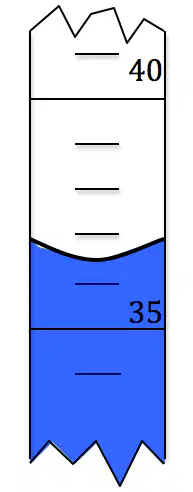
What measurement should be recorded for the volume of liquid in the graduated cylinder?
a)
35 ml
b)
36 ml
c)
36.5 ml
d)
38 ml
5.
What unit do scientist use to record the mass of a solid?
a)
gram
b)
meter
c)
liter
d)
second
6.
The orderly and predictable change that takes place after a community of organisms has been removed but the soil has remained intact is ______________.
a)
secondary succession
b)
primary succession
c)
tolerance
d)
competition
7.
In a temperate forest ecosystem, a black bear feeds on fish that live in a stream while a robin feeds on berries on mountainside bushes. In the ground, earthworms break down leaves.The fish would be classified as a ___________.
a)
decomposer
b)
prey
c)
herbivore
d)
predator
8.
A heterotroph that eats only animals is called a(n) _____________.
a)
omnivore
b)
detritivore
c)
carnivore
d)
herbivore
9.
All the interconnected feeding relationships in an ecosystem make up a food ________.
a)
web
b)
chain
c)
network
d)
interaction
10.
An example of a biotic limiting factor would be:
a)
predators
b)
soil chemistry
c)
rainfall
d)
space
11.

The fungi seen in the picture below occupy which niche in the ecosystem?
a)
primary consumer
b)
autotroph
c)
producer
d)
detritivore
12.

In the picture above, which organism is the primary producer?
a)
Clover and grass
b)
Mushrooms
c)
Soil
d)
Earthworms
13.
An organism that produces its own food is called a(n) ____________.
a)
heterotroph
b)
omnivore
c)
autotroph
d)
herbivore
14.
The area where an organism lives is its _______.
a)
commensalism
b)
habitat
c)
predation
d)
niche
15.
Green plants are
a)
producers
b)
omnivores
c)
herbivores
d)
consumers
16.
A possible solution to a problem that is testable is a(n) __________________, often called an educated guess.
a)
experiment
b)
observation
c)
response to stimuli
d)
hypothesis
17.
The regulation of a stable internal condition is ______________
a)
adaptation
b)
inference
c)
homeostasis
d)
homo sapien
18.
The establishment of a community in an area of exposed rock that does not have any topsoil is
a)
primary succession
b)
competition
c)
tolerance
d)
secondary succession
19.
This occurs when one or more organism uses the same resource at the same time_________
a)
decomposition
b)
competition
c)
respiration
d)
evaporation
20.
The relationship between organisms in which both species benefit.
a)
parasitism
b)
mutualism
c)
communism
d)
commensalism
21.
Which of the following is a density-independent factor?
a)
parasites
b)
predation
c)
competition
d)
drought
22.

What symbiotic relationship is seen in the picture below with lichens growing and feeding on a tree and the tree not being harmed or receiving a benefit.
a)
Mutualism
b)
Parasitism
c)
Commensalism
d)
Predation
23.
A forest fire will prompt ______________________. The ecosystem will experience regrowth from remaining soil.
a)
primary succession
b)
secondary succession
c)
pioneer species
d)
ecosystem services
24.
The role or position an organism has in its environment
a)
niche
b)
occupation
c)
placement
d)
itch
25.
In a temperate forest ecosystem, a black bear feeds on fish that live in a stream while a robin feeds on berries on mountainside bushes. In the ground, earthworms break down leaves.The earthworm would be classified as a ___________.
a)
predator
b)
decomposer
c)
prey
d)
herbivore
26.
Factors in the environment that are NOT living are called
a)
bionic
b)
abiotic
c)
biotic
d)
ambient
27.

Which type of growth is seen in the graph below, where a population of mice has reached the carrying capacity?
a)
Exponential
b)
Logistic
28.
A large group of ecosystems that share the same type of climate make up a
a)
biome
b)
community
c)
organism
d)
population
29.
Lizzy wants to test the effects of fertilizer on plant growth. Which of the following is the dependent variable?
a)
fertilizer
b)
plant height
c)
amount of water
d)
sunlight
30.
Which of the following is a density-dependent factor?
a)
pollution
b)
tornado
c)
flood
d)
disease caused by parasite
31.
When the immigration is less than the emigration rate the population is
a)
declining
b)
growing
c)
consistent
d)
staying the same
32.
In a temperate forest ecosystem, a black bear feeds on fish that live in a stream while a robin feeds on berries on mountainside bushes. In the ground, earthworms break down leaves.The black bear would be classified as a ___________.
a)
prey
b)
predator
c)
herbivore
d)
decomposer
33.
The first species to appear during primary succession are called
a)
primary species
b)
binary species
c)
embryonic species
d)
pioneer species
34.
A type of lichen grows under water on rocks in the ocean. Which of these factors in the lichen's environment is abiotic?
a)
tiny organisms that live on the ocean floor
b)
a fish feeding on algae
c)
the algae found on the same rock
d)
the water current around the rock
35.
All the members of a particular species tha live in one area at one time are a
a)
population
b)
community
c)
biome
d)
ecosystem
36.
An organism that cannot make its own food and gets energy by consuming another organism is called a(n)
a)
heterotroph
b)
chemotroph
c)
autotroph
d)
producer
37.

Which graph represents stabilizing selection?
a)
graph 1
b)
graph 2
c)
graph 3
38.
What organism consume both plants and animals?
a)
herbivores
b)
omnivores
c)
autotrophs
d)
chemotrophs
39.
What pattern of evolution is seen when one species evolves into many subspecies due to a new habitat or niche?
a)
convergent
b)
divergent
c)
coevolution
d)
bottleneck
40.
The evaporation of water from leaves is called
a)
transpiration
b)
respiration
c)
transportation
d)
precipitation
41.
Heterotrophs that obtain nutrients by breaking down dead and decaying plants and animals are called
a)
decomposers
b)
autotrophs
c)
omnivores
d)
producers
42.
Nitrogen is a limiting factor because we cannot use the Nitrogen gas in the air unless it is converted by soil bacteria. What is this process called?
a)
Denitrification
b)
Nitrogen Depletion
c)
Assimilation
d)
Nitrogen Fixation
43.
The process by which organisms best adapted to their environment will survive and pass on their traits.
a)
Mimicry
b)
Pollution
c)
Natural Selection
d)
Convergent Evolution
44.

Which organism in the picture above would increase in population size if there was a significant decrease in the rabbit population?
a)
mushrooms
b)
evergreen trees
c)
grass
d)
predatory hawks
45.
Which of the following is an example of an ecosystem service?
a)
pollution from a factory
b)
coyotes preying on weakened or diseased animals
c)
bees providing honey and pollination of plants
d)
Glaciers receding due to a rise in global temperatures
46.
The relationship between organisms where one benefits and the other is harmed
a)
mutualism
b)
parasitism
c)
commensalism
d)
communism
47.
The relationship between organisms in which one species is benefits and the other is unaffected
a)
mutualism
b)
parasitism
c)
commensalism
d)
communism
48.
What is a heterotroph that only feeds on plants called?
a)
carnivore
b)
omnivore
c)
detritivore
d)
herbivore
49.
Trees, water, and wildlife are classified as
a)
alive
b)
renewable
c)
non-renewable
d)
non-exchangable
50.
What is the process by which nitrogen is converted back into a gas?
a)
denitrification
b)
decomposition
c)
nitrogen fixation
d)
none of the above
51.
Which variable is measured or counted and displayed on the Y axis?
a)
independent
b)
dependent
52.
Organisms, such as the sea otter, play such a vital role in their ecosystem that when removed the ecosystem crashes. These organisms are known as_____________________
a)
endangered species
b)
tertiary consumers
c)
homologous structures
d)
keystone species
100 %

