wayground logo

Free Printable Worksheets

Font size

S
M
L
XL
Worksheets

Geometry Final Review (Part 2)

Total questions: 173

Worksheet time: 10hrs 13mins

Name
Class
Date
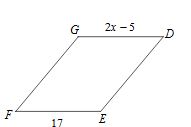
1.
The diagonals of a parallelogram always ... 
a)
are congruent
b)
are perpendicular
c)
bisect each other
d)
are parallel
2.
In a parallelogram, opposite angles are ________.
a)
congruent
b)
supplementary
c)
consecutive
d)
parallel
3.
a)
x = 23, y = 10
b)
x = 10, y = 23
4.
If ABCD is a parallelogram, what is the length of BD? 
a)
10
b)
11
c)
7
d)
5
5.
a)
x = 40 , y = 40 
b)
x = 30, y = 30
c)
x = 40, y = 30
d)
x = 30, y = 40
6.
a)
x = 30, y = 40
b)
x = 40, y = 30
c)
x = 40, y = 15
d)
x = 30, y = 30
7.
a)
1=30 ,  2=82,  3=50
b)
1=32,  2=98 , 3=50
c)
1=30 ,  2=98 , 3=50
d)
1=30 , 2=98 , 3=40
8.
The figure is a parallelogram.  
Solve for x.  
a)
12
b)
4
c)
6
d)
2
9.
The figure is a parallelogram.  
Solve for x.  
Give a reason.
a)
2
b)
10
c)
11
d)
12
10.
In parallelogram CARS, m<C = 5x - 20 and m<A = 3x + 40. Find the value of x. 
a)
15
b)
20
c)
30
d)
130
11.
The figure is a parallelogram.  
Solve for x.  
a)
1
b)
11
c)
7
d)
6
12.
In the diagram of parallelogram STUV, SV = x + 3, VU = 2x - 1, and TU = 4x - 3. What is the length of SV? 
a)
5
b)
2
c)
7
d)
4
13.
a)
x = 9, y = 4
b)
x = 6, y = 4
c)
x = 6, y = 2
d)
x = 4, y = 2
14.
HIJK is a parallelogram
solve for Y
a)
20
b)
15
c)
60
d)
12
15.
Is this quadrilateral a parallelogram?
a)
Yes. Diagonals bisect each other
b)
no
c)
Yes. Opposite angles are congruent
d)
Yes. Opposite sides are congruent
16.
Is the quadrilateral a parallelogram? If yes, state how you know.
a)
Opposite sides parallel
b)
Opposite angles equal
c)
Opposite sides equal and parallel
d)
Not enough info
17.

The diagonals of a rectangle are

a)

parallel

b)

congruent

c)

perpendicular

d)

not congruent

18.

In a rectangle, consecutive angles are supplementary.

a)

True

b)

False

19.

Which of the following is true about sides of a rectangle.

a)

Opposite sides are perpedicular

b)

Opposite sides are congruent

c)

All sides are congruent

20.

Find x.

a)

2

b)

16

c)

8

21.

Find AE.

a)

18

b)

9

c)

Not possible to find

22.

Find BD.

a)

22

b)

11

c)

Not possible to find

23.

Find m.

a)

25

b)

20

c)

15

24.

Find z.

a)

90 degrees

b)

40 degrees

c)

50 degrees

25.

Find m.

a)

50 degrees

b)

30 degrees

c)

90 degrees

26.

Solve for x

a)

12

b)

8

c)

1.5

d)

.3

27.

If DE = 12, what is AC?

a)

12

b)

24

c)

6

d)

8

28.
The diagonals of a rhombus 
a)
never intersect
b)
bisect the opposite angles
c)
are congruent
d)
bisect the sides
29.
A Rhombus has congruent  ________
a)
Angles
b)
Sides
c)
Windows
d)
Doors
30.
The figure is a rhombus.  
Solve for x.  
a)
1
b)
11
c)
7
d)
6
31.
Find the measure of angle 4
a)
90
b)
22
c)
136
d)
44
32.

In Rhombus ABCD if DC = 4x - 7 and AD = 3x - 10, which of the following would be the correct equation with reason?

a)

4x - 7 = 3x - 10, all sides are congruent

b)

4x - 7 = 3x - 10, consecutive sides perpendicular

c)

4x - 7 = 3x - 10, opposite sides are congruent

d)

4x - 7 + 3x - 10 = 180, consecutive interior angles are supplementary

33.

What are the characteristics of a parallelogram?

a)

Parallelogram has 2 pairs of parallel Sides

b)

Parallelogram has no parallel lines

34.

Shape WXYZ is a rhombus. Calculate the value of y.

a)

54o

b)

420

c)

96o

d)

84o

35.

Shape WXYZ is a rhombus. Calculate the value of x.

a)

28o

b)

84o

c)

96o

d)

32o

36.

Shape ABCD is a parallelogram. Calculate the value of x.

a)

58o

b)

87o

c)

93o

d)

64o

37.

ABCD is a parallelogram. What is the perimeter of ∆AED?

a)

5.5

b)

29

c)

19

d)

44

38.
A trapezoid is a quadrilateral with exactly one pair of _____ sides.
a)
parallel
b)
congruent
c)
perpendicular
d)
skew
39.

Find the midsegment of trapezoid EFHC.

a)

14

b)

28

c)

12

d)

16

40.

Find the missing angle of Trapezoid SPQR.

a)

65

b)

115

c)

180

d)

125

41.

Find the missing angle of trapezoid CFED.

a)

60

b)

120

c)

140

d)

180

42.

Find the length of the midsegment for trapezoid WXUV.

a)

11

b)

22

c)

10

d)

10.5

43.

In trapezoid EFGD, ST is the midsegment. Find the missing base.

a)

24

b)

26

c)

25

d)

19

44.

ABCD is a trapezoid. Find the value of x.

a)

7

b)

8

c)

85

d)

None of these

45.

SPQR is a trapezoid. Find the value of x.

a)

4

b)

6

c)

5

d)

129

46.
Is this a kite?
a)
Yes!
b)
No.
47.
According the the definition of a kite, "A kite is a quadrilateral with..."
a)
2 pairs of OPPOSITE congruent sides.
b)
2 pairs of CONSECUTIVE congruent sides.
c)
4 congruent sides.
d)
congruent diagonals.
48.
Kite ABCD is shown.
If AC = 44, what is EC?
a)
44
b)
11
c)
88
d)
22
49.
Kite LMNO is shown.
Solve for x.
a)
40
b)
20
c)
90
d)
10
50.
Kite LMNO is shown.
Solve for x.
a)
90
b)
180
c)
60
d)
75
51.

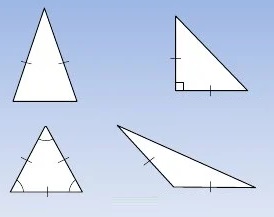
Match the following triangles with their side classification.

a)
1.

Equilateral Triangle

b)
2.

Scalene Triangle

c)
3.

Isosceles Triangle

52.

Match the following triangles with their angle classification.

a)
1.

Right Triangle

b)
2.

Acute Triangle

c)
3.

Obtuse Triangle

53.

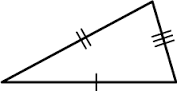
How would you classify this triangle by it's sides and angles?

a)

Isosceles Acute

b)

Scalene Right

c)

Scalene Obtuse

d)

Isosceles Obtuse

e)

Isosceles Right

54.

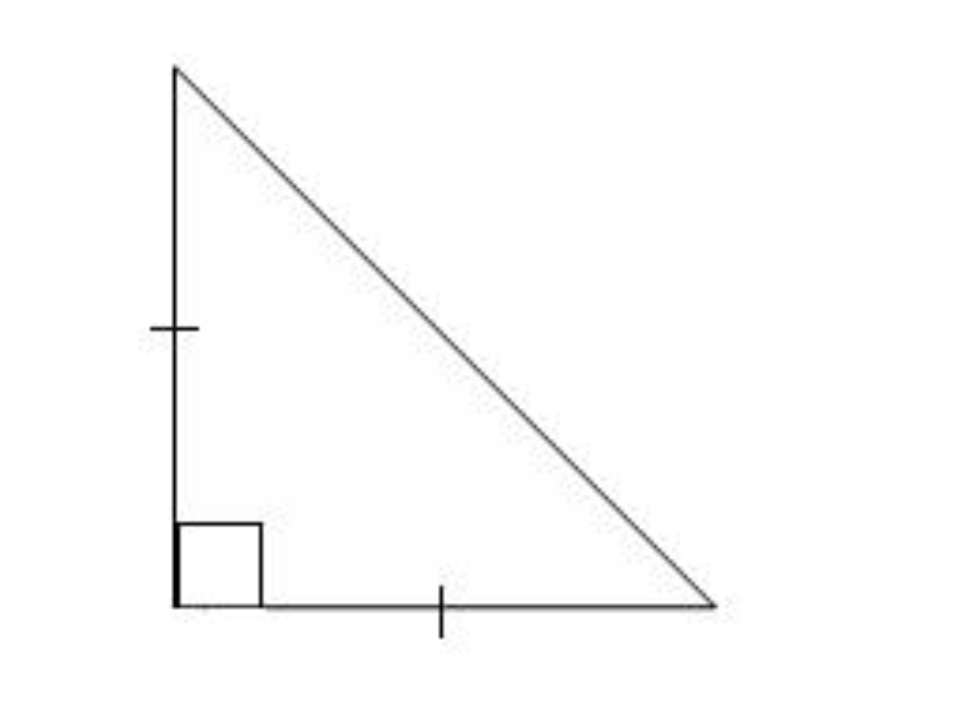
How would you classify this triangle by it's sides and angles?

a)

Scalene Acute

b)

Equilateral

c)

Scalene Obtuse

d)

Isosceles Acute

e)

Isosceles Obtuse

55.

What is the best classification for this triangle?

a)

Isosceles Acute

b)

Scalene Acute

c)

Isosceles Obtuse

d)

Equilateral

e)

Scalene Obtuse

56.

Side Classification: ​ (a)  

Angle Classification: ​ (b)  

Choose from the below words
Scalene
Right
Isosceles
Acute
Obtuse
Equilateral
57.

Side Classification: ​ (a)  

Angle Classification: ​ (b)  

Choose from the below words
Isosceles
Acute
Right
Obtuse
Equilateral
Scalene
58.

Side Classification: ​ (a)  

Angle Classification: ​ (b)  

Choose from the below words
isosceles
right
scalene
obtuse
equilateral
acute
59.

Match the following triangles with their side and angle classification.

a)
1.

Equilateral

b)
2.

Scalene Obtuse

c)
3.

Scalene Right

d)
4.

Isosceles Acute

60.
Name this triangle
a)
Acute, Scalene
b)
Obtuse, Scalene
c)
Right, Isosceles
d)
Acute, Equilateral
61.
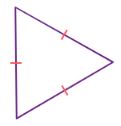
Which type of triangle is pictured?
a)
Equilateral Triangle
b)
Right Isosceles Triangle
c)
Obtuse Scalene Triangle
d)
Obtuse Equilateral Triangle
62.

Inside any triangle the sum of all the angles in degrees is always:

a)

360

b)

90

c)

150

d)

|80

63.

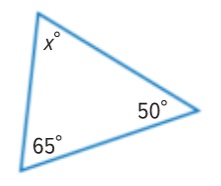
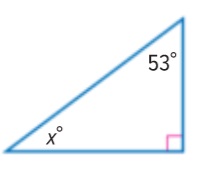
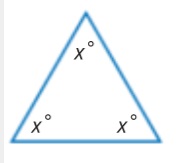
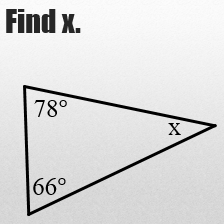
How many degrees is X?

a)

65

b)

70

c)

90

d)

55

64.

How many degrees is X?

a)

37

b)

47

c)

7

d)

90

65.

How much is the value of X?

a)

45

b)

60

c)

90

d)

15

66.

How many triangles in the figure are acute?

a)

1

b)

2

c)

3

d)

4

67.

Classify this triangle by its sides and angles.

a)

acute & scalene

b)

right & scalene

c)

right & equilateral

d)

acute & equilateral

68.

What is the value of the missing angle?

a)

90

b)

100

c)

20

d)

120

69.

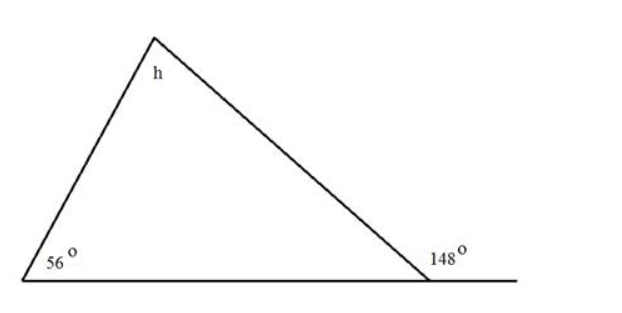
Find h.

a)

32 degrees

b)

92 degrees

c)

56 degrees

d)

not enough information

70.
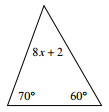
Solve for x.
a)
16
b)
11
c)
50
d)
6
71.
A triangle has angle measurements of 26°, 59°, and 95°. What kind of triangle is it?
a)
acute triangle
b)
right triangle
c)
obtuse triangle
d)
none of the above
72.

A triangle has side lengths of 19 centimetres, 19 centimetres, and 20 centimetres. What type of triangle is this?

a)

equilateral triangle

b)

isosceles triangle

c)

scalene triangle

d)

none of the above

73.
Find the measure of the indicated angle. 
a)
95
b)
85
c)
35
d)
45
74.
Find the measure of the indicated angle. 
a)
26
b)
36
c)
85
d)
144
75.

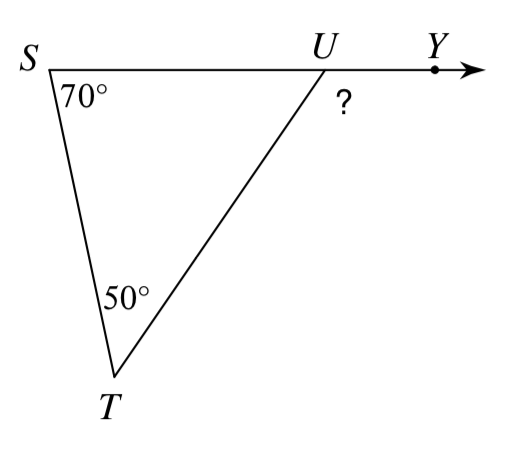
What is the measure of angle A?

a)

30

b)

45

c)

47

d)

50

76.

Triangle DEF has a missing angle measure. If the m∠E is 93 degrees and the m∠F is 24 degrees. What is the measure of angle D?

a)

63

b)

36

c)

90

d)

76

77.

Two angles in a triangle measure 30° and 105°. What is the measure of the third angle in the triangle?

a)

45°

b)

65°

c)

75°

d)

105°

78.

Two angles in a triangle measure 18° and 60°. What is the measure of the third angle in the triangle?

a)

222°

b)

22°

c)

122°

d)

102°

79.

Why is the triangle classified as isosceles?

a)

All angles are acute

b)

At least two sides are congruent

c)

At least one angle is acute

d)

All angles are congruent

80.

Bella has a window in her bedroom shaped like a triangle. Each angle of the triangle measures less than 90 degrees. What kind of triangle is her window?

a)

Straight

b)

Acute

c)

Obtuse

d)

Right

81.

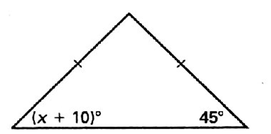
Find the value of x

(a)  

82.

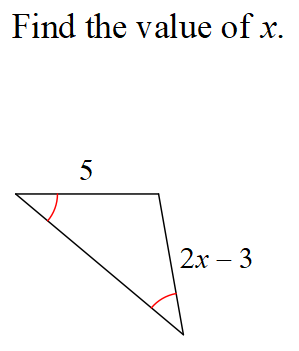
Find the value of x

(a)  

83.
Which segment is the base?
a)
Segment AB
b)
Segment BC
c)
Segment AC
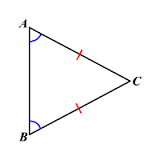
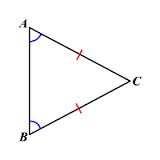
84.
Which angle is the vertex angle?
a)
<C
b)
<A
c)
<B
85.

If an isosceles triangle has a base angle measuring 40°, then what measure is the VERTEX angle?

a)

120°

b)

100°

c)

40°

d)

80°

86.
Find x
a)
90
b)
45
c)
22
d)
35
87.
Find x
a)
10
b)
32
c)
116
d)
16
88.

What is the value of the < A

a)

151

b)

68

c)

80

d)

78

89.
What is the value of x?
a)
75
b)
80
c)
63
d)
60
90.
Find x
a)
90
b)
45
c)
22
d)
35
91.

Find the value of x.

a)

1

b)

4

c)

5

d)

8

92.
Find the value of y. 
a)
y=2
b)
y=18
c)
y=8.22
d)
y=9.33
93.

Which formula is used to show that segments/sides are parallel or perpendicular?

a)

Slope

b)

Midpoint

c)

Distance

94.

An isosceles triangle contains ___________________ congruent sides.

a)

no

b)

2

c)

3

d)

2 or 3

95.

Given the endpoints of line segment AB (2,-7) and (12,3) determine the midpoint of line segment AB.

a)

(7,5)

b)

(-5,-5)

c)

(7,2)

d)

(7,-2)

96.

Segments are congruent because they have the same ______________________.

a)

distance

b)

slope

c)

y-intercept

d)

x-intercepts

97.
Choose an equation of the line that passes through the given point and the given slope.
(1,2) slope:3
a)
y=3x+1
b)
y=3x-1
c)
y=-3x-1
d)
y=1/3x-1
98.
Choose an equation of the line that passes through the given point and the given slope.
(2,-6) slope:-4
a)
y=4x+8
b)
y=4x-2
c)
y=-4x-8
d)
y=-4x+2
99.
Choose an equation in point-slope form for the line that passes through the given point with the slope provided. (6,3) Slope: 5
a)
y-3=5(x-6)
b)
y-1=-3(x+2)
c)
y-2=0(x+4)
d)
y-y1=m(x-x1)
100.
Choose an equation in point-slope form for the line that passes through the given point with the slope provided. (-2,1) Slope: -3
a)
y-3=5(x-6)
b)
y-1=-3(x+2)
c)
y-2=0(x+4)
d)
y-y1=m(x-x1)
101.
Choose an equation in point-slope form for the line that passes through the given point with the slope provided. (-4,2) Slope: 0
a)
y-3=5(x-6)
b)
y-1=-3(x+2)
c)
y-2=0(x+4)
d)
y-y1=m(x-x1)
102.
Choose the right equation in slope-intercept form. y-2=3(x-5)
a)
y=3x-13
b)
y=3x-3
c)
y=3x+5
d)
y=1/3x+2
103.
Choose an equation in slope-intercept form. y-12=-2(x-3)
a)
y=-2x+6
b)
y=2x+18
c)
y=-2x+18
d)
y=2x-6
104.

Create a Linear Equation between the points (-2, 4) and (3, 10)

a)

y = 65x + 325y\ =\ \frac{6}{5}x\ +\ \frac{32}{5}

b)

y = 65x  325y\ =\ -\frac{6}{5}x\ -\ \frac{32}{5}

c)

y = 56x + 532y\ =\ \frac{5}{6}x\ +\ \frac{5}{32}

d)

y = 56x + 532y\ =\ -\frac{5}{6}x\ +\ \frac{5}{32}

105.

Create a Linear Function that is perpendicular to y = (1/2)x + 7 and goes through the point (4, -5)

a)

y = -2x + 3

b)

y = 2x - 3

c)

y = (1/2)x + 3

d)

y = (1/2)x - 3

106.
Find the slope of the line that passes through
(19, -2) and (-11, 10)
a)
-2/5
b)
2/5
c)
5/2
d)
-5/2
107.
Find the slope of the line that passes through
(10, 1) and (5, 2)
a)
1/5
b)
-1/5
c)
5
d)
-5
108.

Write the slope-intercept form of the equation with the given point and slope.

Through ( - 1,4 ) and m = - 3

a)

y = x - 3

b)

y = - 3x + 1

c)

y = x + 2

d)

y= - 3x + 4

109.
Write an equation  
m = 5 through (-1, -3)
a)
y = 5x + 2
b)
y = -5x - 5
c)
y = -5x + 2
d)
y = 2x - 5
110.
Write an equation  
m = 5/4 through         (-4, -3)
a)
y = 5/4x +2
b)
y = -5/4x + 2
c)
y = 2x - 5/4
d)
y = 3/4x + 2
111.
Write equation of the line containing (-3,4) and (-1,-2)
a)
y = -3x - 5
b)
y = -3x + 1
c)
y = -3x + 13
d)
y = 3x + 1
112.
Find the equation of the line that passes through the points:

(2, 2) and (3, 4)
a)
y = 2x + 2
b)
y = -2x - 2
c)
y = -2x + 2
d)
y = 2x - 2
113.
Find the equation of the line that passes through the points:

(3, 4) and (0, -5)
a)
y = 3x + 5
b)
y = -3x + 4
c)
y = -3x + 4
d)
y = 3x - 5
114.

Write the linear equation that is solved by both (−6, 2) and (0, 4):

a)

y = (1/3)x + 4

b)

y = (-1/3)x + 4

c)

y = -3x + 4

d)

y = 3x + 4

115.

What is the equation of the line that goes through the points (2, 9) and (3, 1) ?

a)

y= 8x - 5

b)

y= -8x + 25

c)

y= (1/8)x - 2

d)

y= (-1/8)x + 1

116.

Which equation has a line that would pass through both (8, 5) and (9, −1) ?

a)

y = 6x + 53

b)

y = −6x - 53

c)

y = (−4/5)x + 53

d)

y = −6x + 53

117.
Write the equation of the line that passes through the points (-2, -1) and (0, 5).
a)
y = 3x - 5
b)
y = 1/3x + 5
c)
y = 3x + 5
d)
y = 1/3x
118.
Write the equation of the line through the points (4, 5) and (12, 9).
a)
y = 2x - 3
b)
y = 1/2x + 3
c)
y = 1/2x +7
d)
y = 2x - 15
119.
Slopes of parallel lines are...
a)
opposite reciprocals.
b)
opposites.
c)
identical.
d)
always 7.
120.
Slopes of perpendicular lines are...
a)
opposite reciprocals.
b)
opposites.
c)
identical.
d)
always 7.
121.
y = 3x +2
y = 3x - 3
These lines are...
a)
Parallel
b)
Perpendicular
c)
Neither
d)
The same line
122.
y = -2/3x + 2
y = 3/2x + 9
These lines are...
a)
Parallel
b)
Perpendicular
c)
Neither
123.

Which two lines are parallel?

a)

Line A and Line B

b)

Line A and Line C

c)

Line B and Line C

124.

Which two lines are perpendicular?

a)

Line A and Line B

b)

Line B and Line C

c)

Line A and Line C

125.
The following two numbers are negative reciprocals of each other
2 and -1/2
a)
True
b)
False
126.
Find the slope of a line parallel to the line below.
y = 2x + 4
a)
2
b)
-1/2
c)
1/2
d)
-2
127.
Find the slope of a line perpendicular to the line below.
y = 2x + 4
a)
2
b)
-1/2
c)
1/2
d)
-2
128.
Find the slope of a line parallel to the line below
y = ½x + 4
a)
1/2
b)
-1/2
c)
2
d)
-2
129.
Find the slope of a line perpendicular to the line below
y = ½x + 4
a)

1/2

b)

-1/2

c)

2

d)

-2

130.
The following represents slopes of two lines.  Which answer choice describes the two lines?
m = 5 and m = -1/5
a)
Parallel
b)
Perpendicular
c)
Neither
131.
The following represents slopes of two lines.  Which answer choice describes the two lines?
m = -1/3 and m = -1/3
a)
Parallel
b)
Perpendicular
c)
Neither
132.
The following represents slopes of two lines.  Which answer choice describes the two lines?
m = 7 and m = -7
a)
Parallel
b)
Perpendicular
c)
Neither
133.
The following represents slopes of two lines.  Which answer choice describes the two lines?
m = 3/4 and m = 4/3
a)
Parallel
b)
Perpendicular
c)
Neither
134.
The following represents slopes of two lines.  Which answer choice describes the two lines?
m = 4 and m = -1/4
a)

Parallel

b)

Perpendicular

c)

Neither

135.
What slope is parallel to:  
m = 3/4
a)
4/3
b)
3/4
c)
-3/4
d)
-4/3
136.

The following represents slopes of two lines. Which answer choice describes the two lines?
m=13m=-\frac{1}{3}  and  m=13m=-\frac{1}{3}  .

a)

Parallel

b)

Perpendicular

c)

Neither

137.
What is the slope of a line perpendicular to a line with slope -6/?
a)
-6/5
b)
-5/6
c)
5/6
d)
-4/3
138.

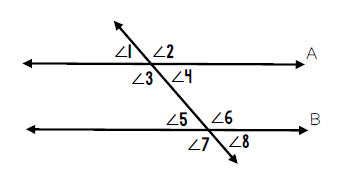
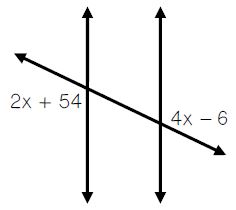
What angle corresponds to 1\angle1 ?

a)

7\angle7

b)

5\angle5

c)

3\angle3

d)

2\angle2

139.

∠3 and ∠6 are...

a)

Supplementary angles

b)

Vertical angles

c)

Corresponding angles

d)

Alternate interior angles

140.

Angle B and Angle R are...

a)

Alternate Interior Angles

b)

Consecutive Interior Angles

c)

Corresponding Angles

d)

Alternate Exterior Angles

141.

Angle C and Angle P are...

a)

Alternate Interior Angles

b)

Consecutive Interior Angles

c)

Corresponding Angles

d)

Alternate Exterior Angles

142.

If the  m1 = 57°,m\angle1\ =\ 57\degree,  find the measure of  5\angle5 ?

a)

123°123\degree  

b)

57°57\degree  

c)

180°180\degree  

d)

Cannot be determined

143.

Find y.

a)

50

b)

130

c)

180

d)

45

144.

Find the value of x.

a)

x = 100

b)

x = 47

c)

x = 90

d)

x = 133

145.

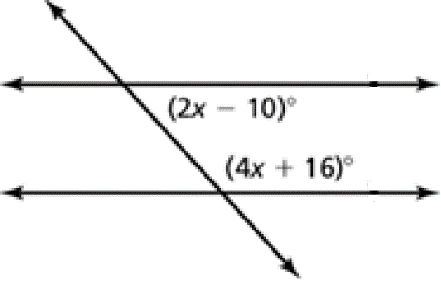
Which is the correct equation to solve for x?

a)

2x10=4x+162x-10=4x+16

b)

(2x10)+(4x+16)=180\left(2x-10\right)+\left(4x+16\right)=180

c)

(2x10)+(4x+16)=90\left(2x-10\right)+\left(4x+16\right)=90

146.

Now, find the value of x.

a)

13

b)

-3

c)

29

d)

-13

147.

Which of the following equations can be used to find the value of x?

a)

(x+16)+(4x5)=90\left(x+16\right)+\left(4x-5\right)=90

b)

x+16=4x5x+16=4x-5

c)

(x+16)+(4x5)=180\left(x+16\right)+\left(4x-5\right)=180

148.

Now solve for the value of x?

a)

7

b)

3 233\ \frac{2}{3}  

c)

33.8

d)

15.8

149.

Which equation can be used to solve for x?

a)

(3x)+(4x+19)=90\left(3x\right)+\left(4x+19\right)=90

b)

(3x)+(4x+19)=180\left(3x\right)+\left(4x+19\right)=180

c)

3x=4x+193x=4x+19

150.

What is the value of x?

a)

22

b)

26

c)

24

d)

23

151.

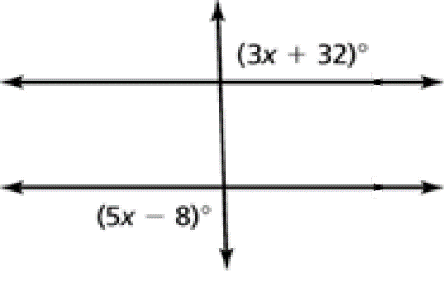
Which is the correct equation to solve for x?

a)

5x8=3x+325x-8=3x+32

b)

(5x8)+(3x+32)=90\left(5x-8\right)+\left(3x+32\right)=90

c)

(5x8)+(3x+32)=180\left(5x-8\right)+\left(3x+32\right)=180

152.

Now, what is the value of x?

a)

20

b)

19.5

c)

5

d)

8.25

153.
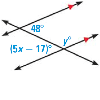
Solve for  y.
a)
y = 20
b)
y = 120
c)
y = 60
d)
y = 10
154.

Which two angles are supplementary

a)

∠1 and ∠3

b)

∠2 and ∠6

c)

∠4 and ∠6

d)

∠7 and ∠8

155.

Which two angles are alternate exterior?

a)

1 & 3

b)

2 & 6

c)

4 & 7

d)

7 & 1

156.

Solve for x.

a)

23

b)

-20

c)

32

d)

20

157.
What is the value of x?
a)
13
b)
6.2
c)
29.8
158.
Tell whether the angles are complementary or supplementary. Then find the value of x.
a)
Complementary; x=3.4
b)
Complementary; x=45
c)
Supplementary; x=20
d)
Supplementary; x=175
159.
Solve for x
a)
6
b)
140
c)
20
d)
90
160.

Supplementary angles add up to...

a)

90°90\degree  

b)

180°180\degree  

161.

Vertical angles are...

a)

equal

b)

not equal

162.
A line that passes through parallel lines is called a ______________.
a)
transitive
b)
passer through line
c)
transversal
d)
bisector
163.

Find x, then find the measurement of both angles.

a)

x = 30; both angles measure 118 degrees

b)

x = 30; both angles measure 114 degrees

c)

x = 20; both angles measure 112 degrees

d)

x = 20; both angles measure 110 degrees

164.
Name a line skew to FG
a)
EH
b)
DC
c)
AD
d)
FB
165.
What does collinear mean?
a)
Points on the same plane
b)
Two lines that never intersect
c)
Points on the same line
d)
Lines that cross each other
166.
What kinds of lines are pictured?
a)
Parallel
b)
Perpendicular
c)
Intersecting
d)
Skew
167.
What are parallel lines?
a)
Two lines that never cross
b)
Two lines that intersect
c)
Two lines that intersect at 90 degrees
d)
Two lines
168.
What does perpendicular mean?
a)
Lines cross each other
b)
Lines cross at 90 degrees
c)
Lines never touch
d)
Lines are skew
169.
Name a line parallel to AD
a)
EH
b)
AB
c)
DC
d)
HG
170.
Name a line perpendicular to AD
a)
EH
b)
AB
c)
CG
d)
HG
171.
Name a line skew to AD
a)
EH
b)
AB
c)
CG
d)
EH
172.
Are lines j and k skew?
a)
yes
b)
no
173.
What are vertical angles?
a)
Angles that are adjacent to each other
b)
Angles that add up to 180°
c)
Angles that are opposite of each other when lines intersect
d)
Angles that add up to 90°