wayground logo

Free Printable Worksheets

Font size

S
M
L
XL
Worksheets

Science Revision Year 4 Autumn

Total questions: 106

Worksheet time: 1hrs 1mins

Name
Class
Date
1.

How many types of teeth we have ?

a)

5

b)

2

c)

3

d)

4

2.

What is the functions of Incisors teeth?

a)

for swallow the food

b)

for cutting and chopping food

c)

for crushing food

d)

for grinding food

3.

How many premolars teeth we have ?

a)

6

b)

8

c)

10

d)

12

4.

Name the type of tooth that you see in the picture above.

a)

Incisor

b)

Canine

c)

Premolar

d)

Molar

5.

Choose the types of teeth that indicate their correct functions.

a)

Canine

b)

Molar

c)

Premolar

d)

Incisor

6.

Which types of feeding level belong to these teeth?

a)

Carnivore

b)

Herbivore

c)

omnivore

7.

These teeth are big and strong to help you grind food so it can be swallowed.

a)

Molars

b)

Premolars

c)

Canines

d)

incisors

8.

Which types of feeding level belong to these teeth?

a)

carnivore

b)

omnivore

c)

herbivore

9.

What types of feeding level belongs to these teeth?

a)

herbivore

b)

carnivore

c)

omnivore

10.

What feeding level belongs to this teeth?

a)

herbivore

b)

carnivore

c)

omnivore

d)

none of the above

11.

What is the function of incisors?

a)

For cutting

b)

For grinding

c)

For swallowing

d)

None of the above

12.

What is the function of canines?

a)

Tearing

b)

Cutting

c)

Grinding

d)

All of the above

13.

What hard, tough, and shiny substance covers the teeth?

a)

wax

b)

diamond

c)

keratin

d)

enamel

14.

The pulp at your teeth contains ______, which send messages to the brain if your ice pop is too cold.

a)

blood vessels

b)

nerves

c)

brain waves

d)

none of the above

15.

This type of tooth is pointy, sharp, and made to help tear food.

a)

molars

b)

incisors

c)

canines

d)

pre molars

16.

What kind of teeth do babies have?

a)

primary

b)

permanent

17.

These teeth are big and strong to help you grind food so it can be swallowed.

a)

wisdom teeth

b)

canines teeth

c)

molars teeth

d)

premolar

18.

What cause tooth decay?

a)

age

b)

cavities

c)

hygiene

19.

What is pink and helps hold our teeth in place in our mouths?

a)

gum

b)

tongue

c)

cheeks

d)

lips

20.

A special doctor who looks after teeth is called what?

a)

dentist

b)

cardiologist

c)

hygienist

21.

In order to keep teeth strong and healthy you should always brush your teeth with a toothpaste containing what?

a)

fluoride

b)

calcium

c)

antibacterial

d)

none of the above

22.

How many baby teeth do we usually have?

a)

10

b)

16

c)

20

d)

26

23.

You must brush and floss your teeth after every meal to prevent gum disease and cavities.

a)

yes

b)

no

24.

Brushing your teeth with an up-and-down or side-to-side motion is the best way to clean your teeth.

a)

yes

b)

no

25.

You can floss your teeth by simply putting the floss between your teeth and pulling it through.

a)

yes

b)

no

26.

You should use a dental rinse along with brushing and flossing to remove plaque.

a)

true

b)

false

27.
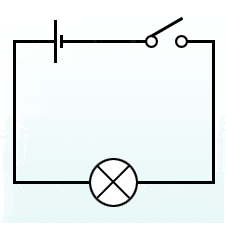
This circuit is _________.
a)
open
b)
parallel
c)
closed
d)
The cutest little circuit evah!
28.
what is this symbol for?
a)
light bulb
b)
switch
c)
battery
d)
resistor
29.
this is the symbol for a _____?
a)
switch
b)
light 
c)
battery
d)
wires
30.
This is the symbol for a ...
a)
Wire
b)
Battery
c)
Buzzer
d)
Fuse
31.
This is the symbol for 
a)
An Ammeter
b)
A Voltmeter
c)
A Meter
d)
A Motor
32.
Which of the following answer choices correctly describes the image? 
a)
Series circuit - Bulbs are lit
b)
Series circuit - Bulbs are off
c)
Parallel circuit - Bulbs are lit
d)
Parallel circuit - Bulbs are off
33.
What is a current?
a)
A constant flow of electricity 
b)
A path that a current can flow along
34.
What is a circuit?
a)
A constant flow of electricity 
b)
A path that a current can flow along
35.

What is the power source in this circuit?

a)

Bulb

b)

Switch

c)

Wire

d)

Battery

36.
A material which electrons are able to move through easily:
a)
Circuit
b)
Insulator 
c)
Resistance 
d)
Conductor 
37.
What is a battery?
a)
switch
b)
power source
c)
insulator
38.
A complete circuit has .......
a)
a motor in it
b)
a switch in it
c)
two bulbs in it
d)
no breaks in it
39.
A student began building a circuit to light a bulb.  What else does the student need to produce light?
a)
a battery that has energy
b)
a wire that is insulated
c)
a switch that is open
d)
another bulb of the same size
40.
An incomplete circuit is shown.
To complete the circuit, a wire should be placed from —
a)
Point D to Point C
b)
Point B to Point C
c)
Point A to Point D
d)
Point B to Point D
41.
Lightbulbs use electricity to make light. What else do lightbulbs often give off?
a)
Food energy
b)
Heat Energy
c)
Solar Energy
d)
Wind Energy
42.
What is an electrical circuit?
a)
lets you turn the energy on and off
b)
a closed path where where electricity flows
c)
stop electricity from flowing through
43.
What is a battery?
a)
switch
b)
power source
c)
insulator
44.
A complete circuit has .......
a)
a motor in it
b)
a switch in it
c)
two bulbs in it
d)
no breaks in it
45.
A student began building a circuit to light a bulb.  What else does the student need to produce light?
a)
a battery that has energy
b)
a wire that is insulated
c)
a switch that is open
d)
another bulb of the same size
46.
This circuit has a battery, buzzer, and switch.
When the switch is closed the buzzer will sound because -
a)
the switch gives energy to the battery
b)
the buzzer is made of special plastic
c)
the wires are cooled by the surrounding air
d)
electricity can flow in a complete path
47.
An incomplete circuit is shown.
To complete the circuit, a wire should be placed from —
a)
Point D to Point C
b)
Point B to Point C
c)
Point A to Point D
d)
Point B to Point D
48.
What kind of circuit is this?
a)
Series
b)
Consecutive
c)
Parallel
d)
Training
49.
What kind of circuit is this?
a)
Series
b)
Consecutive
c)
Parallel
d)
Training
50.
Which of the following can work as an energy source?
a)
Battery
b)
Light bulb
c)
Wire
d)
All of them
51.
Batteries convert what type of energy into electricity?
a)
Chemical energy
b)
Mechanical energy
c)
Both
d)
Kinetic energy
52.
Which bulbs will light?
a)
1 and 2
b)
2 and 3
c)
3 and 4
d)
4 and 2
53.
Lightbulbs use electricity to make light. What else do lightbulbs often give off?
a)
Food energy
b)
Heat Energy
c)
Solar Energy
d)
Wind Energy
54.
Which is NOT true of a series circuit
a)
One light bulb can be broken and other lights will still work.
b)
All loads are a single loop
c)
Adding more loads will lessen the current in the loop
55.
The type of circuit used in your home is a _______ circuit.
a)
series
b)
parallel
56.
Choose the correct sentence.
a)
This circuit will work because it is an open circuit.
b)
This circuit will work because it is a closed circuit.
c)
This circuit will NOT work because it is an open circuit.
d)
This circuit will NOT work because it is a closed circuit.
57.
The way energy is passed from one organism to another
a)
food chain
b)
energy
c)
extinct
d)
habitat
58.
What is this called?
a)
Food Web
b)
Food Chain
c)
Abiotic Factors
59.
Where does the energy start in this food chain?
a)
Plant
b)
Sun
c)
Deer
d)
Wolf
60.
Which food chain is in the correct order?
a)
cat, grass, bird, snail
b)
bird, snail, grass, cat
c)
grass, snail, bird, cat
d)
grass, cat, bird, snail
61.
An animal that eats other animals is a....
a)
carnivore
b)
omnivore
c)
herbivore
d)
decomposer
62.
An animal that eats only plants is an...
a)
carnivore
b)
omnivore
c)
herbivore
d)
decomposer
63.

A food chain is:

a)

an animal that eats only plants.

b)

a diagram that shows how energy moves from one organism to another. (Grass>Mouse>Owl)

c)

An animal that is hunted and eaten by another animal.

64.

which one is a Producer?

a)
b)
c)
d)
65.
What do Herbivores eat? 
a)
Plants ONLY 
b)
Animals ONLY
c)
Plants AND Animals
66.

What do plants need to make their own food?

a)

Sun, Water, and Animals

b)

Sun, Coke, and Soil

c)

Sun, Water, and Soil

d)

Nothing at all

67.
Where does the energy start in this food chain?
a)
Plant
b)
Sun
c)
Deer
d)
Wolf
68.
What are plants called in a food chain?
a)
Producers
b)
Consumers
c)
Decomposers
d)
Scavengers
69.
An organism that produces its own energy
a)
Producer
b)
Consumer
c)
Decomposer
d)
Predator
70.
A diagram that shows how energy is transferred from one organism to another
a)
Carrying Capacity
b)
Producer
c)
Food Chain
d)
Balance of Nature
71.
The relationship between all the resources and organisms in an ecosystem
a)
Food Web
b)
Balance of Nature
c)
Limiting Factor
d)
Food Chain
72.
A diagram that shows how food chains are connected
a)
Producer
b)
Limiting Factor
c)
Consumer
d)
Food Web
73.
Resource that restricts a population's growth
a)
Limiting Factors
b)
Balance of Nature
c)
Food Chain
d)
Food Web
74.
Organism that eats other organisms to get energy
a)
Producer
b)
Consumer
c)
Plant
d)
Food chain
75.
A parrot eats fruit, seeds, and insects.  Which of the following terms best describes a parrot?
a)
Herbivore
b)
Carnivore
c)
Producer
d)
Omnivore
76.
A field mouse eats grass and grass seeds.  Which of the following terms best describes a field mouse?
a)
Herbivore
b)
Producer
c)
Carnivore
d)
Decomposer
77.
An alligator eats fish, turtles, ducks, and small mammals on the bank.  Which of the following terms best describes the alligator?
a)
Herbivore
b)
Carnivore
c)
Omnivore
d)
Producer
78.
In the arctic, polar bears hunt seals.  which of the following terms best describes the polar bear?
a)
Producer
b)
Predator
c)
Prey
d)
Host
79.
A snake hunts lizards and frogs.  Which terms best describes lizards and frogs?
a)
Predator
b)
Microoganism
c)
Prey
d)
Producer
80.
A flea needs to consume the blood of an organism in order to survive.  Which of the following terms best describes the flea?
a)
Host
b)
Decomposer
c)
Prey
d)
Parasite
81.
While swimming in a pond, a boy finds a leech attached to his leg.  Leeches need to consume the blood of another organism in order to survive.  Which of the following terms best describes the boy?
a)
Host
b)
Parasite
c)
Decomposer
d)
Predator
82.
Mushrooms break down dead and decaying wood in the forest.  Which of the following terms best describes the mushroom?
a)
Mold
b)
Algae
c)
Parasite
d)
Decomposer
83.
Where does digestion begin?
a)
in the stomach
b)
in the mouth
c)
in the esophagus
d)
in the small intestine
84.
What breaks food into smaller pieces?
a)
mouth
b)
tongue
c)
teeth
d)
large intestine
85.
What is the muscular tube that pushes food from the mouth the to stomach?
a)
tongue
b)
esophagus
c)
small intestine
d)
large intestine
86.
The ______________ is where food is mixed with juices and is squeezed and churned until it becomes a thick liquid. 
a)
esophagus
b)
stomach
c)
small intestine
d)
large intestine
87.
A hollow tube where nutrients are absorbed into the bloodstream is called the ___________. 
a)
esophagus
b)
stomach
c)
small intestine
d)
large intestine
88.
The _________________ squeezes water out of food and absorbs water into the bloodstream.
a)
esophagus
b)
stomach
c)
small intestine
d)
large intestine
89.
Which part of the digestive system is number 1?
a)
esophagus
b)
mouth
c)
small intestine
d)
liver
90.
Which part of the digestive system is number 2?
a)
esophagus
b)
stomach
c)
small intestine
d)
liver
91.
Which part of the digestive system is number 3?
a)
esophagus
b)
stomach
c)
small intestine
d)
liver
92.
Which part of the digestive system is number 4?
a)
esophagus
b)
large intestine
c)
small intestine
d)
liver
93.
Which part of the digestive system is number 6?
a)
esophagus
b)
large intestine
c)
small intestine
d)
liver
94.
Which is NOT a function of the Digestive System?
a)
To rid the body of solid waste
b)
Absorb nutrients for energy & growth
c)
Break down nutrients from food
d)
Pump blood around the body
95.

Breaking food down into small pieces by way of the teeth and twisting of the esophagus is called (a)   .

96.

Breaking food down by way of saliva, stomach acid, and absorbing nutrients is called (a)   .

97.

Digestion has _________ main stages.

a)

1

b)

2

c)

3

d)

4

98.

Digestion begins in the

a)

Stomach

b)

Mouth

c)

Food pipe

d)

Intestine

99.

The process of breaking down food into simpler substances is known as ________

a)

Digestion

b)

Respiration

100.

Through the food pipe, the food goes into the stomach.

a)

True

b)

False

101.

The stomach is a hollow bag of ________

a)

Tissues

b)

Bones

c)

Muscles

d)

Liquid

102.

From the stomach, the food goes to the ________

a)

Liver

b)

Pancreas

c)

Small intestine

d)

Large intestine

103.

The process of digestion completes here.

a)

Stomach

b)

Mouth

c)

Small intestine

d)

Food pipe

104.

The water from the undigested food is passed to the __________.

a)

Kidney

b)

Pancreas

c)

Liver

d)

Lungs

105.

The walls of the ________ absorb water from the undigested food.

a)

Stomach

b)

Small intestine

c)

Large intestine

d)

Pancreas

106.

Saliva is produced by _____.

a)

Stomach

b)

Salivary glands

c)

Liver

d)

Food pipe