
 Worksheets
vital signs case studies
Total questions: 28
Worksheet time: 25mins

What is the temperature shown? Type just the number, including the decimal.
(a)
If you are checking a patient's heart rate and you counted 15 beats in 15 seconds, what would her heart rate be in bpm?
(a)
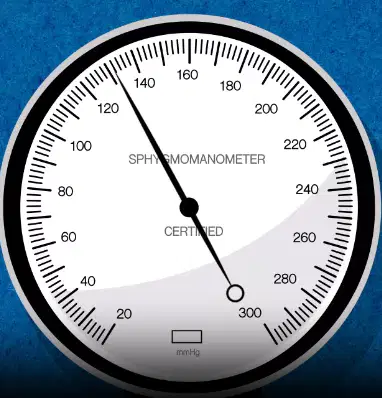
Look at the picture and read the pressure shown (systolic pressure)
132 mmHg
126 mmHg
131 mmHg
150 mmHg
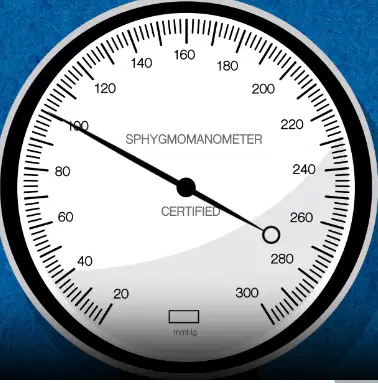
Look at the picture and read the pressure shown (diastolic pressure)
100 mmHg
90 mmHg
110 mmHg
80mmHg

If the first picture is systolic and the second picture is diastolic pressure, what is the patient's blood pressure?
132/100 mmHg
126/100 mmHg
100/126 mmHg
100/132 mmHg

If a patient's weight is 120 lbs and his height is 5 ft. 10 in., calculate his BMI using the following formula provided. Round to the nearest tenth.
(a)
the following are routes to take a temperature EXCEPT ...
oral
temporal
axillary
femoral
When taking someone's temperature, be sure to
wash your hands with soap & water before starting
make sure the patient hasn't had food/drink for at least 5 minutes
place the thermometer under the patient's tongue
have the patient keep their mouth closed (with the thermometer) for at least 3 minutes.
How does the nurse know what a patient's blood pressure is when taking a reading manually?
The first jump of the gauge needle is the diastolic value, and the last jump of the gauge needle is the systolic value
The first pulse beat heard is the systolic value, and the last pulse beat heard is the diastolic value
The first pulse beat heard is the diastolic value, and the last pulse beat heart is the systolic value
The first jump of the gauge needle is the systolic value, and the last jump of the gauge needle is the diastolic value
Where should the nurse place their stethoscope when taking a manual blood pressure?
Over the spot where the brachial artery was palpated
Over the spot where the radial artery was palpated
Around 4 inches down from where the brachial artery was palpated
Around 2 inches above where the radial artery was palpated
As a nurse if you have a patient who presents with tachycardia what factors would you contribute to that condition? (page 654) (select all that apply)
Prolonged exposure to heat
Strong emotions: such as fear, anxiety and anger
An increase in blood pressure
Any condition resulting in poor oxygenation of blood such as COPD or anemia
Vagal stimulation
pain such as surgical pain that lessens with treatment is known as
acute pain
chronic pain
pain that lasts longer, is ongoing, maybe for a lifetime, arthritis is one example
acute pain
chronic pain

What is the thermometer reading?
101.2
102.2
100.2
102.4

we used this tool for ...
measuring the patients pain level
taking the BP
counting the respirations
taking the pulse
What does fever benefit the body?
Kills hope
Kills germs
Kills bacteria and virus
Kills brain cells
Mrs. Heart is at the doctor with shortness of breath. Her blood pressure is 200/110mmHG. What is she at risk of having?
Kidney Stones
Seizure
Stroke
Dizziness
1 rise and 1 fall = 1 respiration
True
False
Maybe
No sure
If your patient's heart rate is 130 after checking 6 sec x10, what should you do?
Count for 2 minutes
recheck and count for 30 seconds
recheck and count for 1 minute
Continue on
When checking pulse rate, you count for_____seconds if regular and multiply by ___.
6,10
15,4
30,2
20,5
Mr. Sutton's feels dizzy. His vital signs are 99.2F, 100, 20, 99% 70/40. Which vital sign is abnormal.
99%
100
70/40
99.2F
Mrs. Smiths vitals signs are 98.6F, 126, 18, 98%, 118/70. Which is the abnormal vital sign?
98.6F
118/70
98%
126
Which of the following is the normal range for temperature in degrees Fahrenheit?
98.0-100.0
97.0-100.4
96.0-99.0
95.0-99.0
While ambulating Mr. Stokes, he tells you that he is feeling faint. After sitting him in the chair, the nurse aide should check his:
Temperature
Respirations
Pulse
Blood Pressure
Two common areas to check for a person's pulse is their ____ & ____
(a)
You were assigned to take vital signs on an 80-year-old male nursing home resident who appears to be having a stroke. Vital signs were B/P 152/94,
P 92, R 32, SpO2 93%. Which vital sign reflects a measurement within normal limits?
blood pressure
pulse
pulse oximetry
respirations

Instrument used to measure blood pressure?
AED
ECG
Sphygmomanometer
ultrasound
the main vital signs include
blood pressure
respirations and pulse
temperature
blood sugar

