
 Worksheets
E.5.8A Summative Studyguide
Total questions: 15
Worksheet time: 8mins
An explorer becomes lost on the ocean in a boat. The sky is covered in clouds. Which tool would help the explorer most, and why?
The telescope; the explorer can look for Polaris in the sky.
The astrolabe; the explorer can determine how fast the boat is moving.
The compass; the explorer can find the direction in which the boat is moving.
The sextant; the explorer can find the positions of different objects in the sky.
A telescope is used to view a faint, faraway object. How will it appear?
faint and closer
faint and farther
brighter and closer
brighter and farther
What is one purpose of a telescope?
to collect less light for the eye
to collect more light for the eye
to make small, close objects larger
to make large, faraway objects smaller
Which tool is most appropriate for studying objects in outer space?


Scientists at NASA have developed the James Webb Telescope. According to the scientists, it will bring a new perspective to viewing the universe. What is the importance of such telescopes?
They help aircraft navigate.
They help protect Earth from solar radiation.
They help predict upcoming climatic conditions.
They help study and explore new objects present in space.
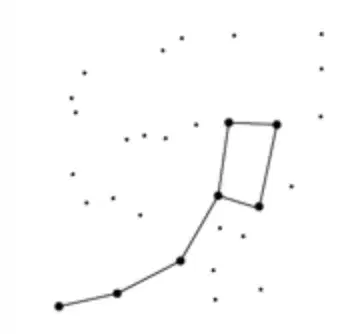
The image shows the constellation Ursa Minor, which never appears to set throughout the year. What can be inferred about this constellation?
It is a very large constellation.
It is located near one of the poles.
It is revolving continuously around the Sun.
It is very close to the solar system.
Why is the constellation Ursa Minor visible throughout the year in the Northern Hemisphere?
The constellation appears to circle the north star.
The constellation appears to revolve around Earth.
The constellation revolves around the Sun from west to east.
The constellation revolves around the Sun from east to west.
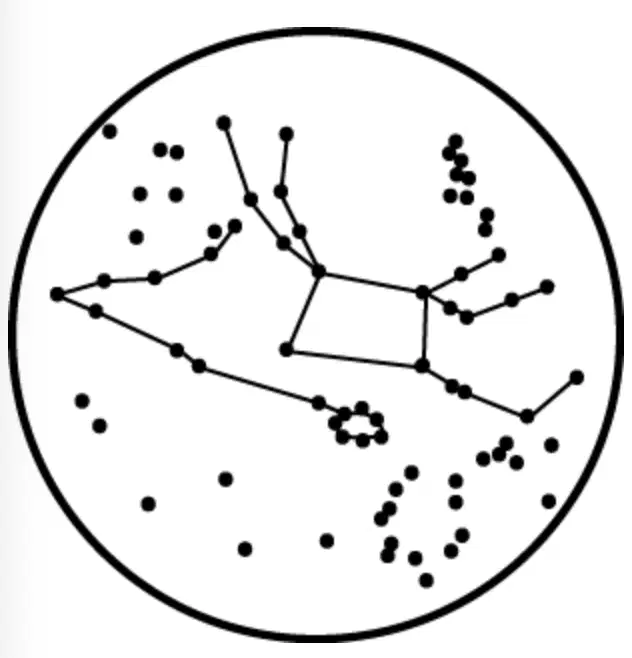
The image shows a star chart. Which information is best inferred from the star chart?
life cycles of the stars
patterns formed by the stars
distances of the stars from Earth
movements of the stars around the Sun
Orion appears in the eastern sky at sunset in December and disappears in the western sky in May in the Northern Hemisphere. What causes a change in the position of Orion in the sky across the seasons?
rotation of Earth on its axis
rotation of stars around Earth
revolution of stars around the pole star
revolution of Earth around the Sun
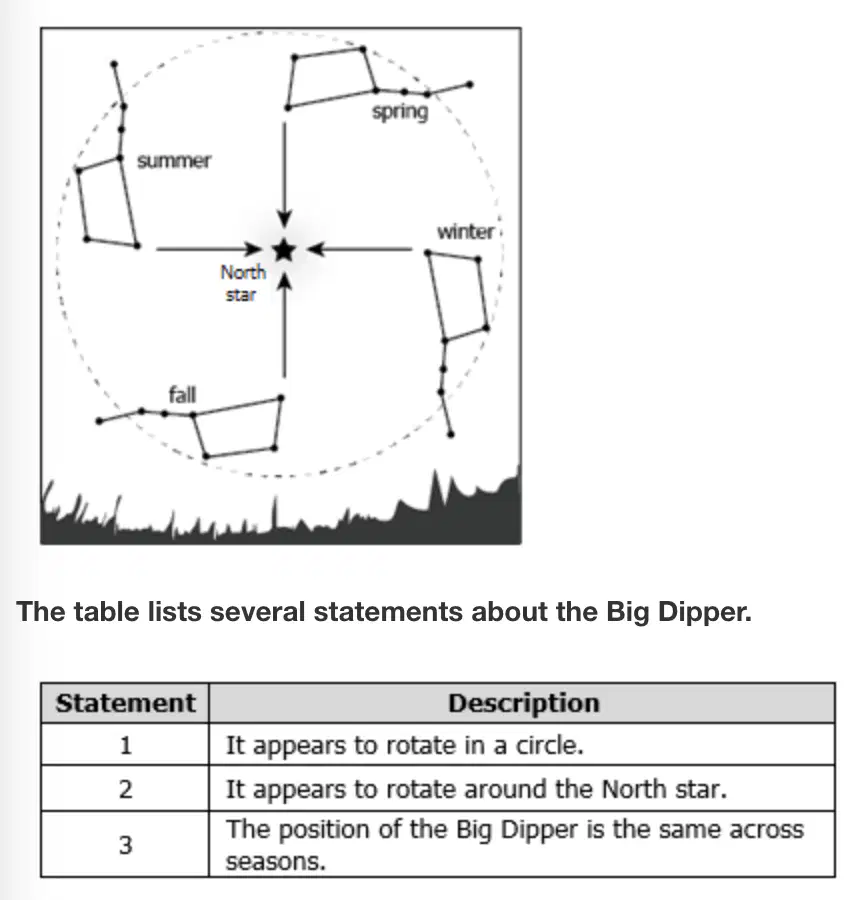
The diagram shows the positions of the Big Dipper in different seasons. Which statements correctly describe the characteristics of the Big Dipper?
Statements 1 and 2 only
Statements 2 and 3 only
Statements 1 and 3 only
Statements 1, 2, and 3
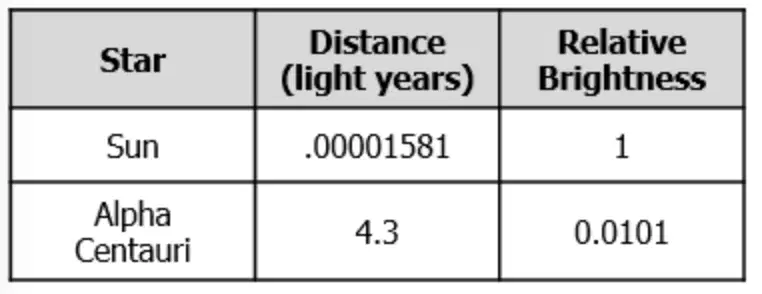
The table shows the distances of the Sun and Alpha Centauri from Earth and their relative brightness. A student claims that the Sun is brighter than Alpha Centauri when viewed from Earth. Is the claim correct, and why?
No. Alpha Centauri is closer to Earth than the Sun.
Yes. The Sun is closer to Earth than Alpha Centauri.
No. The Sun has a lower relative brightness than Alpha Centauri.
Yes. Alpha Centauri has a higher relative brightness than the Sun.
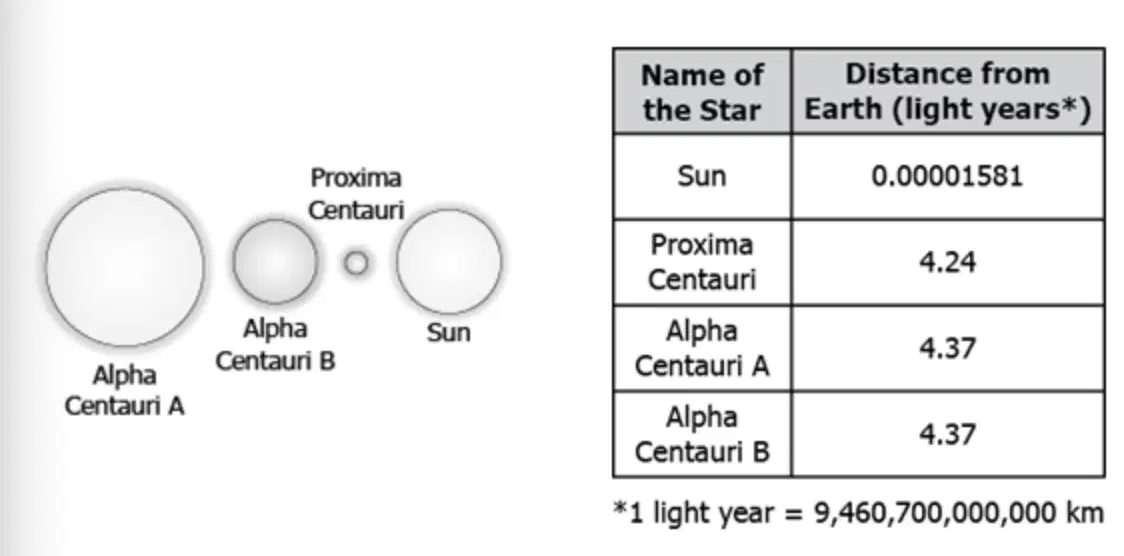
The image and table show the relative sizes and distances of different stars from Earth. A student argues that the Sun appears brightest among the other stars listed. Which statement supports the student’s argument?
The Sun is the biggest star.
The Sun is the closest star to Earth.
The Sun emits less light than other stars.
The Sun burns hot gases that make it brighter.
Which graph best represents the average surface temperatures of the planets in the solar system?


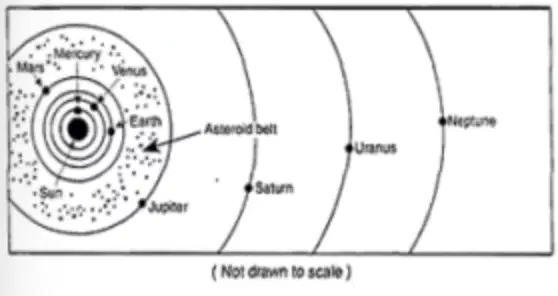
Look at the diagram of the solar system. Which planet has the longestyear based on its position in our solar system?
Jupiter
Mars
Uranus
Venus
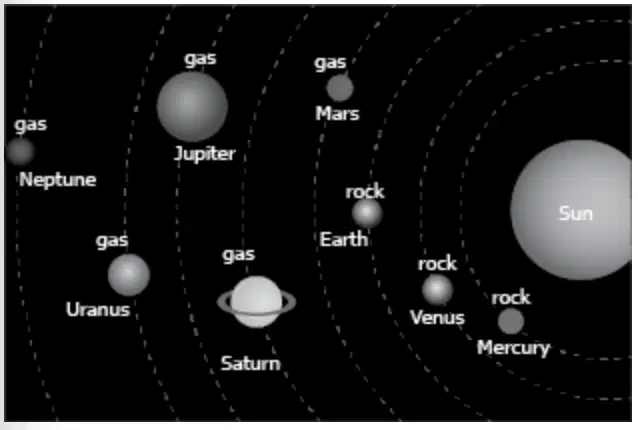
A student makes a model of the solar system, as shown. The student labels the surface compositions of the planets as rock or gas. A teacher observes the student’s model and finds errors. What changes should the student make?



