
 Worksheets
Physical Science Semester 1 Final 23-34, Version R
Total questions: 39
Worksheet time: 20mins
Name
Class
Date
1.
Any push or pull on an object defines _____.
a)
inertia
b)
acceleration
c)
force
d)
momentum
2.
Which statement best explain exactly what a speed of 15 m/s means.
a)
A person travels 15 meters per second.
b)
A person travels 15 miles for every second they are traveling.
c)
A person travels 15 meters every second they are traveling.
3.
A change in position, relative to a reference point defines
a)
motion
b)
speed
c)
velocity
4.
Speed with direction defines
a)
velocity
b)
speed
c)
distance
5.
____ is a measure of how fast something is moving without the direction of travel
a)
density
b)
speed
c)
velocity
6.
According to Newton's 1st Law of Motion, under balanced forces, an object _____
a)
will accelerate
b)
will only change direction, not speed
c)
will not accelerate
7.
Unbalanced forces cause
a)
acceleration
b)
motion
c)
movement
d)
inertia
8.
Newton's ____ law of motion is also called the law of inertia.
a)
1st
b)
2nd
c)
3rd
d)
universal gravitation
9.
Gravity is a force that is a pull toward ____.
a)
the top half of an object
b)
an object's bottom half
c)
the center of the Earth, only
d)
any object's center of mass
10.
The definition of acceleration is the rate of change in
a)
velocity
b)
displacement
c)
direction
d)
distance
e)
speed
11.
Which is the SI unit used for acceleration?
a)
m/s
b)
km/hr
c)
m/s/s or m/s2
d)
km/hr/s
12.
The planets of the solar system and their moons are accelerating because of constantly _____.
a)
changing direction
b)
speeding up
c)
slowing down
13.
Mass is defined as a substance's ___.
a)
volume
b)
space taken up
c)
weight
d)
amount of matter
14.
The SI unit of mass is the _______.
a)
g (gram)
b)
mg (milligram)
c)
newton, N
d)
kg (kilogram)
15.
Newton's 2nd Law of Motion explains and defines the relationship between ____.
a)
speed, velocity, and acceleration
b)
force, mass, and acceleration
c)
force and inertia
d)
action and reaction
e)
action-reaction
16.
If the net force on an object is zero, then the object is experiencing _________ forces.
a)
reaction
b)
balanced
c)
unbalanced
d)
action
17.
Net force is defined as the
a)
multiplication of the forces acting on a body
b)
sum of all forces acting on a body
c)
leftover force minus the mass of an object
d)
mass times force
18.
Acceleration is always in the direction of the
a)
inertia
b)
net force
c)
downward force
d)
gravitational force
19.
A car is traveling along a 60 mi/h. When the road suddenly curves to the left, the car flies straight ahead off of the road. This happened BECAUSE of the car's.
a)
acceleration
b)
weight
c)
inertia
20.
The law of conservation of momentum says that,
a)
the force of momentum is conserved
b)
momentum is transferred
c)
an object's momentum is the same before and after a collision
d)
the total momentum is the same before and after a collision
21.
In action-reaction force pairs, the two forces occur
a)
the first force quickly followed by the second force
b)
at totally different times
c)
simultaneously (at the same time)
d)
within one nanosecond of each other
22.
Action-Reaction refers to ___
a)
1st Law of Motion
b)
Law of Conservation of Momentum
c)
2nd Law of Conservation
d)
3rd Law of Motion
23.
The SI unit of velocity is
a)
kg
b)
m/s
c)
kgm/s
d)
m/s2
24.
In an isolated system, the total momentum after a collision is 367 units. The total momentum before the collision was
a)
considerably less than 367 units
b)
considerable more than 367 units because some momentum is always lost in a collision
c)
also 367 units
d)
367 + 367 = 734 units
25.
A moving object has
a)
kinetic energy
b)
potential energy
c)
both kinetic and potential energy
d)
neither kinetic nor potential energy
26.
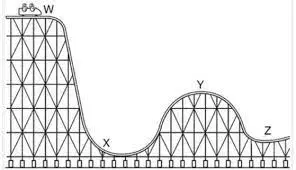
At which point is the KE the greatest?
a)
W
b)
X
c)
Y
d)
Z
27.
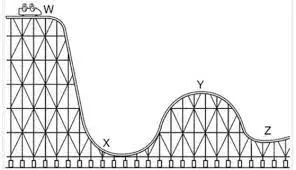
At which point is the PE the least?
a)
W
b)
X
c)
Y
d)
Z
28.
Thermal energy is the
a)
same as heat
b)
total amount of PE of a substance's particles
c)
the total amount of KE of a substance's particles
d)
special kind of chemical energy in light
29.
Energy is defined as the
a)
motion and position of particles of a substance
b)
amount of power use in a given amount of time
c)
the number of joules used per time
d)
ability to do work
30.
The amount of TE depends on the
a)
momentum if the particles and temperature
b)
mass and temperature of the substance
c)
KE and temperature of the particles
d)
temperature of the particles, only
31.
The SI unit of energy and work
a)
Newton
b)
Newton-second
c)
Joule-meter
d)
Joule
32.
Energy can neither be
a)
transferred nor transformed
b)
changed nor maintained
c)
created nor transferred
d)
created nor destroyed
33.
The Law of Conservation of Energy says that energy can be
a)
created or destroyed
b)
transferred and created
c)
transferred or transformed
d)
transformed but not transferred
34.
TE is always transferred from
a)
higher to lower temperatures
b)
greater concentration to lower concentration
c)
KE to an increase in momentum
d)
PE to KE
35.
If impulse is 703 Ns, what is the will change in momentum?
4 lines
36.
The greater the impulse, the greater the change in
a)
mass
b)
time
c)
momentum
d)
energy
37.
A change in momentum by almost always accomplished by changing a mass's _____________.
a)
velocity
b)
weight
c)
volume
d)
friction
38.
The SI base unit of momentum is
a)
kg-m/s/s
b)
kg/m/s
c)
kgms
d)
kg-m/s
39.
Ns (N-s) are units of ______
a)
momentum
b)
change in momentum
c)
impulse
d)
force
100 %

